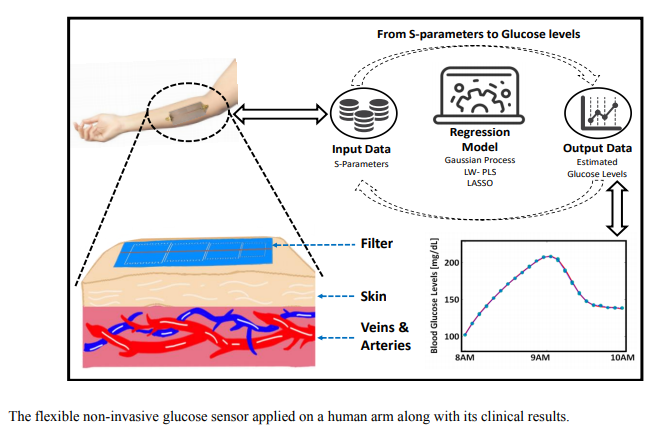
A Non-Invasive Flexible Glucose Monitoring Sensor using a Broadband Reject Filter
Read Description
Size reduction techniques are applied on the embedded resonators that are optimized to exhibit an enhanced sensitivity to track the variations of the glucose level across a frequency span from 1.25 GHz to 2.65 GHz. The proposed flexible filter is tested pre-clinically and clinically, where a high correlation between its scattering parameters and the variations in glucose levels is attained. Regression models are also developed using experimental data obtained from healthy patients that are subjected to glucose tolerance tests. Results demonstrate less than 4% mean absolute relative difference between the reference and estimated glucose levels, and the predicted glucose levels lie 100% within the clinically acceptable zones as shown by the Clarke Error Grid analysis.
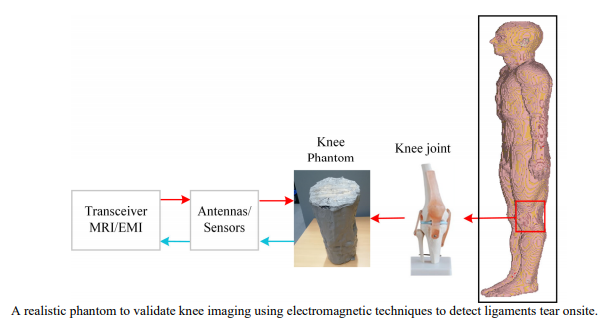
Anthropomorphic Durable Realistic Knee Phantom for Testing Electromagnetic Imaging Systems
Read Description
These materials are selected to achieve high dielectric properties and realistic distribution of knee tissues in addition to long-life stability. A positive mold of muscle tissue and a negative mold of skin tissue are extracted from MRI data, whilst the positive molds for bones, tendons, ligaments, and tibia are extracted from a 1:1 commercial knee joint model. Due to a lack of data about dielectric properties of human knee ligaments in microwave frequency (0.5-10 GHz), dog’s ligament tissues are characterized. The fabricated tissues of the knee phantom are stable and accurately match the dielectric properties of knee tissues across the wideband 0.5 GHz to 10 GHz. The phantom will open the door for a portable, low cost, and onsite electromagnetic imaging techniques to detect knee injuries.
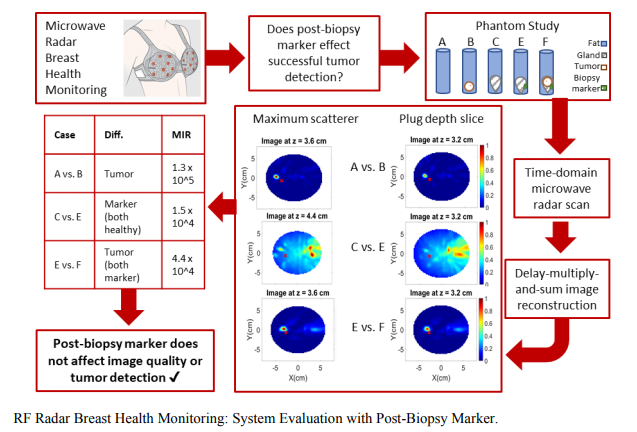
RF Radar Breast Health Monitoring: System Evaluation with Post-Biopsy Marker
Read Description
To evaluate the system’s performance with respect to post-biopsy site markers, we then show investigations of the system performance with the same phantom and a biopsy marker attached to a glandular insertion with and without an embedded tumor, and compare the imaging results to those phantoms without the biopsy marker. We conclude that our RF radar can detect the tumor despite the presence of a biopsy site marker, and that the conductive titanium marker does not interfere with the system’s intended function.
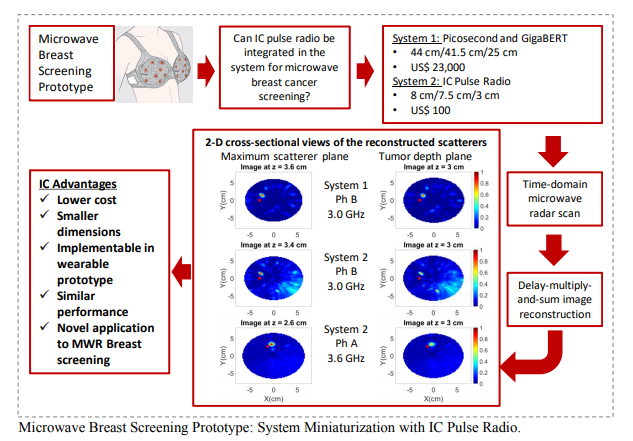
Microwave Breast Screening Prototype: System Miniaturization with IC Pulse Radio
Read Description
To assess the system’s suitability as a breast screening prototype, we compare measurements on two different experimental breast models (phantoms) with the established and previously reported prototype using off-the-shelf components and the here-introduced IC. We test both systems on a homogeneous fat-mimicking phantom with a 2-mm skin layer as well as a phantom with a 2-mm skin layer and glandular insertions, while the antennas, antenna housing, and sampling oscilloscope are the same for both systems. Additionally, we advance with the IC to higher frequencies, aiming to comply with the band intended for microwave imaging devices with medical applications. Furthermore, we compare the economic requirements of the IC and of the previously reported system by evaluating their cost and compactness. The objective of this study is to investigate if the IC pulse radio can replace bulky off-shelf components to allow us to implement the pulse generation circuitry in one flexible circuit board with the switching and antennas.
Towards the Robust and Effective Design of Hyperthermic Devices: Improvement of a Patch Antenna for the Case Study of Abdominal Rhabdomyosarcoma With 3D Perfusion
Read Description
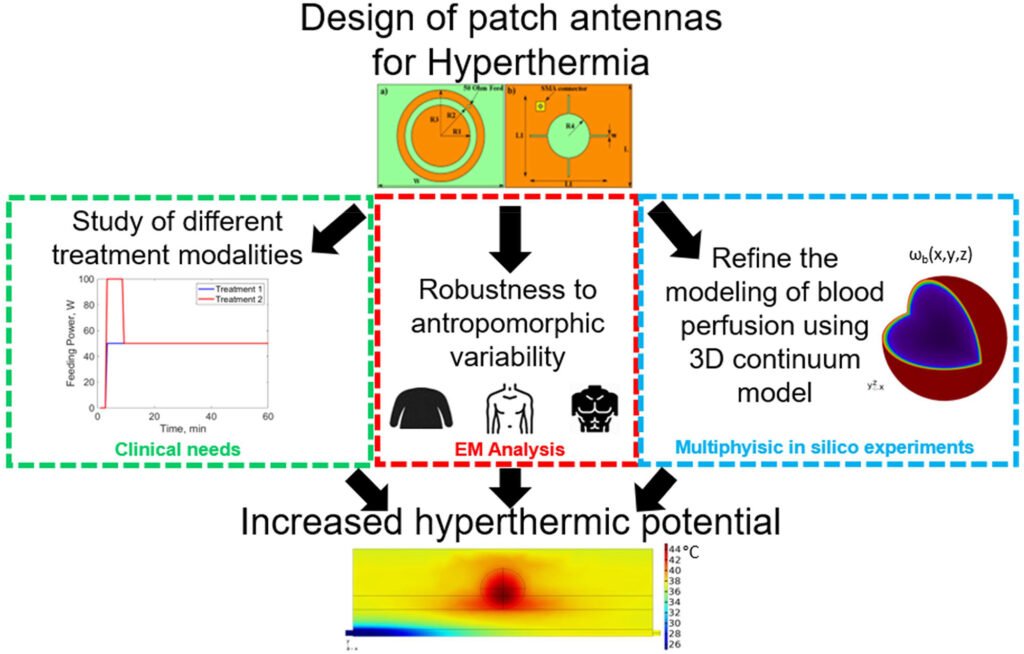
The proposed general approach is used to investigate the specific case of the hyperthermia treatment of abdominal rhabdomyosarcoma. Instead of using patient-specific geometries with discrete vascular tree models, a surface phantom with a continuum 3D blood perfusion model of tumors is used. The geometrical parameters of the antennas are selected to provide a robust design against the variation of the phantom parameters. The effectiveness of the antenna is evaluated simulating the treatment with a recent non-linear multi-physic model, considering the different description of tumor vasculature. A more robust and effective design is obtained, with respect to its previous version. Indeed, the antenna bandwidth is increased with about 7%. The treatment performed using the old version of the antenna lead to unsuccessful results (40 °C after 60 min), whilst the novel robust design could successfully treat the target region. The new version of the patch can withstand a temperature of 42.5 °C for 60 min of treatment. To further enhance the effectiveness of the treatment, the use of a time-modulated power is studied. The proposed model could be extended to different body regions and used to develop an application-oriented design of antennas for hyperthermia treatment.
Classification of Alzheimer’s Disease Using RF Signals and Machine Learning
Read Description
Current progression monitoring techniques are based on MRI and PET scans which are inconvenient for patients to use. In addition, more intelligent and efficient methods are needed to predict what the current stage of the disease is and strategies on how to slow down its progress over time. Technology or Method: In this paper, machine learning was used with S-parameter data obtained from 6 antennas that were placed around the head to noninvasively capture changes in the brain in the presence of Alzheimer’s disease pathology. Measurements were conducted for 9 different human models that varied in head sizes. The data was processed in several machine learning algorithms. Each algorithm’s prediction and accuracy score were generated, and the results were compared to determine which machine learning algorithm could be used to efficiently classify different stages of Alzheimer’s disease. Results: Results from the study showed that overall, the logistic regression model had the best accuracy of 98.97% and efficiency in differentiating between 4 different stages of Alzheimer’s disease. Clinical or Biological Impact: The results obtained here provide a transformative approach to clinics and monitoring systems where machine learning can be integrated with noninvasive microwave medical sensors and systems to intelligently predict the stage of Alzheimer’s disease in the brain.