Design of an Interstitial Microwave Applicator for 3D Printing in the Body
Read Description
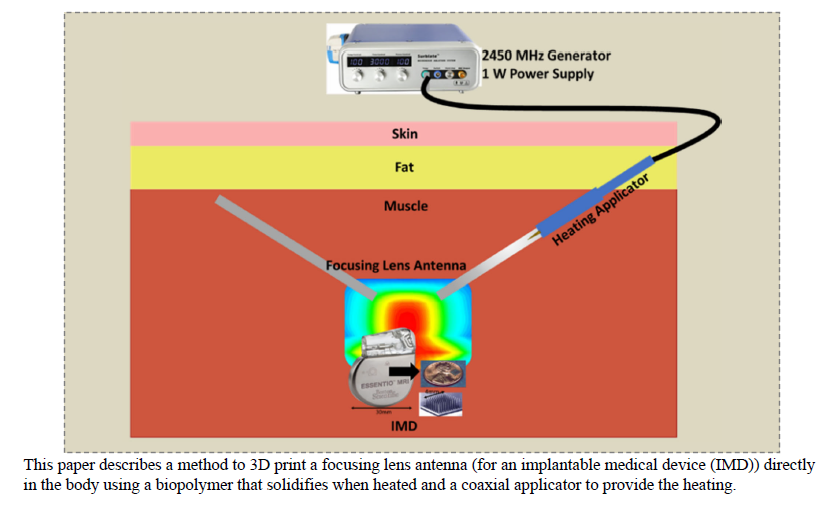
A 2450 MHz sleeved slot coaxial applicator with a pointed, extended, hollow tip is designed to heat 400 mm3 of polymer from body temperature to its crosslinking temperature of 40°C in 10s.
Numerical Assessment of RF Human Exposure in Smart Mobility Communications
Read Description
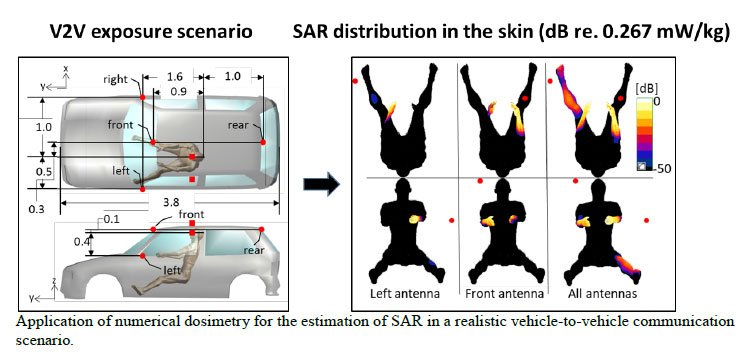
This challenging scenario is raising cross-cutting issues, such as those related to new radio-frequency exposures of the human body also when travelling. We evaluate the Specific Absorption Rate (SAR) induced in a realistic smart mobility communication scenario operated at 5.9 GHz. V2V antennas were modeled and placed on a realistic 3D model of a city-car to numerically estimate SAR in the body regions and tissues of a human phantom (adult male) inside the car. We found that both local and whole-body average exposures were below the ICNIRP and IEEE limits for the general public in the 100 kHz-6 GHz band, being equal in the worst case scenario to 1.58 W/kg (head) and 0.008 W/kg, respectively. The highest SAR was found in the most superficial tissues (the skin) of body regions very close to the sources. The distance of the passenger from the antennas played an important role in the resulting SAR. This research has a potentially great clinical impact as it contributes to new and realistic knowledge on the exposure scenario in smart mobility communication to assess possible health effects and for the design of policies for public health management.
Wireless Double Micro-Resonator for Orientation Free Tracking of MR-Catheter During Interventional MRI
Read Description
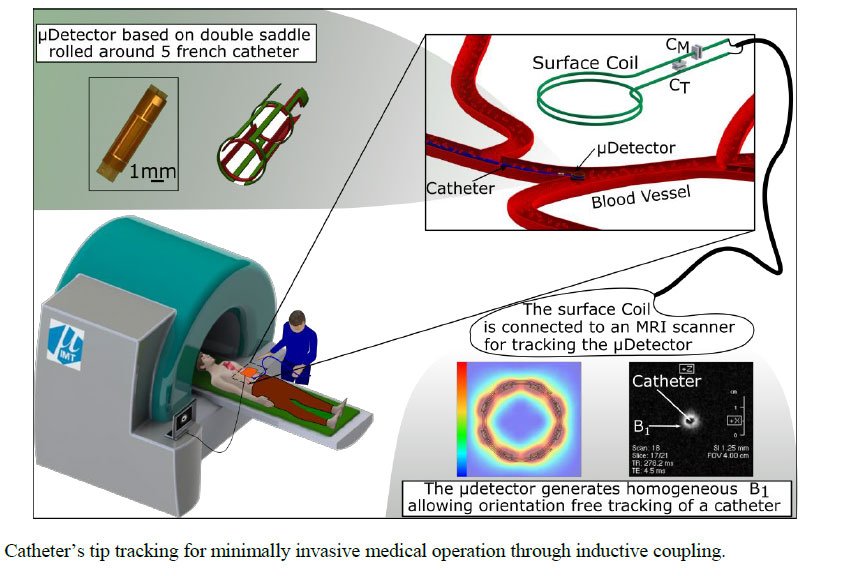
Here we propose a novel micro detector with a total length of 8 mm built upon a flexible substrate with a total thickness of less than 60 um. The design of the detector is based on two perpendicularly oriented saddle coils that together create a homogeneous magnetic field when wrapped onto the catheter tube, thus maintaining constant visibility of the catheter under rotation, with practically no dead angle. Being self-resonant, the proposed detector allows wireless tracking of the catheter position, whilst preventing any heating hazard due to the absence of radiofrequency cables. The micro-resonator was fabricated using a multilayer flexible electronics fabrication process.
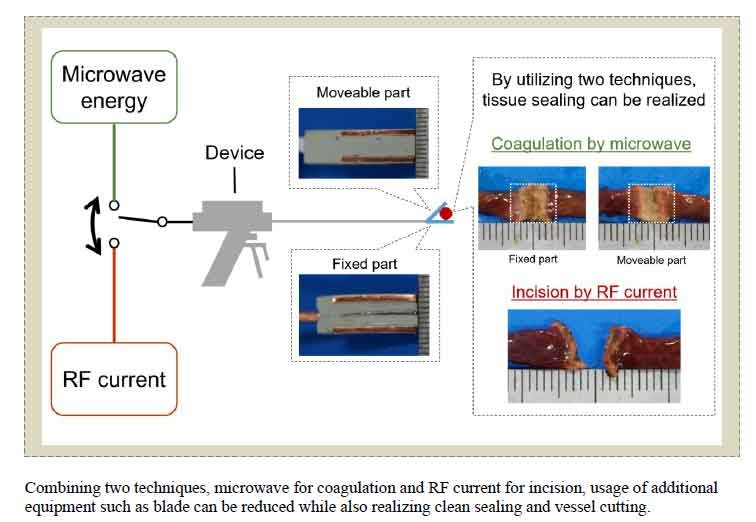
Vessel Sealing Device Using Microwave and High Frequency Current
Read Description
High power microwave energy can generate a coagulated region at the surface of the biological tissue such as organs. By coagulating organs, bleeding can be stopped. However, a microwave surgical device cannot cut the tissue without any device support, such as a blade. On the other hand, radio frequency (RF) current capable of cutting tissue without any support. This study presents a combination of a forceps type microwave surgical device combined with RF current for biological tissue cutting mechanism. Furthermore, ten sealed porcine blood vessels, sealed by the device, capability to withstand pressure were measured. Sealed blood vessels can withstand up to 200 mmHg of pressure and sufficient to withstand human blood pressure.
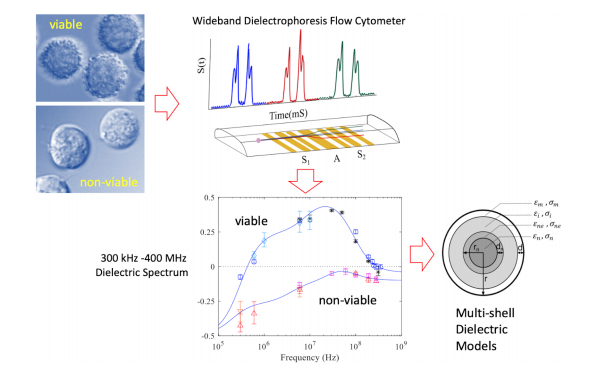
Full Beta-Dispersion Region Dielectric Spectra and Dielectric Models of Viable and Non-Viable CHO Cells
Read Description
Dielectrophoresis (DEP) single cell in-flow techniques were employed to quantitatively measure the Clausius-Mossotti factor spectrum of individual cells over the 300 kHz 400 MHz range, covering both the MF and UHF DEP cross-over frequencies. Experiments were performed on Chinese hamster ovary (CHO) cells, one set cultured in growth media, the other in nutrient depleted media to induce apoptotic cells. Both cell states were measured using multi-frequency DEP flow cytometry, which provides the equivalent complex dielectric permittivity of individual cells. The measured dielectric spectra facilitate determination of a cell’s morphology and the dielectric properties of its intracellular compartments, and are used to develop multi-shell dielectric models of viable and non-viable cells. The developed dielectric models can aid in biosensor design, in interpretation of bulk biomedia measurements where the heterogeneity in cell population can be masked, and in relating measured dielectric responses of cells to stimuli with changes in cellular physiology.
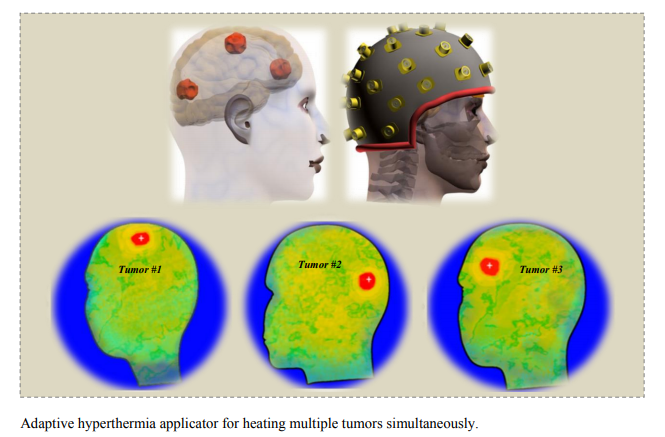
Design of Hyperthermia Applicator to Heat Multi Brain Tumors Simultaneously based on Adaptive Beamforming Technique
Read Description
Therefore, in this research, the technique of non-invasive heat focalization in multiple tumors, simultaneously, without affecting healthy tissue based on adaptive beamforming was investigated and presented. It is done by controlling the feeding of the antenna array surrounding the brain using a modified hybrid version of gravitational search algorithm and particle swarm optimization (MGSA-PSO). An antenna system in the form of a head helmet was designed and evaluated with 48 antenna elements each of them has a separate excitation that controls the field intensity and beamforming direction towards the tumors. Many scenarios considering a single tumor in different positions with different volumes or multiple tumors are studied to evaluate the performance of the applicator. The helmet was tested on the challenging scenario of a very mature and dense brain with realistic thermal and dielectric properties. The results confirmed the ability of the helmet technology and the proposed antenna system to use a microwave power of 65 W to lift the neoplasm temperature to over 42oC while keeping healthy tissue safe at 37 degrees with none hot spots. Furthermore, the results showed the capability of the proposed model to treat multiple tumors simultaneously.