Electromagnetic Inversion for Noninvasive Specific Absorption Rate Characterization
Read Description
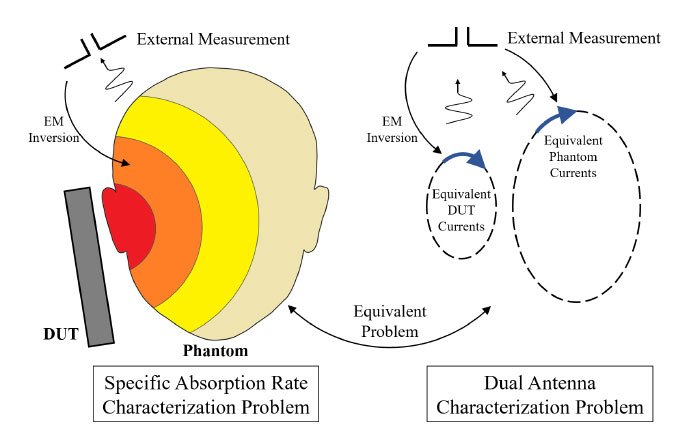
The unique aspect of this inverse source algorithm is that it casts the problem as the simultaneous inversion (SI) of two sets of equivalent currents: one for the device under test (DUT), and the other for the phantom. The dependency of these two sets of currents is then incorporated as an explicit regularization term in the resulting algorithm. The method is proposed to be relatively robust in terms of measurement noise. A simplified two-dimensional problem is presented to support this proposition.
A 0.09 mm2On-Chip Coil Designed in 0.5 μm CMOS process for Brain Neuromodulation Applications
Read Description
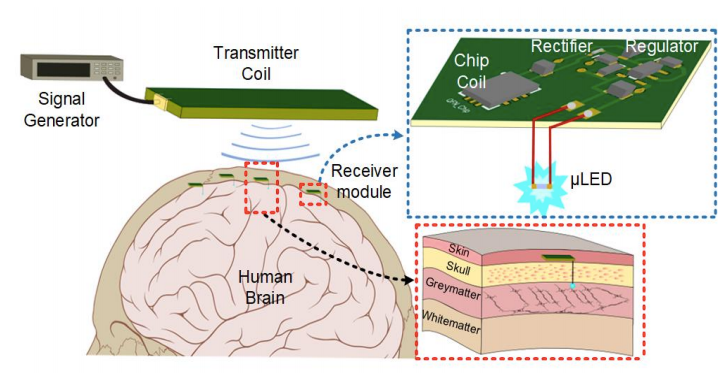
To stimulate multiple neurons simultaneously, distributed miniaturized implants are needed to cover a wide range of areas. In this paper, an on-chip design of an inductively coupled wireless power transfer (WPT) system for an optogenetic implant is presented. A $0.3 text{mm} times 0.3 text{mm}$ on-chip spiral coil is designed using a standard $0.5 mu m$ CMOS process and characterized as the receiver of the WPT system. The EM field distribution through different tissue layers is investigated which helps to further evaluate the maximum Specific Absorption Rate (SAR) and temperature through the brain tissue. The system achieves a power transfer efficiency (PTE) of 0.65% and 0.96% with matching networks through 10 mm tissue layer and air links respectively. At 10 dBm transmitted power, the maximum SAR value is simulated to be 1.51 W/kg with the maximum temperature increase of 0.73 °C through the skin layer due to the EM field exposure. A case study of the proposed on-chip coil based WPT system shows the different light intensity level that can be achieved for optognetic neuromodulation application. Thus, the proposed miniaturized system proves to be a good candidate for the future distributive neural interfacing application.
Design and Optimization of a Slotted Monopole Antenna for Ultra-wide Band Body Centric Imaging Applications
Read Description
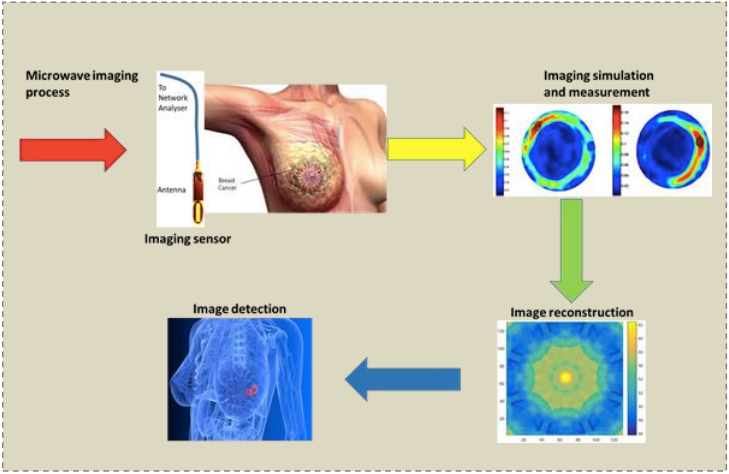
To ensure that the proposed designs are meeting the required specifications with reduced design time, the parallel surrogate model-assisted hybrid differential evolution for antenna optimization (PSADEA) is proposed to optimize the design. Based on the best set of geometry parameter for the optimum antenna performance, the antenna prototype is realized on an FR-4 substrate and analyzed in terms of bandwidth, gain, efficiency, and radiation pattern with and without the tissue models. All measured results are found to be in good agreement with the simulated results. The antenna provides a good reflection coefficient (S11 <-10 dB) in the UWB frequency band from 3.1 GHz to 10.6 GHz and maintains its bandwidth UWB operation without detuning when placed in closed contact with the human body or breast mimicking tissues (phantoms).
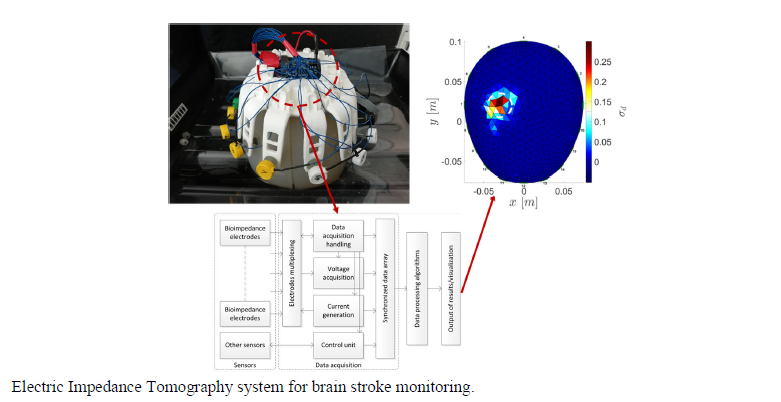
An Electrical Impedance Tomography System for Brain Stroke Imaging based on a Lebesgue-Space Inversion Procedure
Read Description
In particular, a time-difference formulation is adopted, and the resulting ill-posed equation is solved by means of an iterative procedure performing a regularization in the framework of Lebesgue spaces. The performance of the method has been assessed by means of several numerical simulations. Moreover, a preliminary validation with experimental data has been performed, too. The obtained results confirm that the approach is able to effectively detect inclusions with different sizes and locations inside the considered head models.
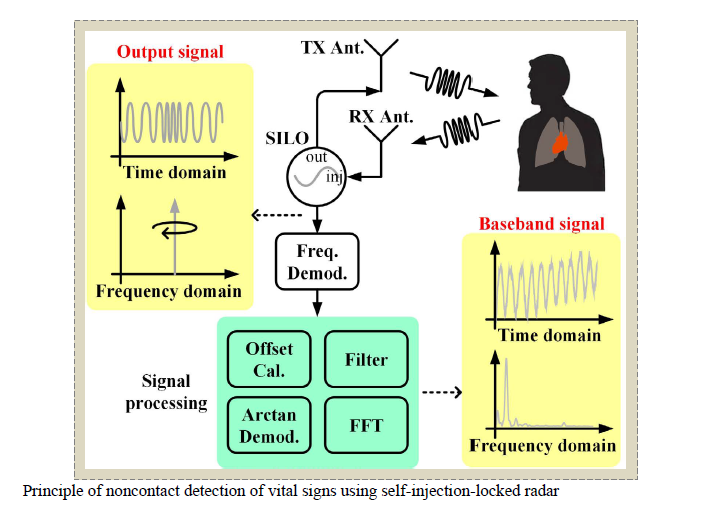
Review of Self-Injection-Locked Radar Systems for Noncontact Detection of Vital Signs
Read Description
Several approaches to detecting vital sign signals and locations using SIL radar systems have been proposed. This paper summarizes developments in vital sign detection and localization. Finally, some results of detecting animals using SIL radar systems are presented.
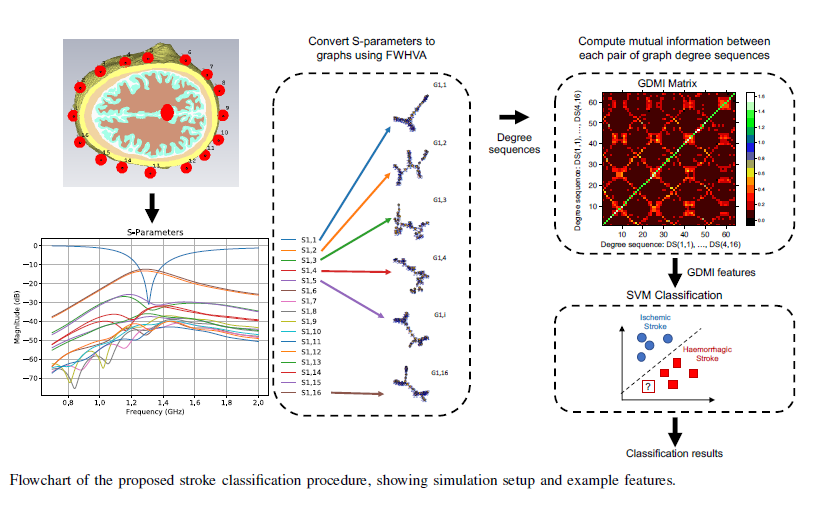
Stroke Classification in Simulated Electromagnetic Imaging Using Graph Approaches
Read Description
A total of 50 ICH and 50 IS signals simulated using a 16-antenna electromagnetic head imaging system are analysed to evaluate GDMI. The data collected from each model consists of 256 reflected and received signal. Subsequently, noise is injected into the collected signals to generate three groups of signals with different signal-to-noise ratios (40~dB, 25~dB and 10~dB SNR), to emulate measurement noise and to test the algorithm’s robustness}. Each signal is converted into a graph to avoid the variable signal amplitudes. Then, the relationship between each pair of graph degrees is calculated by mutual information and forwarded to a support vector machine to identify stroke type. The results indicate that signals from ICH subjects exhibit a significantly higher GDMI compared to the IS group (p<0.01). An accuracy of 88% is achieved in identifying ICH from IS without the need to use time- and resource-expensive brain image reconstruction algorithms even under 25~dB signal-to-noise levels. The execution time for graph feature extraction and classification is less than one minute on a PC. Such a short time is suitable for stroke emergency requirements.