Wirelessly Powered 3-D Printed Headstage Based Neural Stimulation System for Optogenetic Neuromodulation Application
Read Description
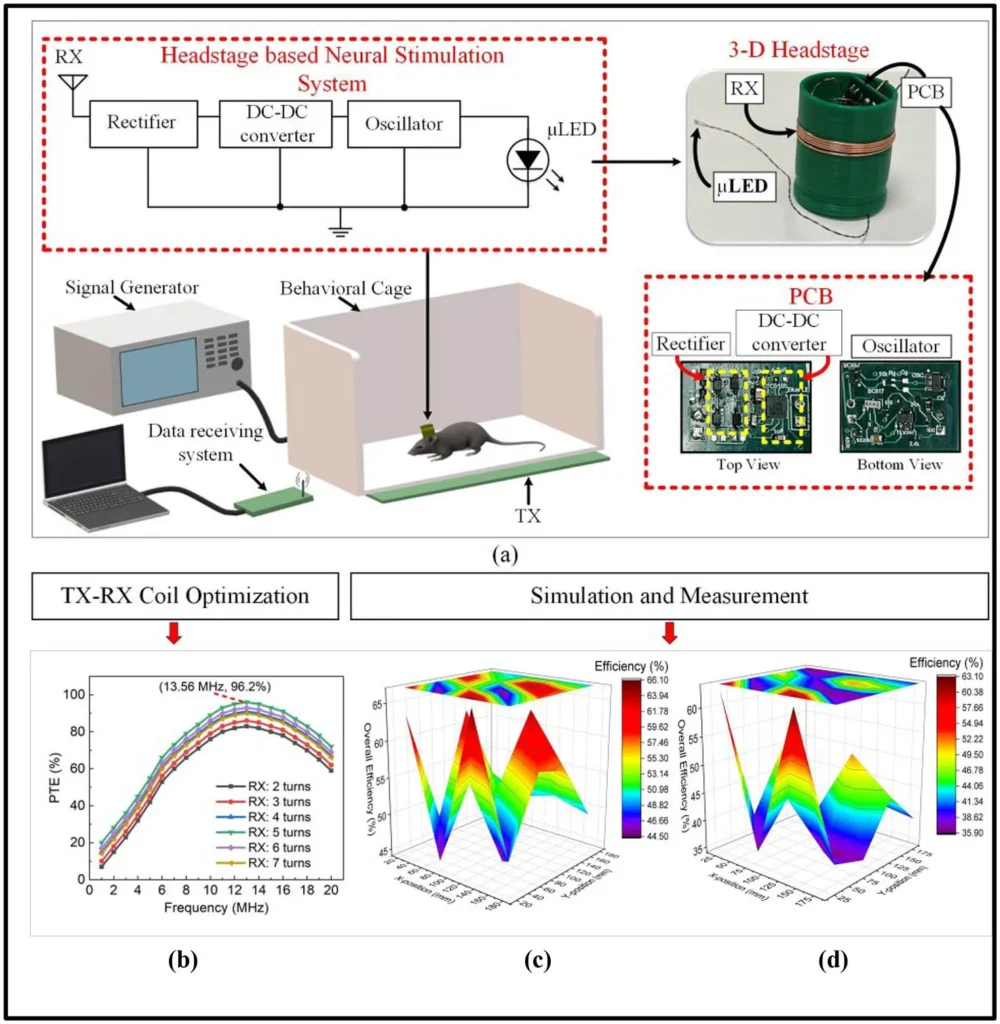
The total power consumption of the stimulation system is 14 mW which is provided using the WPT method. The WPT system includes a novel transmitter (TX) coil implemented on a printed circuit board (PCB), and a solenoid receiver (RX) coil wrapped around a customized 3-D printed headstage. The proposed TX coil is designed in such a way that the magnetic field all across the TX coil is sufficient to provide the required power to the optical stimulation system that is worn as a headstage by the freely moving rat. The headstage device’s dimension is 18.75 mm × 21.95 mm, weighing 4.75 g. The ratio of the weight of the headstage and rat is 4.75:300. The proposed system is able to achieve a maximum overall efficiency of ∼63% at 5 cm separation between the TX and RX coils, where the maximum power transfer efficiency (PTE) of the WPT system is ∼88% and the power conversion efficiency (PCE) of the rectifier is 71.6%. The proposed system with reconfigurable stimulation frequency is suitable for exciting different brain areas for long-term health monitoring.
Wireless and Zero-Power Trans-Cardiac Link With Antennified Aortic Valve Bioprostheses
Read Description
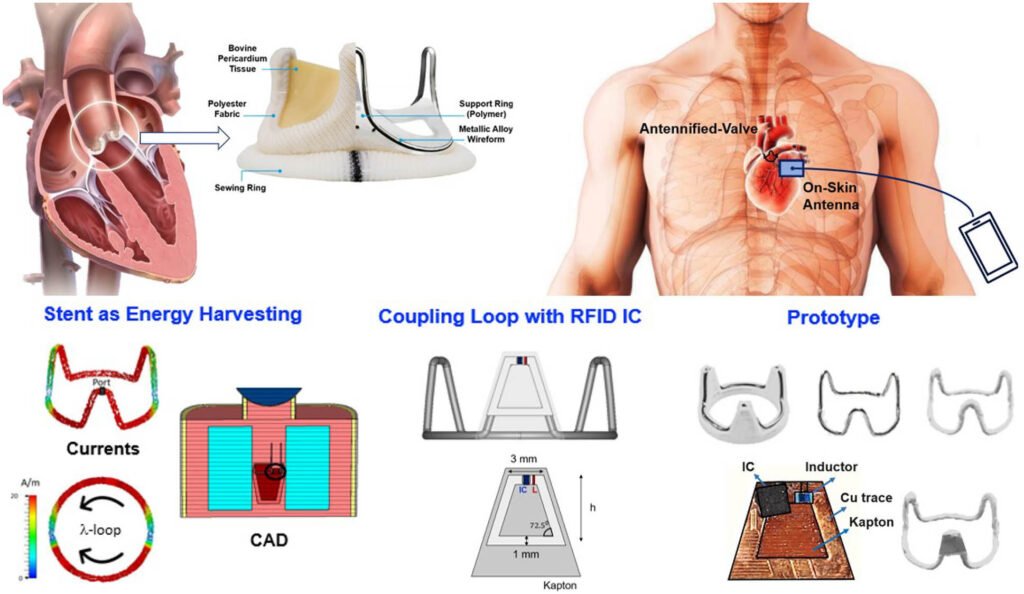
Unfortunately, it often undergoes physio-pathological processes after implantation, including the risks of functional and structural deterioration. Periodic monitoring is hence mandatory all along the life of the patient. As standard screenings are intrusive, this paper proposes a method to exploit the peculiar form-factor of the internal metallic stent of a bioprosthesis as a natural energy harvester to achieve a reliable wireless trans-cardiac RFID-based, battery-free, communication link with no relevant change to the valve. Simulations and tests with a mock-up demonstrate that a robust link with a small size on-skin patch antenna is feasible notwithstanding potential user-specific placement as well as misalignment between the antennas.
Heart ID: Biometric Identification Using Wearable MIMO RF Heart Sensors
Read Description
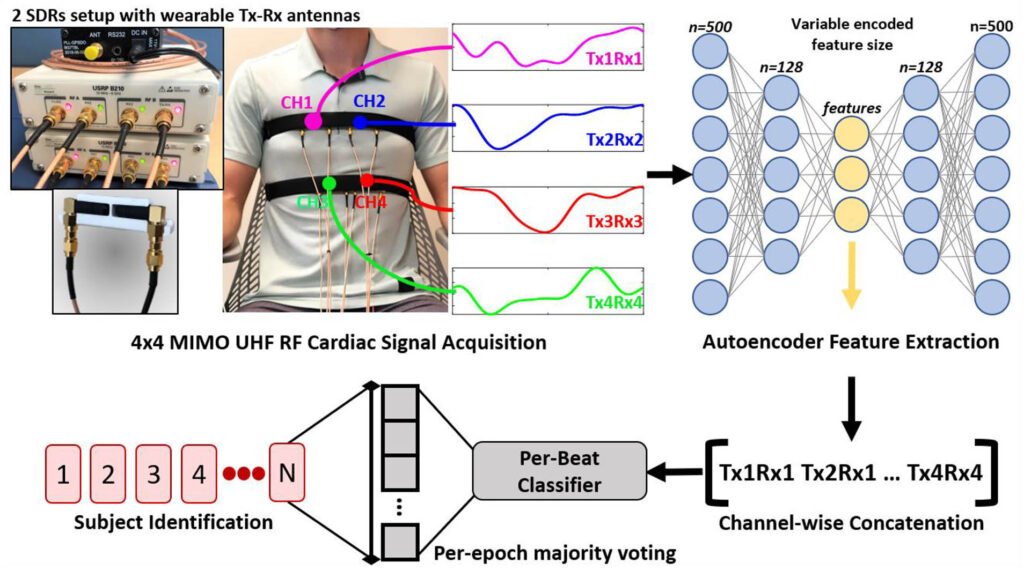
Current development has expanded to dynamic biometrics, such as gait and electrocardiogram, that enable continuous authentication and are significantly more resistant to presentation attacks. However, dynamic biometrics often involve cumbersome acquisition which restricts their widespread use. Here, we introduce Heart ID, a novel dynamic biometric system that uses near-field coherent sensing (NCS) with a multiple-in multiple-out (MIMO) radio-frequency (RF) antenna setup to non-invasively acquire detailed recordings of internal cardiac dielectric boundary motion over clothing. NCS couples localized energy to the heart to derive interpersonal structural differences, while MIMO significantly increases the biometric entropy compared to single-point observation. We performed a human study of 20 subjects as well as 2 longitudinal evaluations, and employed an unsupervised feature extraction method to explore the ID performance of this new biometric. We found an ensemble classification approach using features derived from unsupervised learning can achieve accuracy exceeding 99% at a 40-second epoch.
Heart ID: Biometric Identification Using Wearable MIMO RF Heart Sensors
Read Description
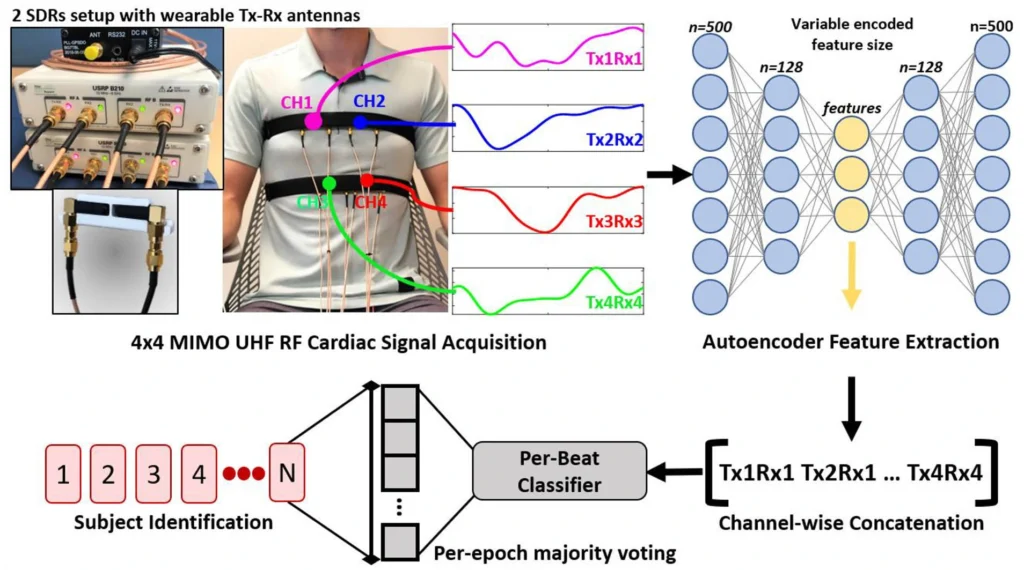
Current development has expanded to dynamic biometrics, such as gait and electrocardiogram, that enable continuous authentication and are significantly more resistant to presentation attacks. However, dynamic biometrics often involve cumbersome acquisition which restricts their widespread use. Here, we introduce Heart ID, a novel dynamic biometric system that uses near-field coherent sensing (NCS) with a multiple-in multiple-out (MIMO) radio-frequency (RF) antenna setup to non-invasively acquire detailed recordings of internal cardiac dielectric boundary motion over clothing. NCS couples localized energy to the heart to derive interpersonal structural differences, while MIMO significantly increases the biometric entropy compared to single-point observation. We performed a human study of 20 subjects as well as 2 longitudinal evaluations, and employed an unsupervised feature extraction method to explore the ID performance of this new biometric. We found an ensemble classification approach using features derived from unsupervised learning can achieve accuracy exceeding 99% at a 40-second epoch.
Review on Advanced Short-Range Multimode Continuous-Wave Radar Architectures for Healthcare Applications
The microwave auditory effect
Read Description
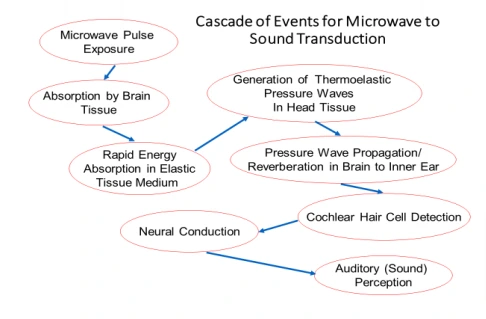
The microwave auditory effect has been widely recognized as one of the most interesting and significant biological phenomena from microwave exposure. The hearing of pulsed microwaves is a unique exception to sound waves encountered in human auditory perception. The hearing of microwave pulses involves electromagnetic waves. This paper reviews the research in humans and animals leading to scientific documentations that absorption of a single microwave pulse impinging on the head may be perceived as an acoustic zip, click, or knocking sound. A train of microwave pulses may be sensed as buzz, chirp, or tune by humans. It describes neurophysiological, psychophysical, and behavioral observations from laboratory studies involving humans and animals. Mechanistic studies show that the microwave pulse, upon absorption by tissues in the head, launches a pressure wave that travels by bone conduction to the inner ear, where it activates the cochlear receptors via the same process involved for normal sound hearing. Depending on the impinging microwave pulse powers, the level of induced sound pressure could be considerably above the threshold of auditory perception to cause tissue injury. The microwave auditory effects and associated pressures could potentially render damage to brain tissue to cause lethal or nonlethal injuries.