Detection of Sodium Ion Imbalance in Human Body Fluids Using an Improved RF Sensor
Read Description
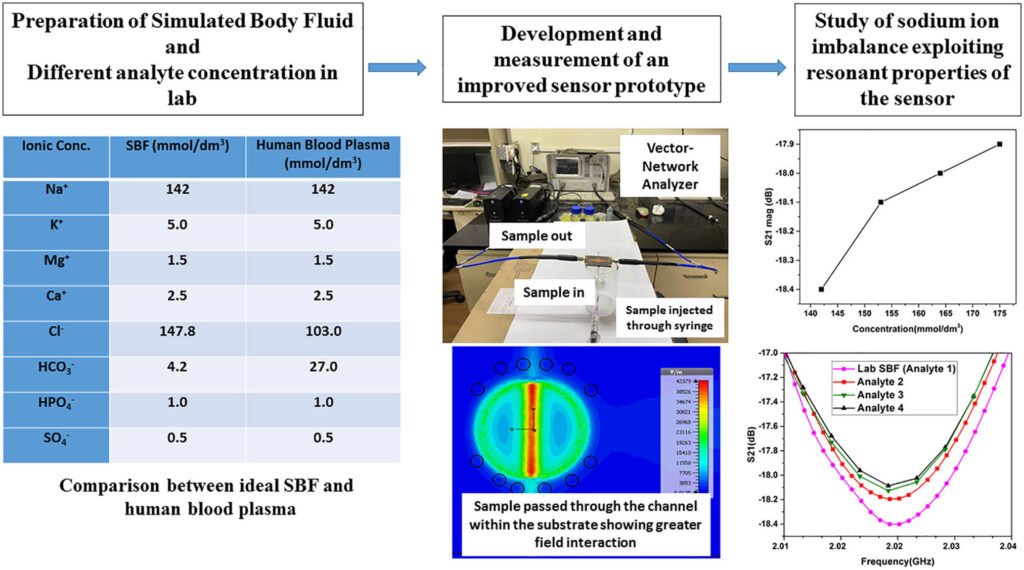
The proposed RF sensor is designed using the full wave EM simulator, the computer simulation technology (CST) Microwave Studio, and fabricated on Rogers 6002 ( ${{rm{varepsilon }}}_{mathrm{r}}$ = 2.2) having a thickness of 3.75 mm. The various parameters of the designed sensor are optimized for improved performance, and its equivalent circuit model is developed using the ADS software. The proposed sensor confines the field in the sensing area and the test fluid is injected into the sensing region through a specially designed 1.5 mm fluidic channel made across the width of the substrate. This kind of channel embedded in the substrate limits the quantity of fluid interacting with the sensing region thereby facilitating testing of Simulated Body Fluid (SBF) possessing even high-value permittivity in the range of 80–100. The SBF in the present situation is primarily being used to mimic human blood plasma to detect Na + concentrations in a lab environment. The developed RF sensor prototype is successfully utilized to determine the Sodium ion constituent variation in the body fluid, which is an important aspect as Na + concentration affects the metabolic functioning in the body. The measured sensitivity for Na + ions in the body fluid is recorded to be 0.03 dB/(mmol/dm 3 ) for the fabricated RF sensor.
Whole-Body Exposure System Using Horn Antennas With Dielectric Lens at 28 GHz
Read Description
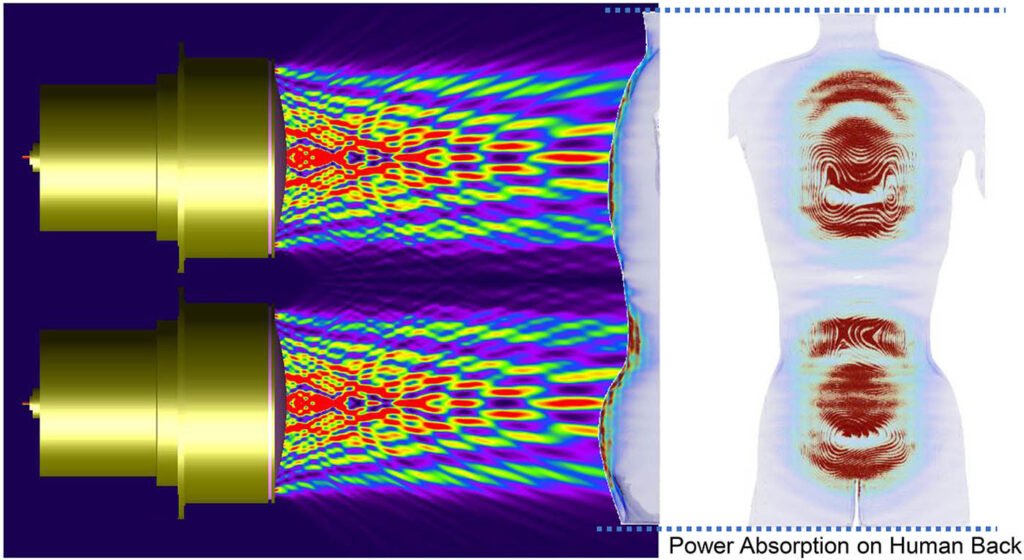
However, experiments of whole-body exposure in human subjects are limited to a few studies, which were conducted below 6 GHz. In this study, an exposure system at 28 GHz targeting a wide area of the human back was developed, which consists of two horn antennas with a dielectric lens. The effectiveness of the proposed exposure system was evaluated by computational dosimetry and experiments. The computed power absorption and measured distributions in the wave absorber and the back of the human subject were in good agreement. Under the compliance with the local exposure limits, the whole-body average SAR was 0.35 W/kg, which is comparable to the limit for whole-body exposure of 0.4 W/kg for occupational exposure in the international guidelines and standard. The developed exposure system would be useful to evaluate the thermophysiological response to whole-body exposure above 6 GHz.
Asymmetric Tapered Solenoid Designs for Halbach-Based Portable Magnetic Resonance Imaging
Read Description
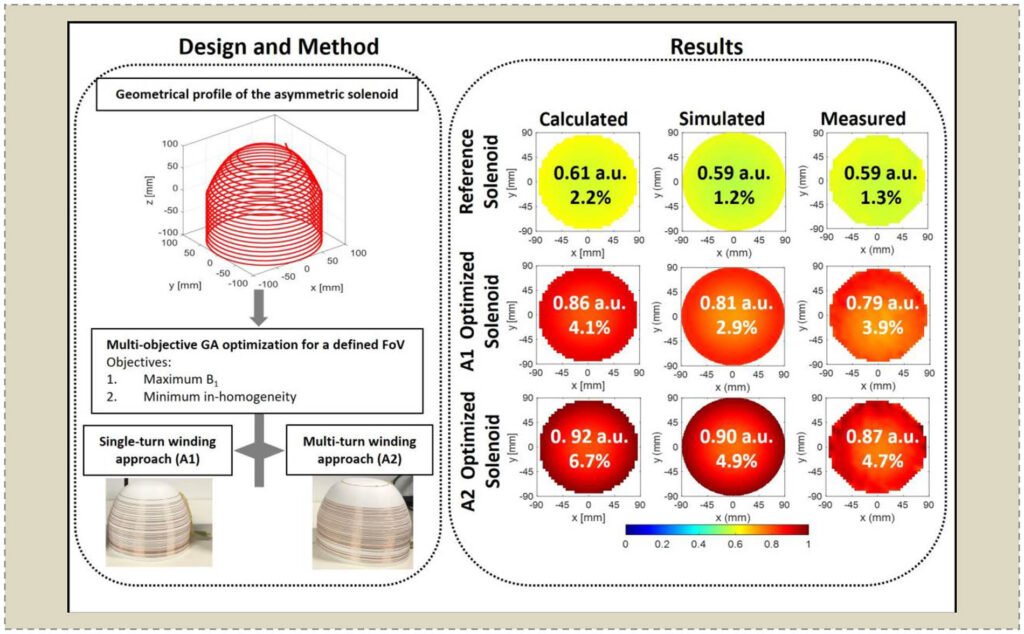
The B0a Halbach array supplies is low. To compensate this, it is desired to have a high coil sensitivity of the solenoid coil that works in such a system. Hence in this paper, an asymmetrical tapered solenoid was proposed and an optimization was carried out for both the coil profile and pitches between turns for high coil sensitivity and homogeneity. Multi-objective genetic algorithm was used. B1-field was calculated using Biot-Savart’s law in the optimization process. The targeted field of view (FoV) is a 190 mm diameter of spherical volume (DSV) for head imaging. The optimized solenoid coils were simulated using frequency domain solver in CST Microwave studio, physically constructed, and compared with a reference coil of comparable dimensions. The optimal design shows B1field increase of ∼ 35% (calculation), ∼ 33% (simulation) and minimal trade-off in homogeneity of ∼ 10% (calculation and simulation) within 190 mm DSV. For validation, the B1sensitivity of the constructed coils were measured in the FoV on the xy− plane at z=0 . The measured results are in good agreement with the simulated and calculated results.
Attachable DC Coil Array for Improved Functional MRI at 7T
Read Description
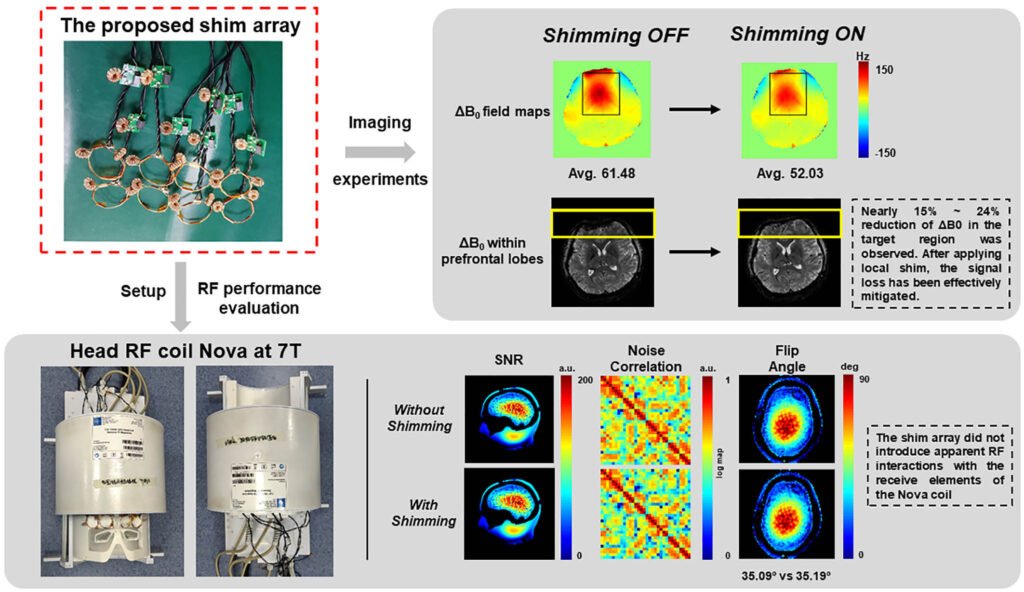
However, images within PFC region are subject to susceptibility artifacts, which give rise to undesired image distortion and signal drop-out. In this work, we proposed a method of adding a static magnetic field with high-order spatial pattern for artifact correction. Based on that, a compact attachable 8-channel coil array was constructed. Two toroid chokes were optimized and connected to each coil loop to minimize radiofrequency coupling. To evaluate the array performance, bench measurements and MRI experiments over phantoms and a human subject at 7T were conducted. With the proposed array applied, only 0.3 MHz and 1 MHz frequency shift were introduced to the RF coil, and no apparent RF performance change was observed; the inhomogeneity was reduced by 15%∼24%; in fMRI images over the human subject, “notorious” artifacts within target region were relatively mitigated. The present setup offers a feasible means for practical artifact correction, which is promising for the research that focuses on PFC regions.
Area-Averaged Transmitted and Absorbed Power Density on a Realistic Ear Model
Read Description
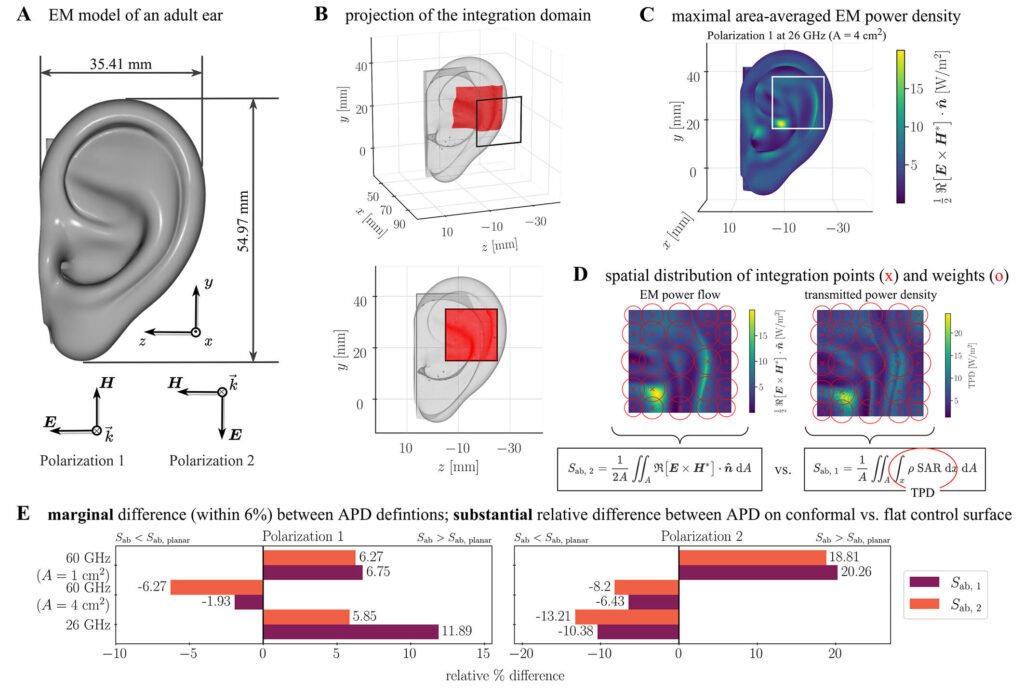
In this study, we address this problem by developing an averaging technique for the assessment of the absorbed power density ( Sab) on the anatomically-accurate electromagnetic (EM) model of the human ear. The dosimetric analysis is performed for the plane-wave exposure at 26 and 60 GHz, and the accuracy of the proposed method is verified by using two commercial EM software. Furthermore, we compare the two definitions of Sabprovided in the international guidelines and standards for limiting exposure to EM fields above 6 GHz. Results show marginal relative differences between the obtained values from the two different definitions (within about 6 %) in all considered scenarios. On the other hand, in comparison to flat models, the spatial maximum Sabon the ear is up to about 20 % larger regardless of definition. These findings demonstrate a promising potential of the proposed method for the assessment of Sabon surfaces of anatomical models at frequencies upcoming for the 5th generation (5G) wireless networks and beyond
Implementation of Thinned Array Synthesis in Hyperthermia Treatment Planning of 434 MHz Phased Array Breast Applicator Using Genetic Algorithm
Read Description
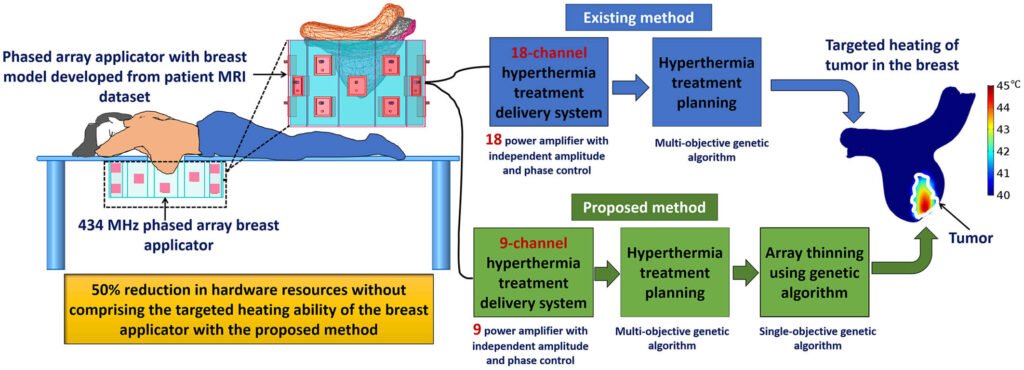
The average hotspot to target quotient of 18-, 15-, 12-, and 9-antenna excitation in 25 patient models was 1.18, 1.09, 1.09, and 1.13, respectively. The average temperature in 50% tumor volume for 18-, 15-, 12-, and 9-antenna excitation was 42.42 °C, 42.48 °C, 42.49 °C, and 42.48 °C, respectively. The temperature induced in tumor and healthy tissues is similar for varying number of active channels. However, the amount of power consumed was 25.2%, 53.9%, 97.9% higher for 15, 12, 9 active antennas compared to the filled array. Antenna array with 12 active elements was chosen as the optimal combination as it provided selective tumor heating with good tradeoff between number of channels and power consumption. The heating ability of the thinned array was assessed for 50% reduction in the number of active antennas on patient derived heterogeneous breast phantoms for five tumor target locations. The good agreement between simulated and measured thermal distributions demonstrate the selective heating ability of our phased array applicator for 50% reduction in hardware resources. The study outcome enables us to realize a cost-effective hyperthermia treatment delivery system.