IEEE Sites
Edit Template

Articles

Simplified Assessment Method for Population RF Exposure Induced by a 4G Network
×

Take Out Message

Take-Home Messages

  • We propose a simplified method based on surrogate modeling to assess the day-to-day global RF-EMF exposure of a population, which offers us a fast analysis of the evolution of wireless networks in view of EMF exposure.
  • The RF exposure from mobile phones accounts for only 25% of global exposure, resulting from the high speed of uplink throughput in 4G, considering a mobile usage in data service used in front of the chest.
  • This is the first study to characterize the uncertainty of day-to-day RF-EMF exposure of a population taking into account the variability linked to geographical environment specificities, communication traffic, EM radiations originating from personal wireless devices and from base stations as well as data rates; the novelty of this paper is also in its sensitivity analysis in order to assess the influence of these parameters on RF-EMF exposure.
  • Results show that the 4G-induced RF-EMF exposure of a population follows a Generalized Extreme Value distribution with an average value of 1.19×10⁻⁷ W/kg, which is far below the international standard limits.
Measurement of Deep Tissue Implanted Antenna Efficiency Using a Reverberation Chamber
×

Take Out Message

Take-Home Messages

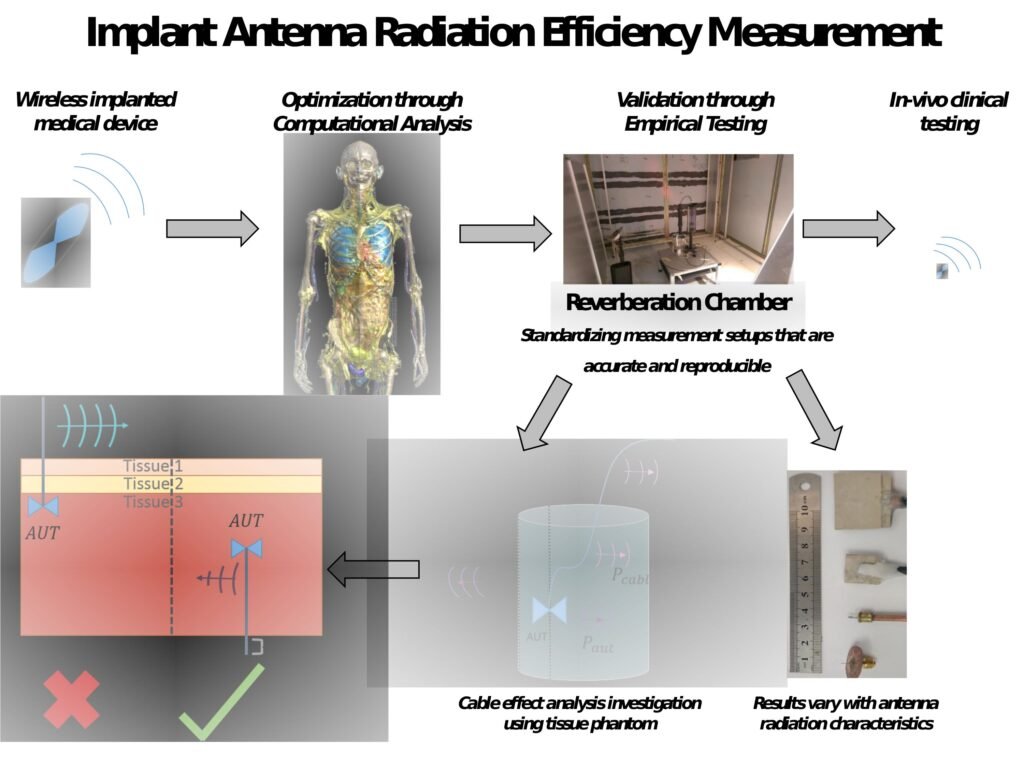
  • For the first time in literature, deep tissue implanted antenna radiation efficiency is accurately measured inside a tissue mimicking liquid phantom using a Reverberation Chamber (RC) technique.
  • Although the radiation efficiency of a deep tissue implanted antenna can be extremely low (< 0.1%), this work shows how the RC technique can be used if care is taken to ensure that the feed cable does not significantly radiate, for example by routing the cable through the bulk of the tissue mimicking phantom.
  • This work is relevant to any biomedical application or solution that is based on active implants that employ UHF radio communications or power transfer since in-situ radiation efficiency is the key design metric for such antennas and is core to the system link budget.
  • In addition to establishing a method of efficiently and effectively measure implant antenna efficiency, something that is avoided in most published research papers, this work shows that significant errors are introduced when the antenna under test feed cable is not deeply inserted in the tissue phantom.
Local Pulse Wave Detection using Continuous Wave Radar Systems
×

Take Out Message

Take-Home Messages

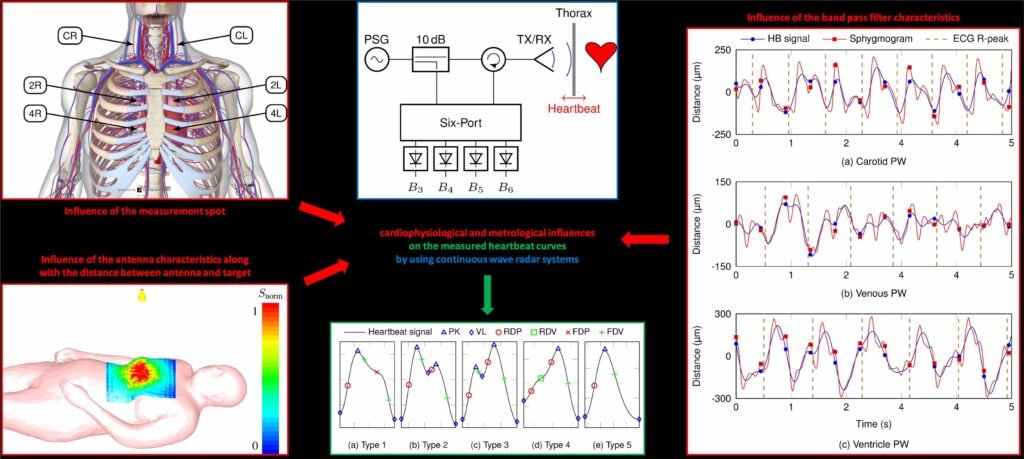
  • For the first time, detailed cardiophysiological and metrological causes of the diversity of measured heartbeat curves by continuous wave radar systems are presented as well as the possibility to measure locally specific pulse wave curves called sphygmograms.
  • The measurement spot on the human body, the cutoff frequencies of the applied band pass filter, the antenna characteristics as well as the distance between antenna and target contribute to the signal shape of the measured heartbeat curves.
  • Radar based locally specific pulse wave detection enables novel, contactless, cardiophysiological investigations for medical diagnostics.
  • The causes of the diversity of published heartbeat curves are researched by investigating the cardiovascular system and the metrological influences on the measured signal shapes. Hereby, it is shown that adjusted filter characteristics and an appropriate distance between antenna and target enable radar based measurements of locally specific and medically relevant sphygmograms.
  • The presented measurements were verified by a laser sensor as gold standard and medically substantiated by cardiophysiological researchers.
Data Packet Transmission through Fat Tissue for Wireless Intra-Body Network
×

Take Out Message

Take-Home Messages

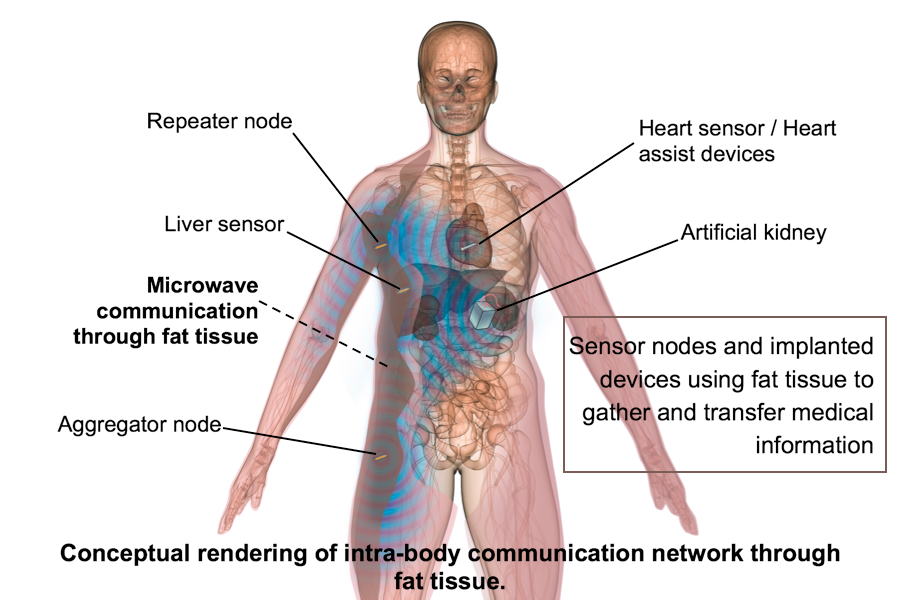
  • We propose a novel channel for supporting high data rate microwave communication by using the fat tissue.
  • For up to 10 cm long fat tissue channel, we were able to achieve approximately 96 % data packet receptionwith a path loss of 1 dB and 2 dB at 10 mm in both phantom and ex-vivo environments, respectively.
  • This work can be used in body area network, sensors application, and man-machine interfaces.
  • Microwave communication through fat tissues was not known before. This work was successfully able todemonstrate data packet transmission through the porcine fat tissue.
  • Through this study, we were able to show that the transmission loss (dB) in the muscle layer is more than twofoldof the transmission loss (dB) through the fat layer.
Multi-Frequency Constrained SAR Focusing For Patient Specific Hyperthermia Treatment
×

Take Out Message

Take-Home Messages

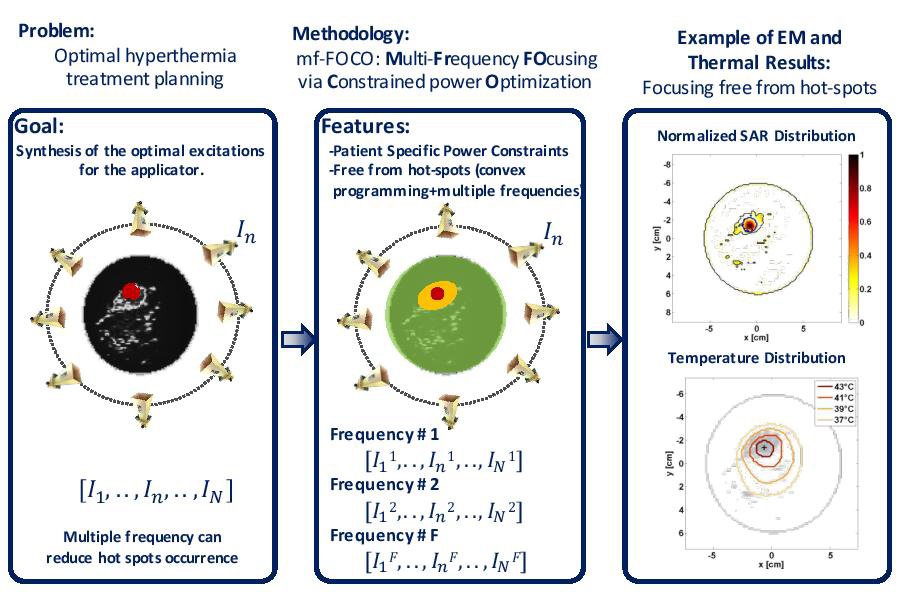
  • An innovative multi-frequency hyperthermia treatment planning strategy addressing the limitingclinical need represented by minimizing undesired heating is presented.
  • This multi-frequency planning strategy, mf-FOCO, based on a convex programming problem, ensurea safe and efficient outcome of the treatment.
  • The targeted medical application is hyperthermia treatment planning.
  • Preliminary results confirmed the possibility of counteracting undesired heating exploiting multifrequencyapplicator while enforcing a patient-specific mask.
Detection of African Trypanosomes using Asymmetric Double-Split Ring based THz Sensors
×

Take Out Message

Take-Home Messages

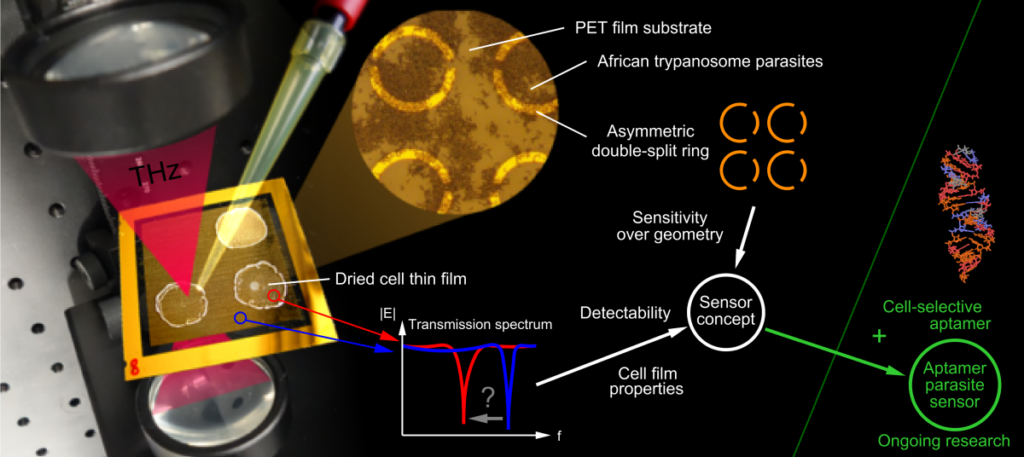
  • In this work, the detectability of African trypanosome parasites through passive resonant thin film sensing isexamined for the first time, providing the basis for a novel approach to fast pathogen screening tests targetingHuman African Trypanosomiasis (HAT).
  • Cell-film sensitivity of asymmetric double-split rings is evaluated in simulation over different gap and filmconfigurations, using the material characterization presented in the original conference paper as a data basis.
  • Simulation results are verified using phantom material and actual trypanosome parasites in pure form, whilealso examining the influence of varying dielectric contrast to dry cell buffer residue.
  • The observed significant and rapid detectability of pure trypanosome parasites as a bulk material using planarresonators is a very important intermediate result on the way to a surface-functionalized parasite sensor, whichachieves high selectivity by use of RNA-based, highly affine and parasite-specific aptamer coatings.
  • In ongoing research, we hope to achieve a sensor design which can immediately detect parasite presence in abarely pre-treated patient fluid sample based on the selection function of the aptamer, but possibly also byspectroscopic recognition of the cell itself if an individual spectral feature can be found in future work.
1 2 3 33

SPONSORED BY

Announcements

June 15, 2026

Best Paper Award 2024 Winners Announced

Congratulations to the recipients of the IEEE J-ERM Best Paper Award for outstanding contributions to the field published in volume 7.
June 15, 2026

New Editor-in-Chief Appointed for IEEE J-ERM

IEEE is pleased to announce the appointment of a new Editor-in-Chief effective January 2025. We thank the outgoing EIC for years of exceptional service.
June 14, 2026

IEEE J-ERM Launches Special Issue on AI-Driven Bioelectromagnetics

We invite submissions for a focused issue on the intersection of artificial intelligence and electromagnetic biomedical applications. Deadline: 30 June 2025.

NEWS

IEEE J-ERM Launches Special Issue on AI-Driven Bioelectromagnetics – Copy
News June 19, 2026

IEEE J-ERM Launches Special Issue on AI-Driven Bioelectromagnetics – Copy

We invite submissions for a focused issue on the intersection of artificial intelligence and electromagnetic biomedical applications. Deadline: 30 June 2025.
IEEE J-ERM Launches Special Issue on AI-Driven Bioelectromagnetics – Copy
News June 19, 2026

IEEE J-ERM Launches Special Issue on AI-Driven Bioelectromagnetics – Copy

We invite submissions for a focused issue on the intersection of artificial intelligence and electromagnetic biomedical applications. Deadline: 30 June 2025.
IEEE J-ERM Launches Special Issue on AI-Driven Bioelectromagnetics – Copy
News June 19, 2026

IEEE J-ERM Launches Special Issue on AI-Driven Bioelectromagnetics – Copy

We invite submissions for a focused issue on the intersection of artificial intelligence and electromagnetic biomedical applications. Deadline: 30 June 2025.
IEEE J-ERM Launches Special Issue on AI-Driven Bioelectromagnetics
News June 15, 2026

IEEE J-ERM Launches Special Issue on AI-Driven Bioelectromagnetics

We invite submissions for a focused issue on the intersection of artificial intelligence and electromagnetic biomedical applications. Deadline: 30 June 2025.

IEEE Journal of Electromagnetics, RF and Microwaves in Medicine and Biology. Publishing peer-reviewed research at the intersection of electromagnetics and biomedical science since 2017.


ISSN (Print)       2469-7249


ISSN (Online)    2469-7257


Publisher           IEEE


Frequency         Continuous (4–6 issues/year)

Quick lINKS

© Copyright 2026 IEEE – All rights reserved. Use of this website signifies your agreement to the IEEE Terms & Conditions. A not-for-profit organization, IEEE is the world’s largest technical professional organization dedicated to advancing technology for the benefit of humanity.

Scroll to Top