Design of Dual Frequency Mixed Coupling Coils of Wireless Power and Data Transfer to Enhance Lateral and Angular Misalignment Tolerance
Read Description
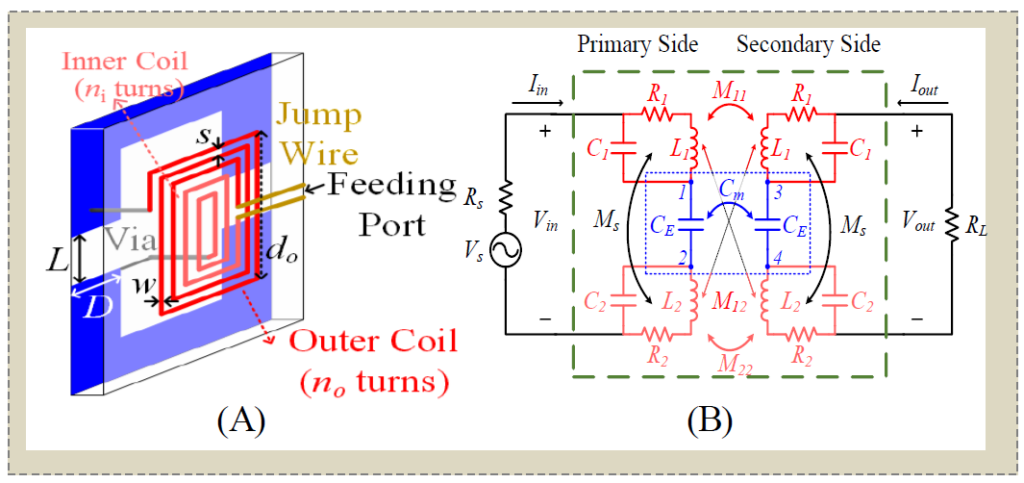
A complete, sophisticated equivalent circuit is proposed and demonstrates the features of the dual-resonant characteristic and lateral and angular misalignment tolerance. Comparing to traditional printed spiral coil systems, the proposed mixed coupling structure reduces decline rate of S21 by 26.4 % and 78.1 % at 35 mm axial misalignment and 90° angular misalignment at low resonant frequency, respectively. Moreover, at high resonant frequency, S21 only drops 16.5% with 60 mm lateral misalignment and is almost flat for 90° angular misalignment. Last but not least, data communication is also validated by transmitting a 200 kHz frequency shift keying signal, and the probability errors remain at acceptable level when misalignment occurs.
Measurement of Ion-Pairing Interactions in Buffer Solutions with Microwave Microfluidics
Read Description
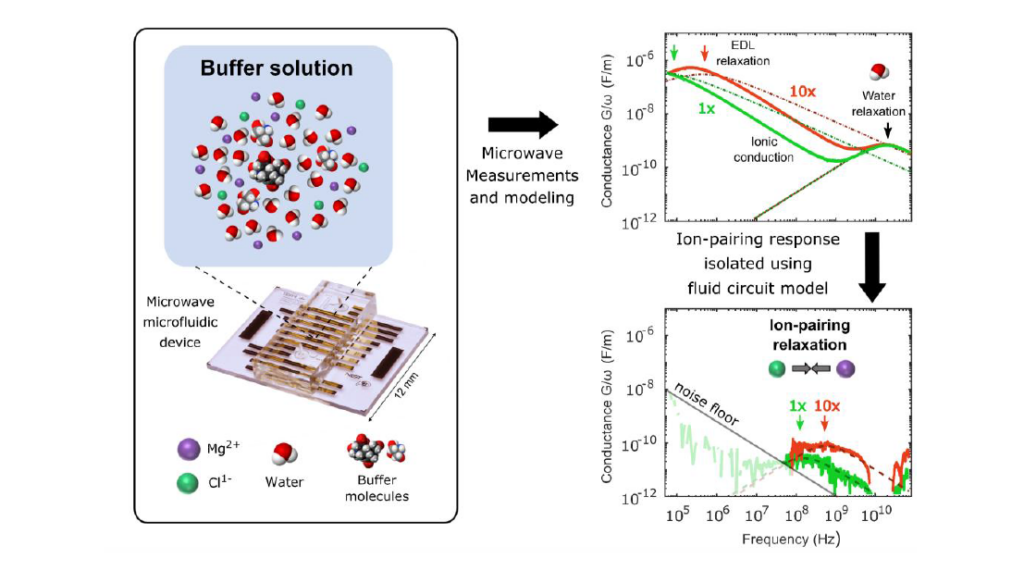
One critical step towards quantifying these effects is to develop accurate models for the behavior of buffer solutions containing mobile ions. Here, we show that ions in buffer solutions produce a weak ion-pairing response. We used microfluidic channels integrated with coplanar waveguides in combination with a hybrid microwave calibration protocol to extract the broadband microwave admittance spectra of a standard TAE-Mg2+ buffer solution between 100 kHz and 67 GHz. To characterize the ion-pairing response, we fit the calibrated admittance data with two models: a conventional model without ion-pairing and with a water relaxation described by a ‘Cole-Cole’ function, to our alternative model that includes ion-pairing and a single Debye-type water relaxation. Including ion-pairing improved the goodness of fit across the entire frequency range. In the higher concentration buffer solution, we saw a reduction in the max systematic error in the fit residuals from 10% to less than 4%. The measurement and fitting techniques are widely applicable, providing critical information about the behavior of solvated ions.
Evaluation of a Microwave Biosensor for On-chip Electroporation and Efficient Molecular Delivery into Mammalian Cells
Read Description
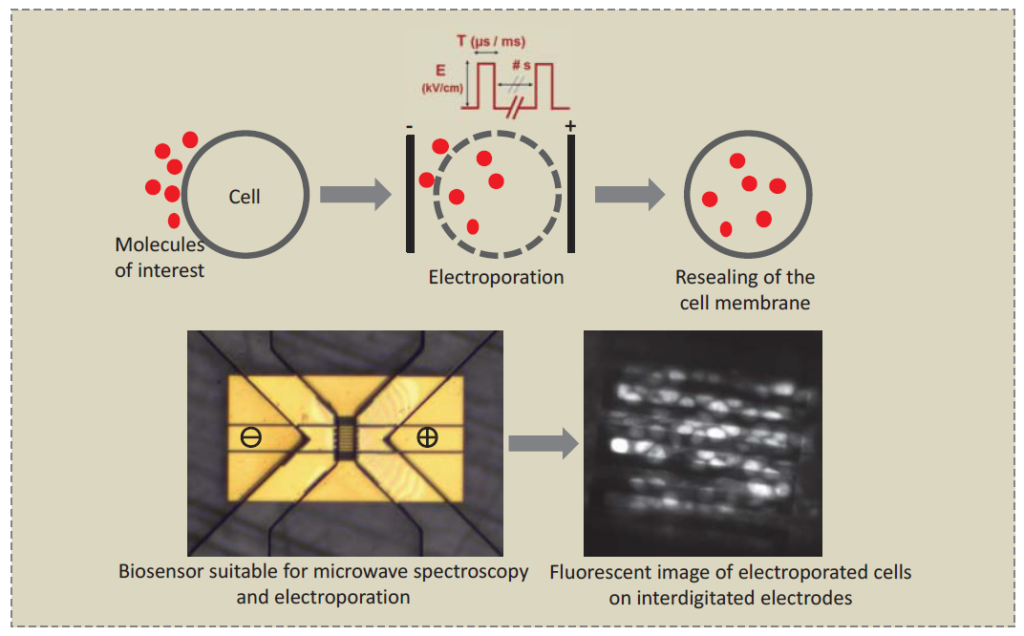
We demonstrate the applicability of our device for electroporation-mediated molecule transfer of adherent cells in standard laboratory conditions. Application of electric pulses (6 V, 100μs, 1 Hz) to the cells induces successful delivery of a fluorescent probe (∼98%), while maintaining a high viability rate (∼100%). The comparable delivery rate to existing systems along with the improved viability suggest that our proposed electroporation system has great potential in the research fields, considering that our system is conceived to perform electrical microwave spectroscopy measurements after electroporation.
Design Considerations for Radiofrequency Whole-Body and Head Coils
Read Description
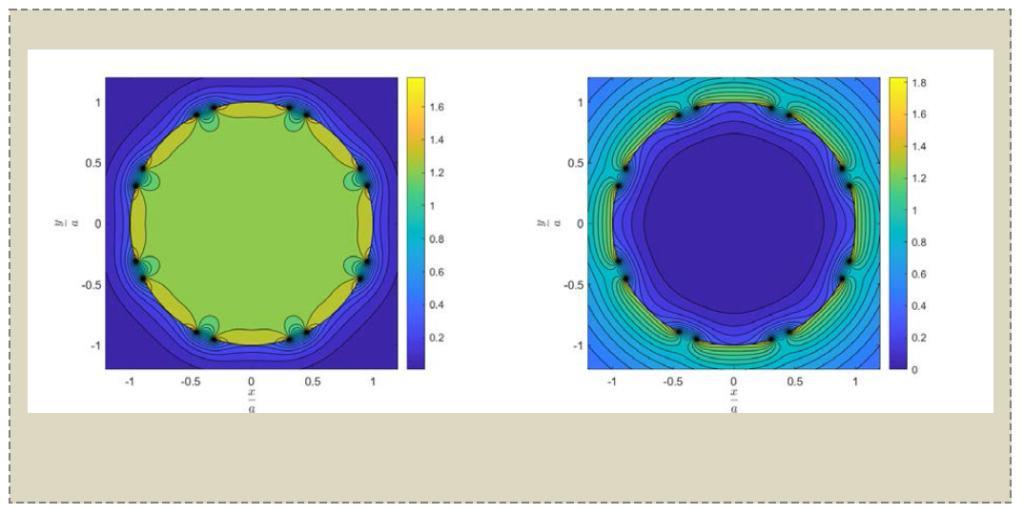
Alternatively, full-orthogonal excitation of the coil, if possible, would mitigate this design challenge, especially if high-Q operation cannot be guaranteed. In this contribution a field theoretical technique for the optimization of the capacitive coupling is introduced and applied to the birdcage configuration as representative of TEM coils. A fairly general analysis of these coils is also introduced and/or revisited, which underlies the proposed technique and offers simple analytic design equations. Simulation results are presented to validate the considered approach. The presented analysis deals with the homogeneously filled coils and therefore does not consider the B+1 inhomogeneities caused by the loading. The latter will be the subject of future publications.
Portable Microwave Head Imaging System Using Software-Defined Radio and Switching Network
Read Description
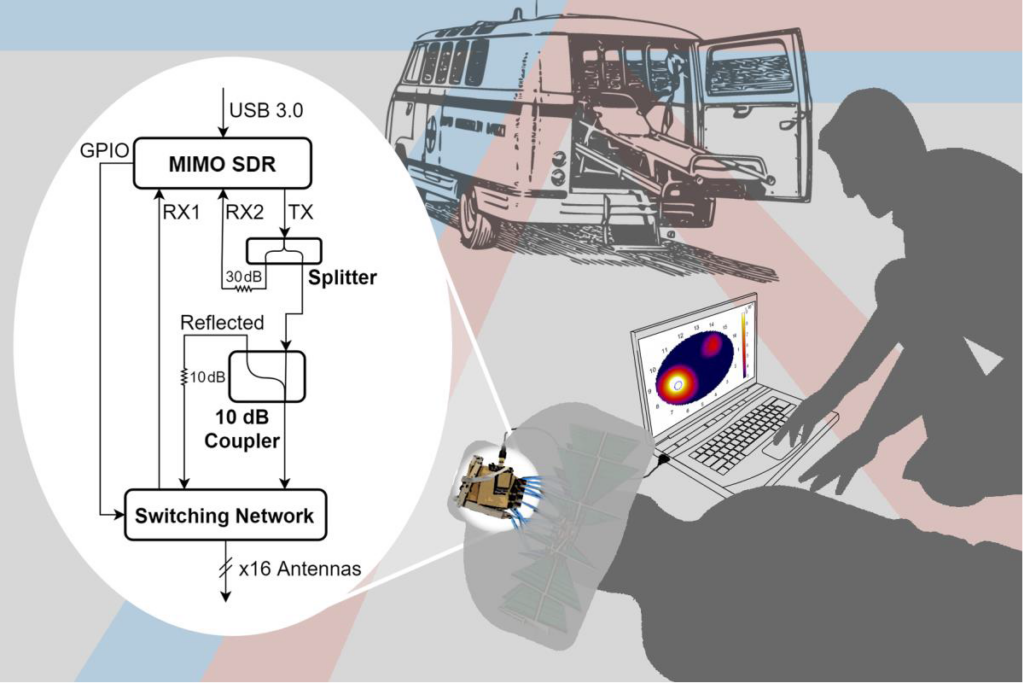
This paper proposes a portable microwave head imaging system that can easily be taken to the patient. The system utilises a novel combination of a software-defined radio and solid-state switching network to collect the imaging data, and operates in the frequency band of 0.85 – 2 GHz. It can capture input signals over a range of approximately 106 dB, which is suitable for detecting realistic brain injuries. The concept has been validated through experimental data collection and confocal image generation, and was capable of producing images in less than a minute. A simplified head phantom was developed for gathering the verification data and proved that the system was capable of locating targets with dielectric properties similar to brain tumours and bleeds. The presented design is highly accessible, achieved through being small, light, and inexpensive: key factors that could help save lives in time-critical medical emergencies.
Subject-specific, Non-invasive Helmet-restraint RF Coil for Awake, Non-human Primate MR Imaging
Read Description
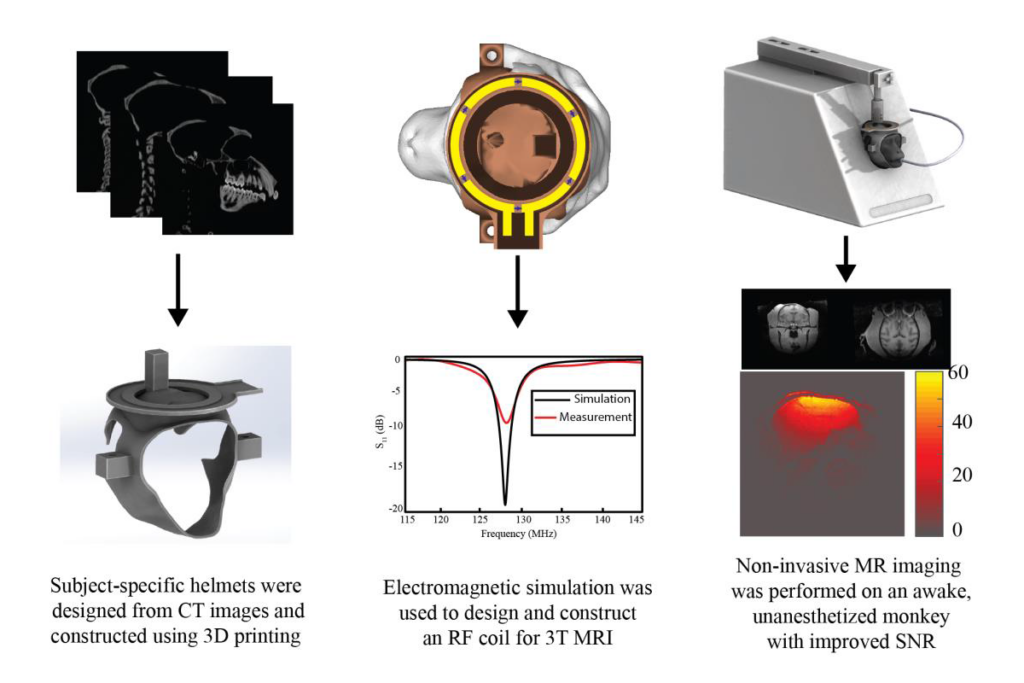
In this work, an RF coil holder was integrated into the design of a subject-specfic helmet to place the coil in closest distance to the head for improved signal-to-noise ratio (SNR). Additive manufacturing was used to print the helmet based upon CT images of the subject. A single channel transmit/receive loop coil was designed using electromagnetic simulations loaded with a voxel-based monkey head model. The Rhesus macaque used in this study underwent behavioral training based on positive reinforcement before engaging in MR imaging. Imaging was performed using the helmet coil which was successful in immobilizing the macaque head in an awake, unanesthetized subject. Results showed improved SNR by approximately 28% compared to a loop coil used with an implanted head post, and minimal motion artifact in structural imaging. The non-invasive helmet coil eliminates the need for permanently implanting monkeys with a headpost, provides the necessary head immobilization, and allows the use of more subjects for neuroimaging studies.