Selecting the Optimal Subset of Antennas in Hyperthermia Treatment Planning
Gennaro G. Bellizzi, Maarten Paulides, Tomas Drizdal, Gerard Van Rhoon, Lorenzo Crocco, Tommaso Isernia.
Read Description
Among them, increasing the frequency and the number of radiating elements has shown effective for achieving more conformal heating. However, as each radiating element requires a power amplifier to control it, increasing the number of antennas considerably impacts the overall cost and complexity of the system. Accordingly, a procedure capable of selecting an optimal patient-specific subset of antennas from an oversized phased array applicator (with more antenna elements than available amplifiers) could help improving cost-effectiveness. In this study, we present an original approach which allows improving performance by adaptively selecting the optimal subset of antennas to be activated for a given (redundant) applicator and a given patient. The proposed approach takes inspiration from the compressive sensing theory by embedding the sparsity promotion paradigm into a treatment planning procedure which casts power-deposition as a constrained convex optimization. Performance were demonstrated for the case of head and neck hyperthermia, and benchmarked against the antenna selection procedure presently used in the clinical practice.
×
Take Out Message
Take-Home Messages
- For the first time the compressive sensing theory has been applied and clinically tested in hyperthermia treatment planning.
- The proposed approach allows to improve treatment quality for head & neck tumors with the HYPERCollar3D (despite its general formulation) exploiting both sparsity promotion concepts and FOCO (a convexprogramming- based SAR optimizer).
- The approach proposed in this work deals with the optimal planning of an hyperthermia treatment.
- The proposed SP-FOCO allows to optimally and case-specifically select a subset of antennas from an oversized applicator. Oversized applicators represent a way to exploit additional degrees of freedom and consequently dealing with arbitrary located tumor.
- Results suggested the development of similar approaches for applicator design.
RF Injection Network Development for Testing of Active Implantable Medical Devices Exposed to RF Fields in 1.5 T MRI Systems
Ali Attaran, William B. Handler, Blaine A. Chronik.
Read Description
The system was developed to meet the requirements of ISO/TS 10974:2018(E). A directional lumped element coupler, power splitter, an attenuator/isolator, low pass filter and high pass filter were designed and implemented as part of the network. The RF injection network was developed in both a compact version implemented in a single PCB and discrete PCB version for use in different situations. The performance of each designed component was simulated and compared to measurement results. As an application example, a neuromodulation system was tested using the developed RF injection network for conductive emission testing.
×
Take Out Message
Take-Home Messages
- This work presents the design, construction, and testing of an RF injection network for MR-conditional medical device testing of devices for use within 1.5 T MRI scanners to reduce the risks to patients with an active implantable medical device (AIMD) in this electromagnetic environment.
- A directional lumped element coupler, power splitter, an attenuator/isolator, low pass filter and high pass filter were designed and implemented as part of the network and at the end a neuromodulation system was tested using the developed RF injection network for conductive emission testing.
- Application target is active implantable medical devices exposed to 63.4 MHz RF field in 1.5 T MRI systems.
- MRI scanner is well-known to pose a series of risks to patients with an active implantable medical device (AIMD). The anticipated risks to both the patient and the implanted device are described in ISO/TS 10974:2018(E).
- In this work, RF injection network was developed for conductive emission testing of AIMDs to reduce the risk of loss of device functionality such as, but not limited to, a failure to deliver the intended therapy, re-programming, device reset, permanent damage, and tissue stimulation due to RF rectification.
Effects of Coaxial-lateral and Coaxial-angular Displacements on Link Efficiency of a Wirelessly Powered Optogenetic Implant: Design, Modeling and Experimental Validation
Dipon Kumar Biswas, Nishat Tarannum Tasneem, Ifana Mahbub.
Read Description
The coupling coefficient deteriorates significantly due to the displacements thus decreasing the overall power transfer efficiency (PTE) of the system. In this paper, we present an analysis and modeling of the effects of various displacements on the efficiency and the overall performance of a miniaturized WPT system designed for an optogenetic implant. To emulate the tissue media inside a human head, skin, skull and gray matter layers are theoretically modeled using dielectric properties and simulation models are developed using the Ansys High Frequency Structure Simulator (HFSS) software. The propagation loss and link efficiency are modeled and simulated as a function of various displacement combinations. To validate the theoretical and simulation models, the WPT system is characterized in various displacement conditions using chicken breast as the media. The measurement results also show a good agreement with the simulation results, thus providing an estimation for the misalignment tolerance range for given specifications. The efficiency performance analysis of the proposed WPT system for various worst-case scenarios also provides a preliminary model for designing a closed-loop wireless power delivery regulation scheme in the future.
×
Take Out Message
Take-Home Messages
- Neuromodulation approach such as optogenetics helps regain the functionality of the paralyzed limbs due to stroke and neural diseases.
- An optogenetic implant requires a fixed amount of power to turn on the μLED and stimulate the neurons via inductive coupling based wireless power transfer method.
- Coaxial and lateral displacements and angular misalignment cause degradation of inductive coupling and thus reduce the delivered power to the implants. Our approach of deriving the misalignment tolerance range based on the modeled, simulated and measured path loss and the link efficiency through the tissue media is a unique approach to estimate the performance reliability of the implant.
- The proposed approach and methodology of designing a wireless power transfer system for optogenetic application with the aim to maximize the link efficiency given the constraints of the sizing and Specific Absorption Rate (SAR) would be highly valuable for the biomedical implant research community.
Determining the Position and Orientation of In-body Medical Instruments Using Near-Field Magnetic Field Mapping
Vedat Cavlu, Paul Brennan.
Read Description
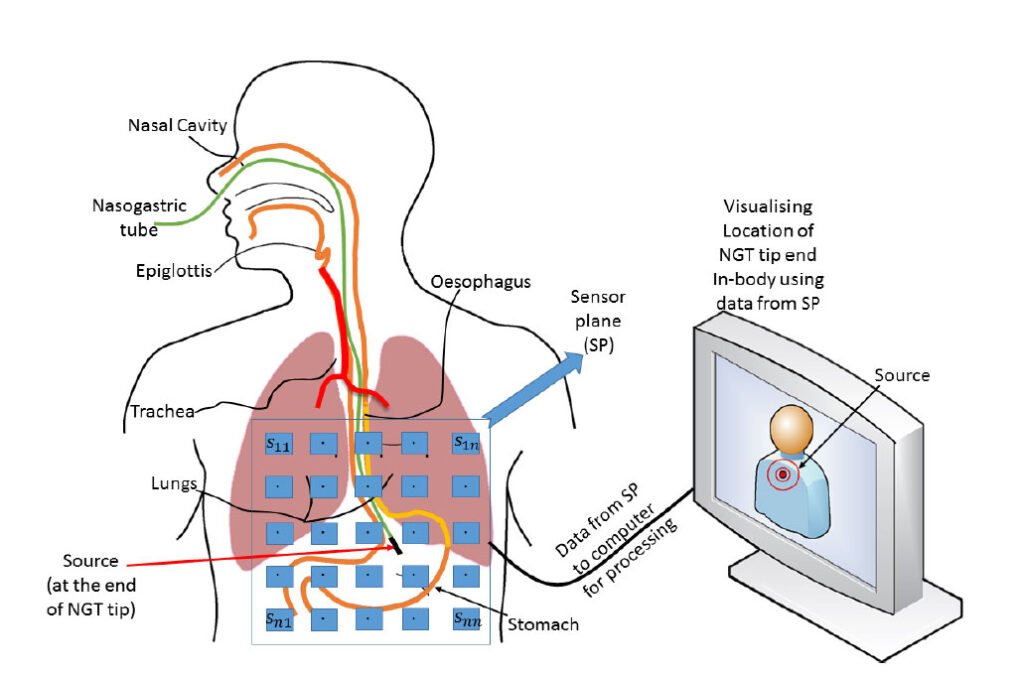
The permanent magnet fails due to low power, and static current source requires relatively high power source. The RF field source requires high frequencies to get enough precision, which undergoes high attenuation in the body. At low frequency, when the distance between the source and the receiver array is shorter than the wavelength, the far field assumption fails for localization methods. Therefore, we propose a novel method of mapping the magnetic field vector in the near field region, with which wavelength independent localization is done. We did extensive MATLAB and CST Microwave simulations followed by practical experiments. The proposed method has achieved localization accuracy of less than 1 cm in Y-Z plane, 2 cm in depth (in X-axis) and the maximum orientation error remained 10° in 3-D.
×
Take Out Message
Take-Home Messages
- This research aims to solve the issue with localization with near field of electromagnetism and in the lossy human tissues.
- The results show that, the position of in-body medical instrument can be determined within 1 cm and predict the orientation with error of maximum 10 degree.
- The proposed method is a novel way to determine location and orientation of an in-body medical-instrument.
- High accuracy localization in the challenging near field with relatively low frequency.
- This method can be performed from DC to up to frequencies that goes through the human tissues with negligible losses.
Impact of Electrode Structure on RF-induced Heating for an AIMD Implanted Lead in a 1.5-Tesla MRI System
Rui Yang, Jianfeng Zheng, Yu Wang, Ran Guo, Wolfgang Kainz, Ji Chen.
Read Description
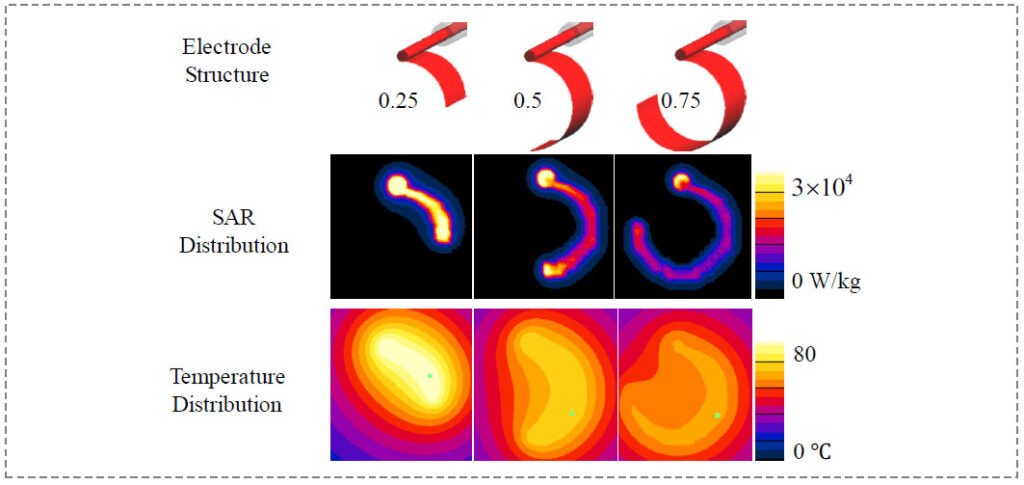
It is shown that increasing the size of lead electrode reduces the SAR distribution and temperature rise near the electrode. Our results indicate that a larger electrode size will reduce the magnitudes of the lead transfer function, and subsequently reduces the heating effect near the electrode. Both numerical simulations and experimental measurements were performed to verify the effectiveness of a large electrode in mitigating the RF-induced heating.
×
Take Out Message
Take-Home Messages
- Sophisticated electromagnetic modeling and experiments were performed to assess the effect of the electrode structure on the radio frequency (RF) -induced heating.
- For this case study, we found that increasing the electrode size tends to reduce the magnitude of the lead transfer function, subsequently reducing the RF-induced heating near the electrode.
- To present a lead electrode which can reduce the RF-induced heating for active implantable medical devices (AIMDs) under magnetic resonance imaging (MRI).
- We could demonstrate that the electrode structure of the lead tip has an impact on the MRI RF-induced heating of the AIMDs.
- Both simulations and experiments demonstrate that increasing the electrode size reduces the RF-induced heating for an implanted lead during MRI scanning.
Feasibility Study of Hydration Monitoring using Microwaves Part 2: Measurements of Athletes
David Christopher Garrett, Jared R. Fletcher, David B. Hogan, Tak Shing Fung, Elise Fear.
Read Description
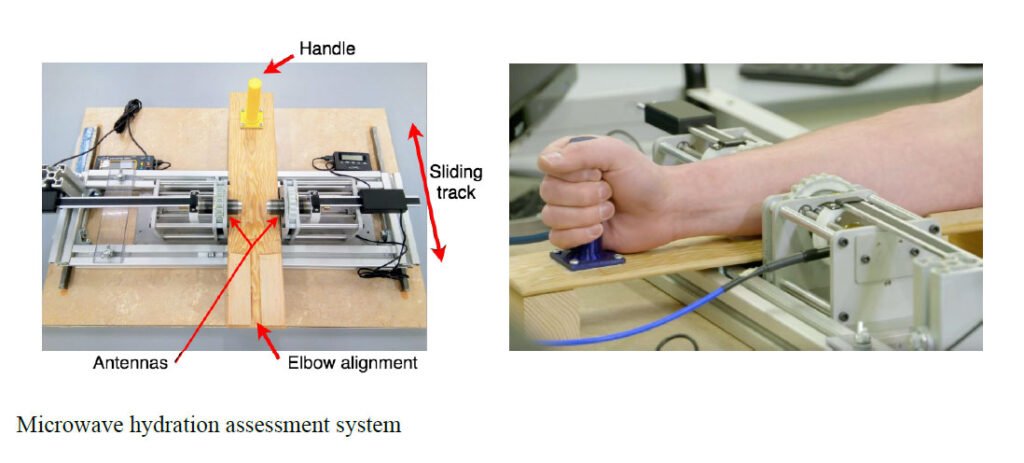
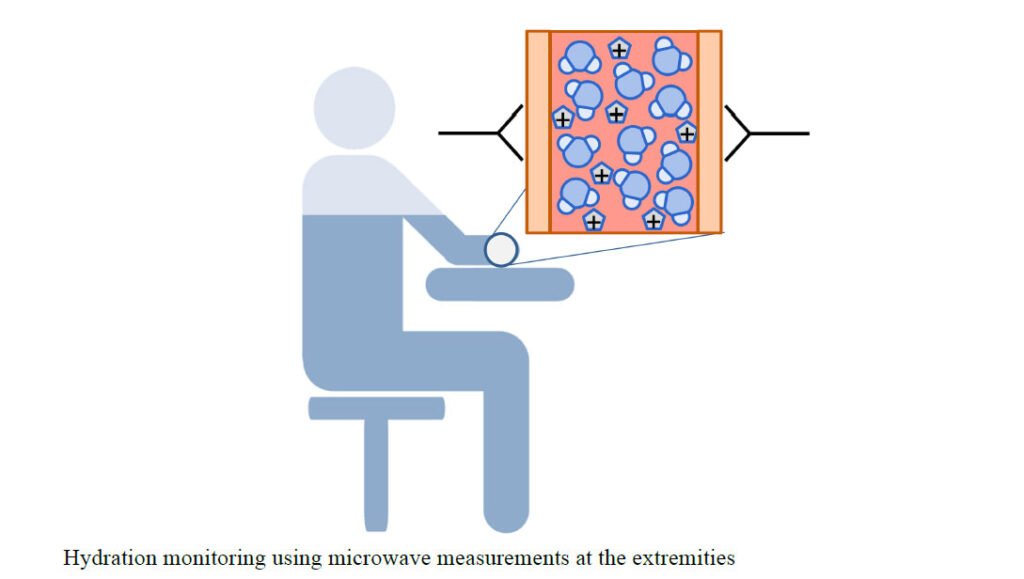
Extremity microwave measurement is a promising method for ongoing hydration monitoring, owing to the inherent differences in dielectric properties with varying tissue water content. This paper reports on a feasibility study of textit{in vivo} hydration assessment using microwave measurements in athletes undergoing acute water loss during exercise. We developed and then tested a system for performing reliable microwave property estimation at the forearm. This system was used to measure hydration status in varsity wrestlers before and after a training session. A relationship between estimated permittivity and body weight change due to water loss was found, showing promise for the use of microwaves to assess hydration status. No significant relationship with attenuation was found. A novel method of assessing changes in hydration status is described, which may be of practical use for athletes in guiding fluid replacement during and after exercise.
×
Take Out Message
Take-Home Messages
- Microwaves are inherently sensitive to water content, and may therefore provide a clinically-relevant method of noninvasive hydration monitoring.
- This study presents a validation study of microwave techniques for hydration assessment in athletes by performing measurements prior to and following acute water loss due to exercise.
- We find changes in estimated permittivity with water loss, but no relationship with measured attenuation.
- Athletes may find applications of this technique in guiding fluid replacement for maximal performance and safety during exercise and recovery.