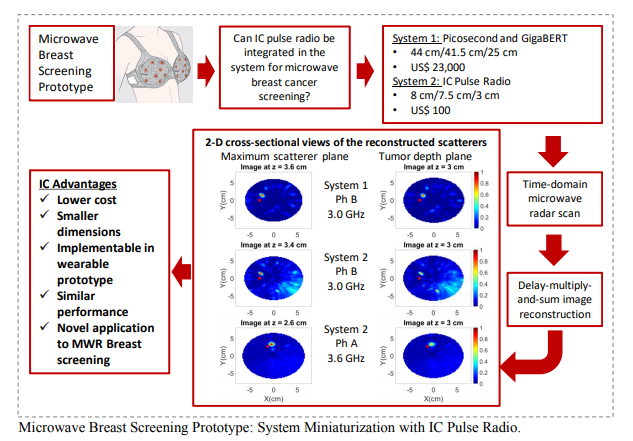
Microwave Breast Screening Prototype: System Miniaturization with IC Pulse Radio
Read Description
To assess the system’s suitability as a breast screening prototype, we compare measurements on two different experimental breast models (phantoms) with the established and previously reported prototype using off-the-shelf components and the here-introduced IC. We test both systems on a homogeneous fat-mimicking phantom with a 2-mm skin layer as well as a phantom with a 2-mm skin layer and glandular insertions, while the antennas, antenna housing, and sampling oscilloscope are the same for both systems. Additionally, we advance with the IC to higher frequencies, aiming to comply with the band intended for microwave imaging devices with medical applications. Furthermore, we compare the economic requirements of the IC and of the previously reported system by evaluating their cost and compactness. The objective of this study is to investigate if the IC pulse radio can replace bulky off-shelf components to allow us to implement the pulse generation circuitry in one flexible circuit board with the switching and antennas.
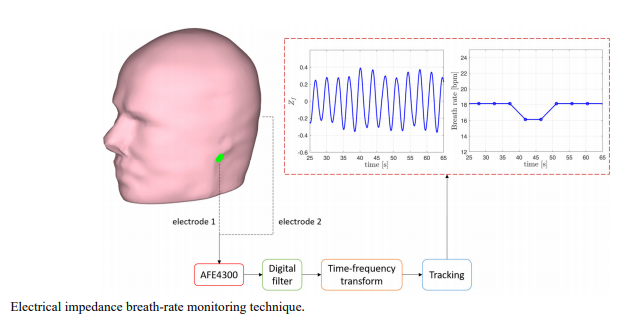
A Breath Monitoring Approach based on Electrical Impedance Measurements
Read Description
The feasibility of the adopted configuration has been assessed by means of electromagnetic simulations involving a simplified model. Moreover, an ad-hoc data processing algorithm has been developed for extracting the breath rate from the measured signals. Preliminary experimental results are provided for investigating the capabilities of the developed setup.
Noise-robust Microwave Breast Imaging Applied to Multi-frequency Contrast Source Inversion
Read Description
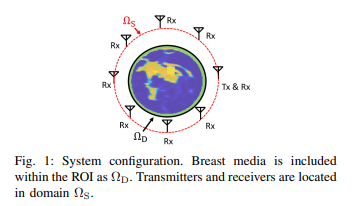
This is because additive noises severely contaminate scattered signals. In this study, we apply a post-processing multi-frequency integration scheme to contrast source inversion (CSI) data to suppress image fluctuations. These are caused by the additive noise expected in a UWB system, which is also applicable to other inversion schemes. To deal with the dispersive dielectric properties in the CSI scheme, we introduce a first-derivative model of the Debye dispersion model to compensate for the dispersive effect. The FDTD numerical validations, using realistic breast phantoms with dispersive properties, show that a multi-frequency integration scheme considerably upgrades noise-robustness in complex permittivity reconstruction tissues.
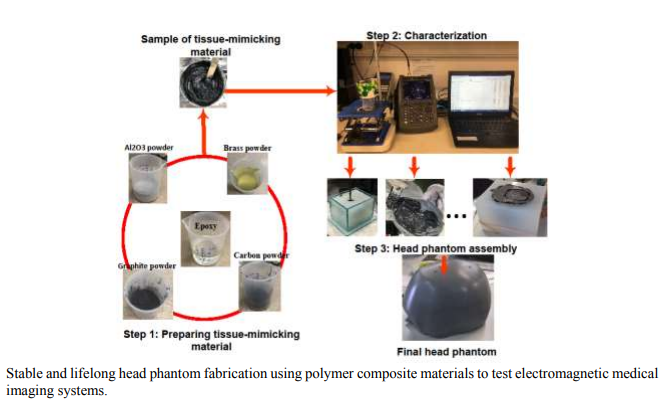
Stable and Lifelong Head Phantoms Using Polymer Composition Mimicking Materials to Test Electromagnetic Medical Imaging Systems
Read Description
In this study, a polymer composition that use to develop head tissues-mimicking materials that satisfy the aforementioned requirements. Polyepoxides (Epoxy), and assorted types of micro scale additive, including graphite, aluminium oxide, carbon black, and brass powders, are used to fabricate the phantom. Different mixing ratios are used to mimic four healthy head tissues; white matter, grey matter, skull, and skin. Blood-mimicking material is also included in the unhealthy phantom to represent stroke (hemorrhagic) at different locations and sizes. Also, water-based mimicking material is used to emulate cerebrospinal fluid (CSF) tissue. The measurements confirm close agreement to properties of actual head tissues across the frequency band 0.5- 5 GHz, which has been used in the ongoing research activities of electromagnetic head imaging systems. Stability over time is investigated and compared with the widely used gelatin-in water-based mimicking materials. The results show the superiority of the developed phantom compared to currently using gelatin-based phantoms.
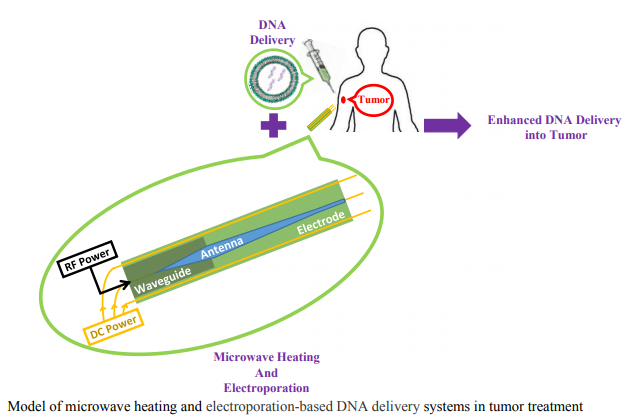
An X-Band Dielectric Rod Antenna for Subdermal Tumor Heating to Assist Electroporation-Mediated DNA Delivery
Read Description
This capability is demonstrated through a combination of a directional antenna applicator operating at 8 GHz, and utilization of forced air cooling of the outer surface (skin layer). The directionality of the antenna is improved by cladding its high permittivity core with 3D printed, low permittivity dielectric material. Experimental data using a pork skin-fat-muscle tissue show that the desired temperature elevation at the tumor location is obtained after 2.5 W RF illumination for 3 minutes, which is in good agreement with electro-thermal simulations. With the addition of realistic human body model parameters to the same simulation setup, the results indicate that tumors can be uniformly heated with 3 minutes of illumination at 2.5 W input power while keeping the surrounding healthy tissues at a safe temperature.
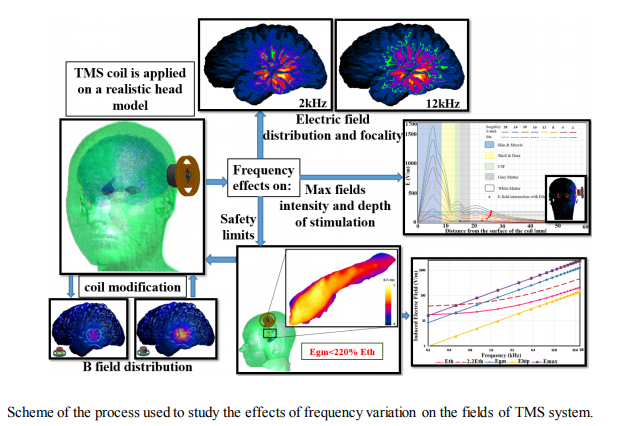
Effects of Frequency on the Induced Fields of Deep Transcranial Magnetic Stimulation Systems: A Numerical Case Study
Read Description
A modified magnetic resonance coupling (MMRC) coil is designed and utilised to stimulate a realistic human head model at frequencies from 1 to 30 kHz, with constant and variable excitation current scenarios, while considering the safety guidelines on the head phantom. It is found that the maximum value of the induced electric field increases with the increase of operating frequency, while the general pattern of that field distribution inside the head demonstrates similarity over the frequency. Both depth of stimulation and field’s focality demonstrate a noticeable change with frequency at frequencies below 12 kHz, while these attributes are almost saturated above this frequency band when using the MMRC coil. It is also noted that although increasing operating frequency can reduce the excitation current, the safety of the patient is prone to be jeopardized. Hence, to choose the optimum frequency range for the TMS coil, several factors including, safety limits, stimulation threshold, desired magnetic flux density, power consumption, and target depth need to be considered. This study provides a systematic approach to design deep TMS (dTMS) systems while making adequate tradeoffs for the frequency selection to stimulate the targeted depth without exceeding the safety limits, while using minimum possible power.