The microwave auditory effect
Read Description
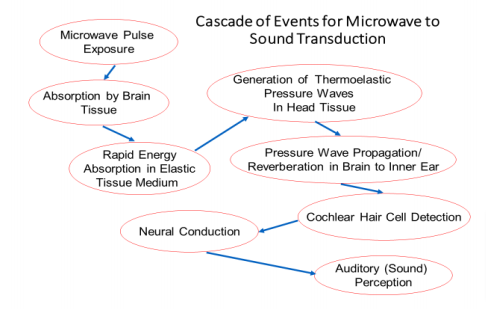
The hearing of microwave pulses involves electromagnetic waves. This paper reviews the research on humans and animals leading to scientific documentation the absorption of a single microwave pulse impinging on the head may be perceived as an acoustic zip, click, or knocking sound. A train of microwave pulses may be sensed as a buzz, chirp, or tune by humans. It describes neurophysiological, psychophysical, and behavioral observations from laboratory studies involving humans and animals. Mechanistic investigations show that the microwave pulse, upon absorption by tissues in the head, launches a pressure wave that travels by bone conduction to the inner ear, where it activates the cochlear receptors via the same process involved for normal sound hearing. Depending on the impinging microwave pulse power, the level of induced sound pressure could be considerably above the threshold of perception to cause tissue injury. The microwave auditory effects and pressure waves could potentially render damage to brain tissues to cause lethal or nonlethal injuries.
Efficacy of Lung-Tuned Monopole Antenna for Microwave Ablations: Analytical Solution and Validation in a Ventilator-Controlled exVivo Porcine Lung Model
Read Description
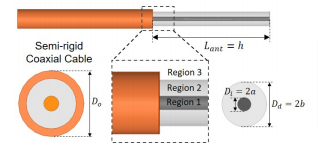
This lung-tuned antenna was then fabricated using a copper 0.085” semi-rigid copper coaxial cable. For validation, the lung-tuned antenna was inserted centrally into lobes of a ex vivo porcine lung that was fully inflated to physiologically appropriate volumes. Microwave ablations were then created at 50 and 100 W for 1 minute and 5 minutes. Reflected power, cross sectional ablation sizes and spherical shape of the lung-tuned antenna were compared against a liver-tuned antenna in the ventilatorcontrolled ex vivo lung tissue. The study showed that the lungtuned antennas delivered energy significantly more efficiently, with less reflected power, compared to the conventionally-used liver-tuned antennas at 50 W at 1 minute (11.8±3.0 vs 16.3±3.1 W; p value=0.03) and 5 minutes (16.2±2.8 vs 19.4±2.9 W; p value=0.04), although this was only true using 100 W at the 1 minute time point (29.0±3.5 vs 38.0±5.3 W; p value=0.02). While overall ablation zone sizes were comparable between the two types of antenna, the lung-tuned antenna did create a significantly more spherical ablation zone compared to the liver-tuned antenna at the 1 minute, 50 W setting (aspect ratio: 0.43±0.07 vs 0.38±0.04; p value=0.04). In both antenna groups, there was a significant rise in the ablation zone aspect ratio between 1 and 5 minutes, indicating that higher power and time settings can increase the spherical shape of ablation zones when using tuned antennas. Adapting this combined analytic and parametric approach to antenna design can be implemented in adaptive tissue-tuning for real-time microwave ablation optimization in lung tissue.
The Diagnostic Performance of Machine Learning in Breast Microwave Sensing on an Experimental Dataset
Read Description
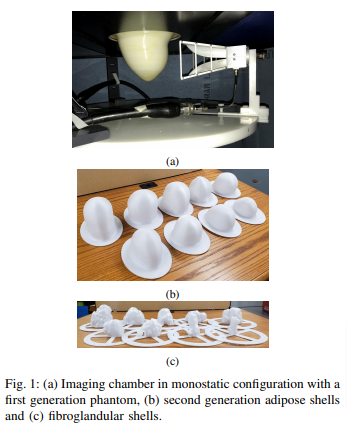
An experimental dataset containing data from 1257 scans was used. The CNN was compared to a similarly sized dense neural network (DNN) and logistic regression classifier. Results: The CNN was able to exploit the sinogram data structure to achieve diagnostic performance significantly better than random classification, while neither the DNN nor logistic regression classifiers could generalize to unseen test data. The area under the curve of the receiver operating characteristic curve of the CNN classifier was estimated to be between (78 3)% and (90 3)%, where the upper estimate was obtained when the testing set was constrained to consist of phantoms with breast volumes that are within the volume bounds of the training set and when the tumour was located at the same vertical position as the system antennas. Conclusion: The results obtained in this investigation demonstrate the potential of combining deep learning and BMS systems for breast cancer detection. Significance: This paper provides an estimate of the diagnostic performance of an air-based BMS system using deep learning methods for automatic tumour detection on a sizable experimental dataset. The performance was found to be comparable to that of AI-assisted mammography and marks a first step toward larger-scale investigations in BMS.
Comparison of time and frequency domain solvers for magnetic resonance coils at different field strengths using a single computational platform
Read Description
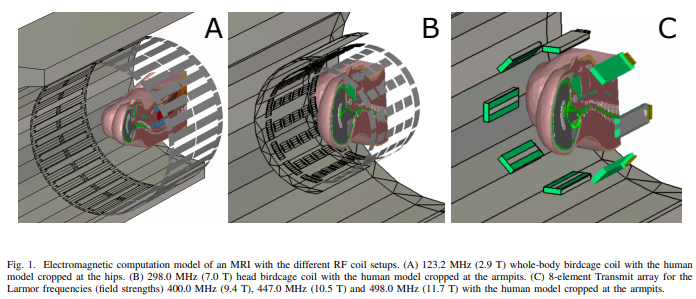
Currently, 3D electromagnetic simulations are mostly solved on variations of two solver types, namely the time domain and the frequency domain solver. In this work, we compared these solvers and tested key simulation parameters using a single computational platform with state-of-the-art computational methods and computational human models. Our analysis included computational cost, B1+-field and power loss density for a range of common radio frequency setups used at different Larmor frequencies (field strengths, respectively) in magnetic resonance imaging systems. We found that a coarse mesh in a time solver has large unpredictable focal errors (>50%) due to partial volume artifacts while the frequency solver showed more linearity in the errors when reducing computational cost which could allow for more efficient simulations with reduced safety concerns. We expect our work to provide further insights into parameter and solver selection and contribute towards standardization in coil simulation in magnetic resonance imaging.
A Microwave-Thermography Hybrid Technique for Breast Cancer Detection
Read Description
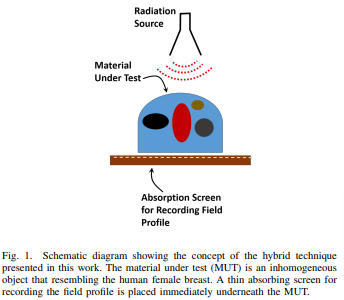
This variation in transmitted power results from the electrical property variance between healthy and cancerous tissues. Under microwave radiation, the power of the transmitted waves leads to a heat distribution pattern on a sensitive screen placed under the breast. This work utilizes the change in the heat pattern to indicate the presence of abnormality inside the breast. Involving a CNN elevates the proposed technique’s detection capability and extracts quantitative data that characterize the tumor’s location and size. The proposed modality shows a capability to detect and determine the size and location of an artificial tumor with a 5 mm radius and a 2:1 permittivity contrast with normal tissue.
The Effect of Contrasts in Electrical and Mechanical Properties between Breast Tissues on Harmonic Motion Microwave Doppler Imaging Signal
Read Description
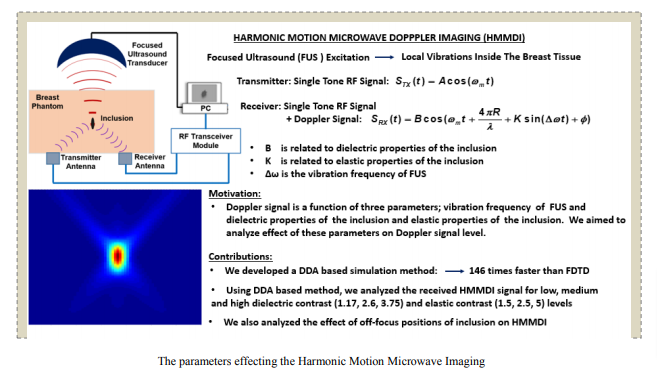
To solve the forward problem of HMMDI, we developed a Discrete Dipole Approximation (DDA) based simulation method, and analyzed the received HMMDI signal for low to medium dielectric contrast (1:1.17, 1:2.6, 1:3.5) and elastic contrast (1:1.5, 1:2.5, 1:5) levels. DDA solver decreased the simulation time by a factor of 146 compared to the Finite Difference Time Domain method and facilitated the extensive number of simulations required for the analysis. The results of this study provide useful information for the development of the HMMDI method as a tool for breast cancer detection in dense tissues.