Modeling and simulation of needle electrical impedance myography in nonhomogeneous isotropic skeletal muscle
Read Description
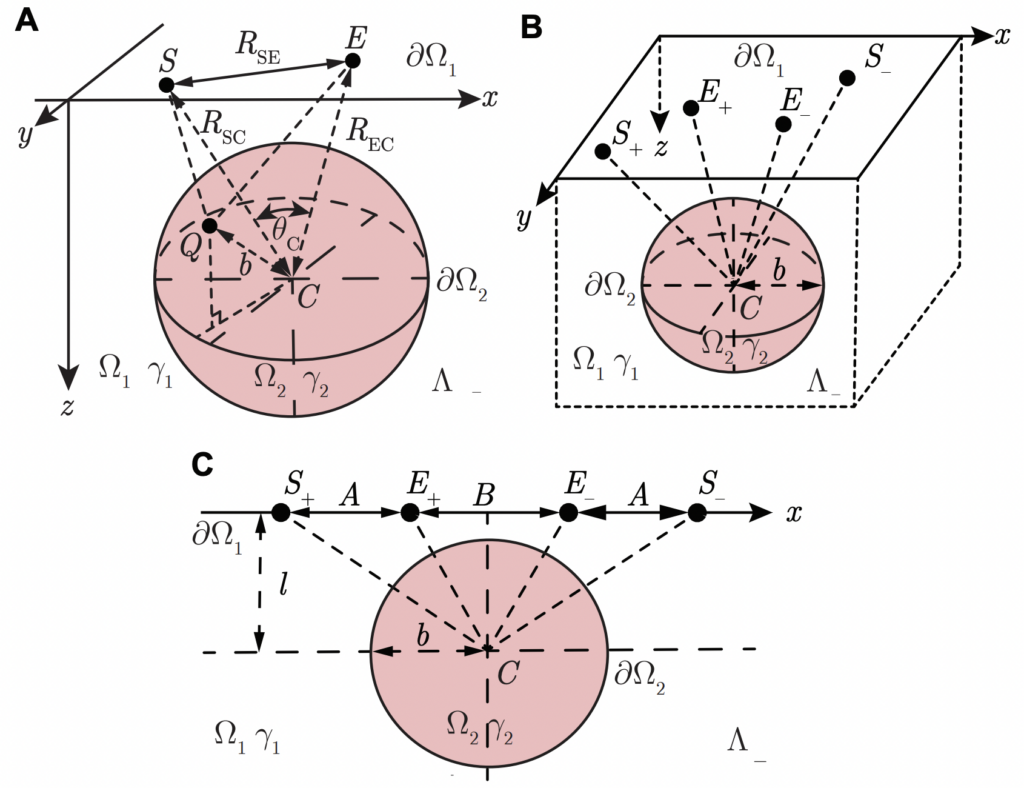
Methods: The framework presented models needle EIM measurements in a bidomain isotropic model. Finite element method (FEM) simulations verify the validity of our model predictions studying two cases: a spherical volume surrounded by tissue and a two-layered tissue. Results: Our models show that EIM is influenced by the vicinity of tissue with different electrical properties. The apparent resistance, reactance and phase relative errors between our theoretical predictions and FEM simulations in the spherical volume case study are 0.2%, 1.2% and 1.0%, respectively. For the two-layered tissue model case study, the relative errors are 2%. Conclusions: We propose a bio-physics driven analytical framework describing needle EIM measurements in a nonhomogeneous bidomain tissue model. Clinical impact: Our theoretical predictions may lead to new ways for interpreting needle EIM data in neuromuscular diseases that cause compositional changes in muscle content, e.g. connective tissue deposition within the muscle. These changes will manifest themselves by changing the electric properties of the conductor media and will impact impedance values.
Electrical Impedance Myography for Evaluating Muscle Fatigue Induced by Neuromuscular Electrical Stimulation
Read Description
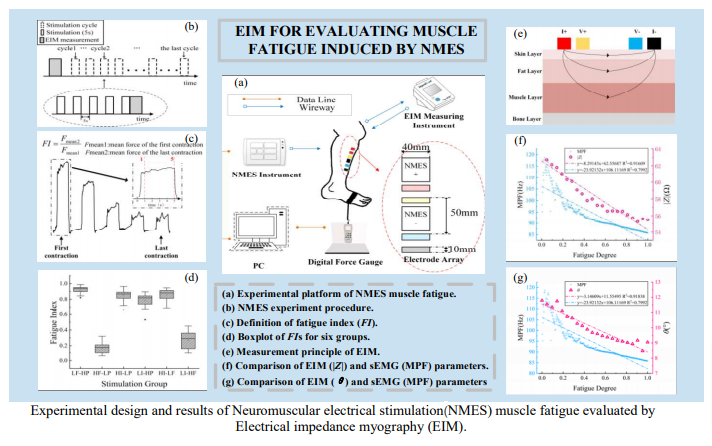
The experiments were performed on the anterior tibialis muscle on several voluunteers. Two EIM parameters : impedance amplitude (|Z|) and phase (), were measured in real time, while applying six NMES parameter combinations. The mean power frequency (MPF) of the surface electromyography (sEMG) was selected for verification of the proposed method. Results: |Z| and of EIM signals decreased significantly after NMES (p < 0.05). They also both showed a linear downward trend during NMES, which was also observed in MPF of sEMG signals. At the measurement frequency of 20 kHz, steady-state fatigue was achieved when |Z| decreased to approximately 14% of the initial value. Clinical or Biological Impact: This study provides a method for monitoring muscle fatigue induced by NMES, which is beneficial to the application of NMES.
Experimental Evaluation of an Axillary Microwave Imaging System to Aid Breast Cancer Staging
Read Description
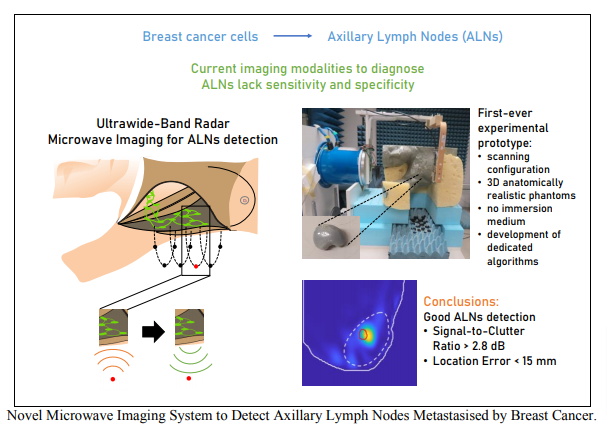
Common ALN screening modalities lack high enough sensitivity and specificity. Level I ALNs produce detectable backscattering of microwaves, opening the way for Microwave Imaging (MWI) as a complementary screening modality. Radar-based MWI is a low-cost, non-invasive technique, widely studied for breast cancer and brain stroke detection. However, new specific challenges arise for ALN detection, which deter a simple extension of existing MWI methods. We present a complete study that proposes dedicated imaging algorithms to detect ALNs, and evaluate their effectiveness experimentally. We describe the developed setup based on a 3D-printed anthropomorphic phantom, and the antenna-positioning configuration. To the authors’ knowledge, this is the first ALN-MWI study involving a fully functional anatomically compliant setup. A Vivaldi antenna, operating in a monostatic radar mode at 2-5 GHz, scans the axillary region. Pre-clinical assessment in different representative scenarios shows Signal-to-Clutter Ratio higher than 2.8 dB and Location Error lower than 15 mm, which is smaller than considered ALN dimensions. Our study shows promising level I ALN detection results despite the new challenges, confirming MWI potential to aid breast cancer staging.
Microwave Imaging of the Breast: Consistency of Measurements over Time
Read Description
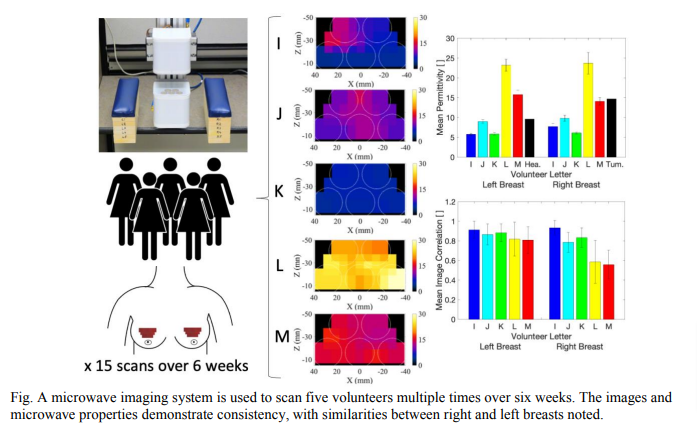
In this paper, we analyze the consistency of microwave imaging when scanning frequently over several weeks, similar to the treatment monitoring timeframe. A custom microwave transmission system was used to acquire 15 scans from a breast phantom and 14-15 scans from each of 5 volunteers. As expected, the breast phantom showed high similarity when comparing signals, property estimates, and images at different time points. Scans of each volunteer also generally demonstrated consistency over time, as well as between right and left breasts. The characterization of consistency from scanning healthy women provides a baseline from which significant changes due to disease or treatment can be identified.
2-D Noninvasive Temperature Measurement of Biological Samples based on Compressive Thermoacoustic Tomography
Read Description
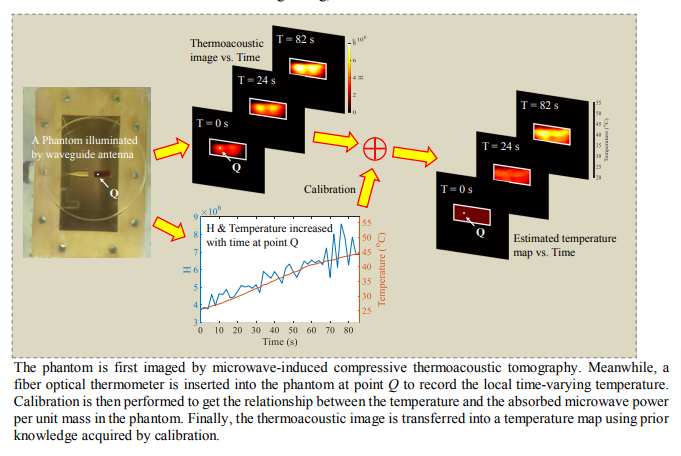
Microwave-induced thermoacoustic tomography (MITAT) has found diversified applications in biomedical related disciplines. It has been shown that MITAT can be used to estimate the temperature in a noninvasive manner. However, the applicability of the technique is still limited. This work presents experimental demonstration of two-dimensional (2-D) temperature detection of biological samples based on compressive TAT, referred to as MICTAT. Detailed principle of the method is established. A phantom sample and a biological sample are tested by experiments and 2-D temperature maps are obtained. This work provides a new route of getting 2-D temperature maps of biological samples and may find many applications in biomedical related areas.
Multiple Back Projection with Impact Factor Algorithm based on Circular Scanning for Microwave-Induced Thermoacoustic Tomography
Read Description
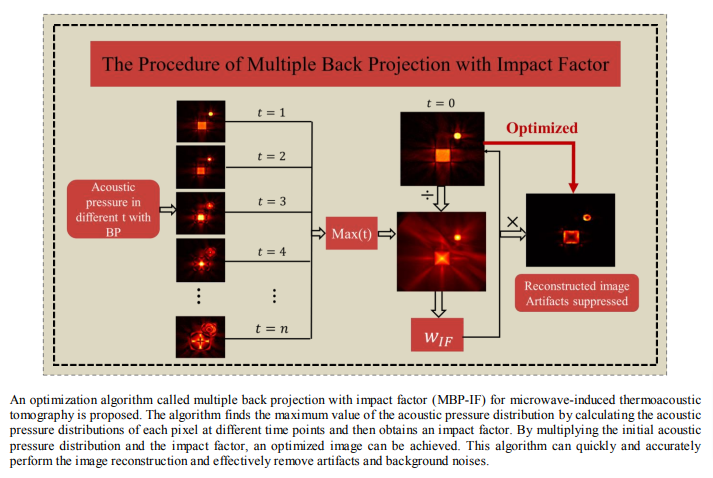
However, high artifacts and background noises which can be caused by incomplete sampling of TA signals seriously affect the image quality. Method: In this paper, a multiple back-projection with impact factor (MBP-IF) algorithm based on circular scanning is proposed to solve this problem. Compared with the BP algorithm, the MBP-IF method calculates not only the initial acoustic pressure of the TA signal of each pixel, but also the complete acoustic pressure distribution at different moments of the thermoacoustic wave transmission, which based on the derivation of time. Then the influencing factors can be obtained which can effectively suppress artifacts and eliminate noises. Results: Through numerical simulation and phantom experiments, the MBP-IF algorithm has excellent advantages in suppressing image artifacts and noises. The method of image quantification is also used to verify this conclusion. Clinical or Biological Impact: In addition, due to the independence of acoustic pressure distribution at different time, the MBP-IF can be computing in parallel with GPU, which can be widely used in real-time medical clinical MITAT system construction.