Microwave Imaging for the Diagnosis of Cervical Diseases: A Feasibility Analysis
Read Description
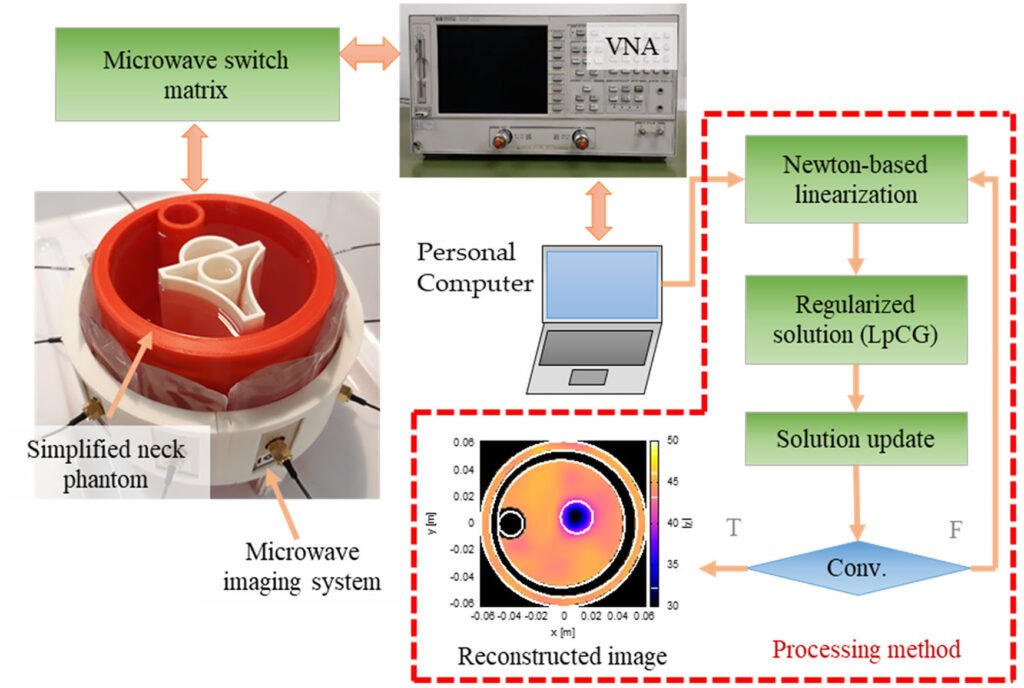
A preliminary feasibility analysis oriented toward the development of an imaging system is reported. The system prototype includes a set of antennas that illuminate the neck and retrieve samples of the scattered electric field. The related inverse scattering problem is solved by using a nonlinear Newton-type reconstruction procedure, which provides two-dimensional images of the dielectric parameters of a neck cross section. A simplified cylindrical phantom mimicking the human neck has been designed for assessing the feasibility of the envisioned microwave measurement system and processing technique. Numerical results are reported to evaluate the capabilities of the proposed approach. Moreover, initial experimental results have been obtained by using cylindrical containers and a 3D printed version of the developed neck phantom.
Human RF-EMF Exposure Assessment Due to Access Point in Incoming 5G Indoor Scenario
Read Description
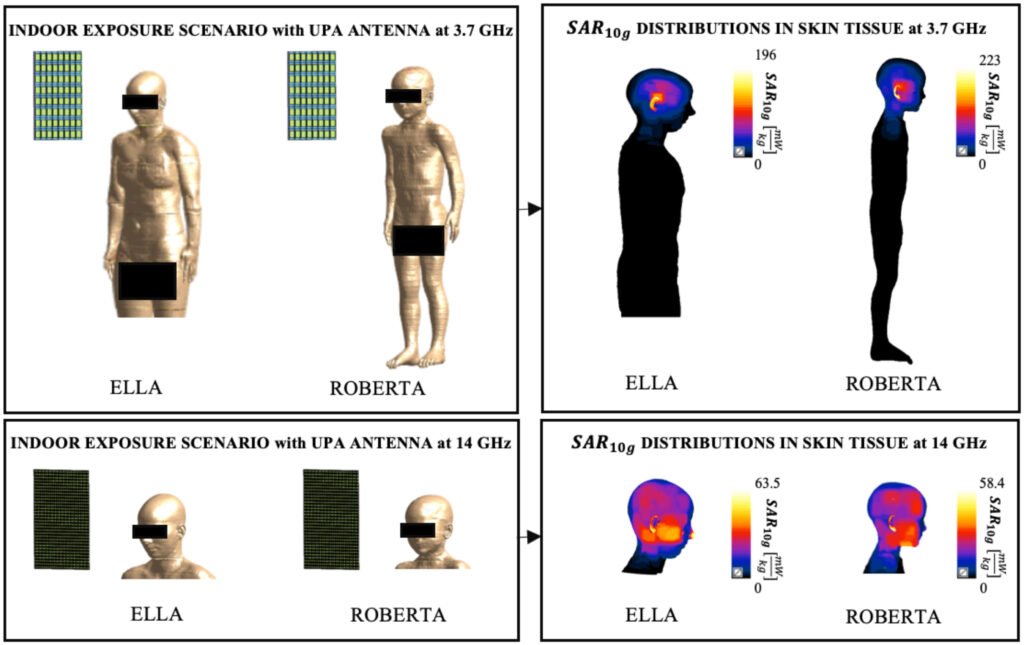
The AP was modelled by two different indoor uniform planar array (UPA) antennas at 3.7 GHz and at 14 GHz, to evaluate how the beamforming and the higher frequency use could impact the exposure levels. Different scenarios were evaluated, considering the maximum antenna gain, two different human computational models, an adult model and a child one, and by varying the distance and the orientation between the UPA antenna and the two models head. All the simulations were conducted using the Sim4Life platform and in particular the exposure levels were expressed by the specific absorption rate averaged on 10 g of tissue (SAR10g), which was analyzed for the skin and for some specific tissues. The work underlined that the highest SAR10gvalues were obtained in the head area for all scenarios, with the skin SAR10ghighest peaks when the UPA is placed laterally to the human model (195.73 mW/kg and 223.29 mW/kg for the adult and child model, respectively, for 100 mW input power). Furthermore, the work permitted to highlight that the SAR10gexposure levels are slightly higher for the child model, compared to the adult one and that the distance between the UPA antenna and the human models could greatly lower the SAR10glevels. At last, it was found that the SAR10gexposure levels obtained with the UPA antenna at 14 GHz were lower than the ones at 3.7 GHz, although further investigations will be necessary.
Impact of Textile on Electromagnetic Power and Heating in Near-Surface Tissues at 26 GHz and 60 GHz
Read Description
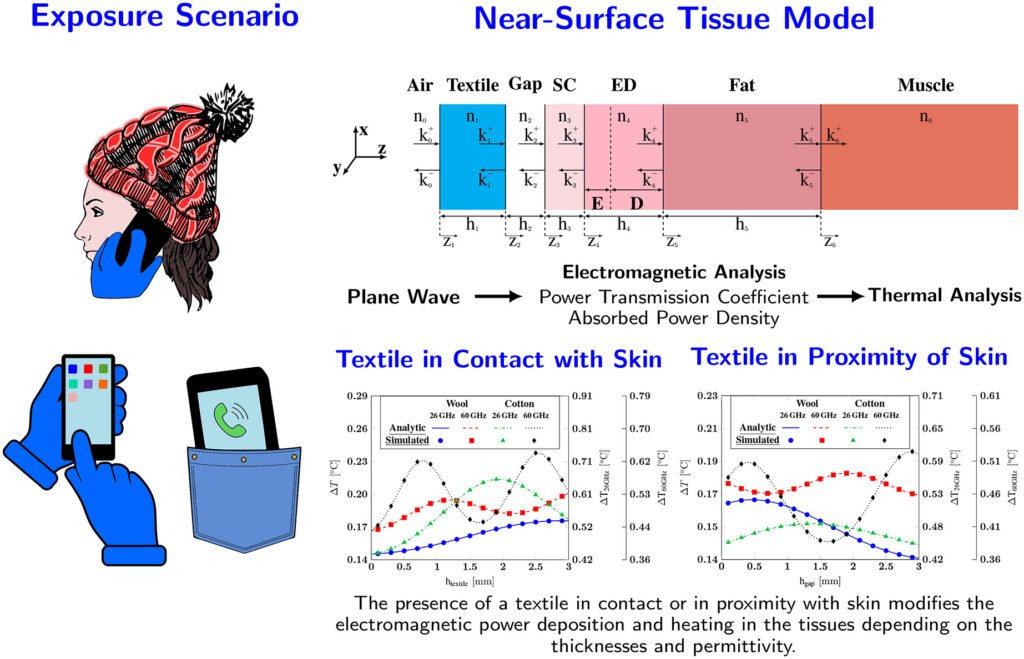
We investigate the impact of a textile layer in contact or in proximity of skin on the power transmission coefficient, absorbed power density and temperature rise using a near-surface tissue model at 26 GHz and 60 GHz. Cotton and wool are considered as representative textiles. Our results demonstrate that the textile in contact with skin increases the absorbed power density up to 41.5% at 26 GHz and 34.4% at 60 GHz. The presence of an air gap between a textile and skin modifies the electromagnetic power deposition in the tissues depending on the thicknesses and permittivity. The temperature rise increases compared to the bare skin by up to 52% at 26 GHz and 46% at 60 GHz with the textile in direct contact with skin. With an air gap, for typical textile thicknesses, the temperature variations range from -3.5% to 20.6% and from -11.1% to 20.9% at 26 GHz and 60 GHz, respectively.
Dielectric Characterization of Ex Vivo Ovine and Human Adrenal Glands for Microwave Thermal Ablation Applications
Read Description
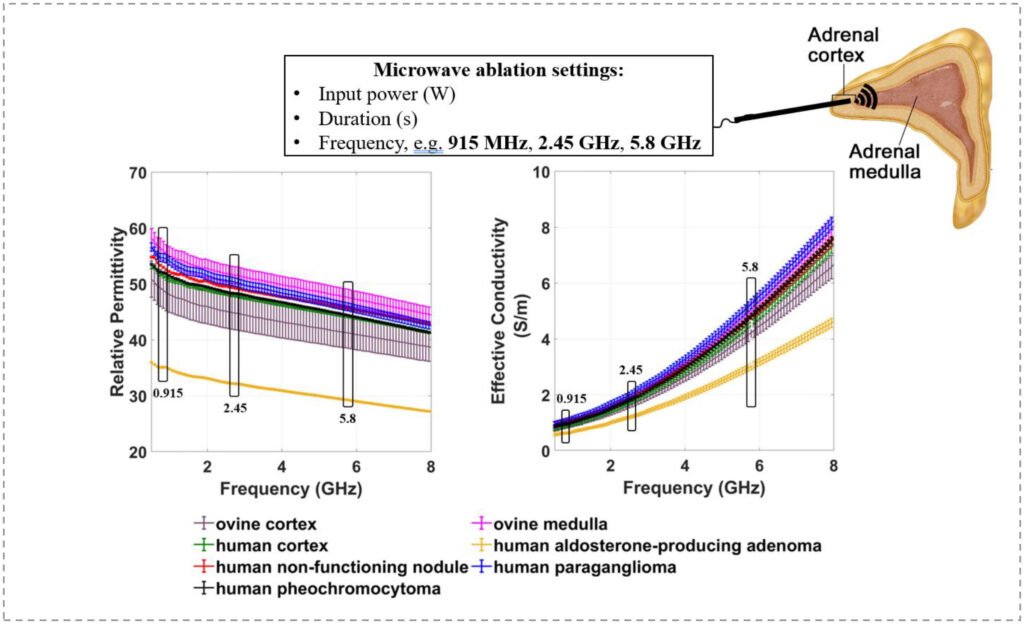
In order to develop and optimize this novel electromagnetic-based therapy, an accurate knowledge of the dielectric properties of human adrenal glands, as well as preclinical animal models, is crucial. In particular, ovine models represent a feasible animal model to test the safety and performances of MWA. In this study, the dielectric properties of ovine adrenal glands and of normal and diseased human adrenal glands are characterized ex vivo in the microwave frequency range. The dielectric properties of the two functional tissues (cortex and medulla) composing ovine adrenal glands are measured using the open-ended coaxial probe technique and represented with a two pole Cole-Cole model in the frequency range from 0.5 GHz to 8 GHz. This paper presents the first dielectric data of normal and diseased human adrenal tissues, including a functioning adenoma responsible for PA and it compares the human data with data from the animal model.
Assessing a Microwave Imaging System for Brain Stroke Monitoring via High Fidelity Numerical Modelling
Read Description
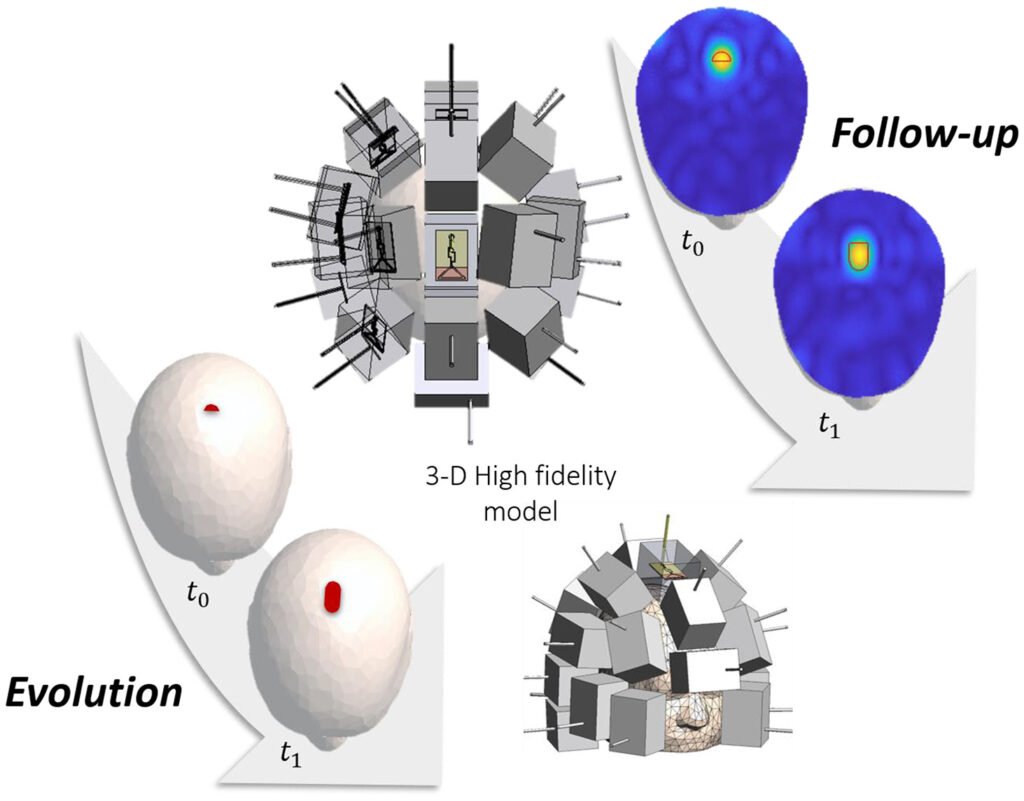
The system consists of an array of twenty-four printed monopole antennas, placed conformal to the upper part of the head; each monopole is immersed into a semi-solid dielectric brick with custom permittivity, acting as coupling medium. The whole system, including the antennas and their feeding mechanism, has been numerically modeled via a custom full-wave software based on the finite element method. The numerical model generates reliable electromagnetic operators and accurate antenna scattering parameters, which provide the input data for the implemented imaging algorithm. In particular, the numerical analysis assesses the capability of the device of reliably monitoring the evolution of hemorrhages and ischemias, considering the progression from a healthy state to an early-stage stroke.
On the Design of a Microwave Imaging System to Monitor Thermal Ablation of Liver Tumors
Read Description
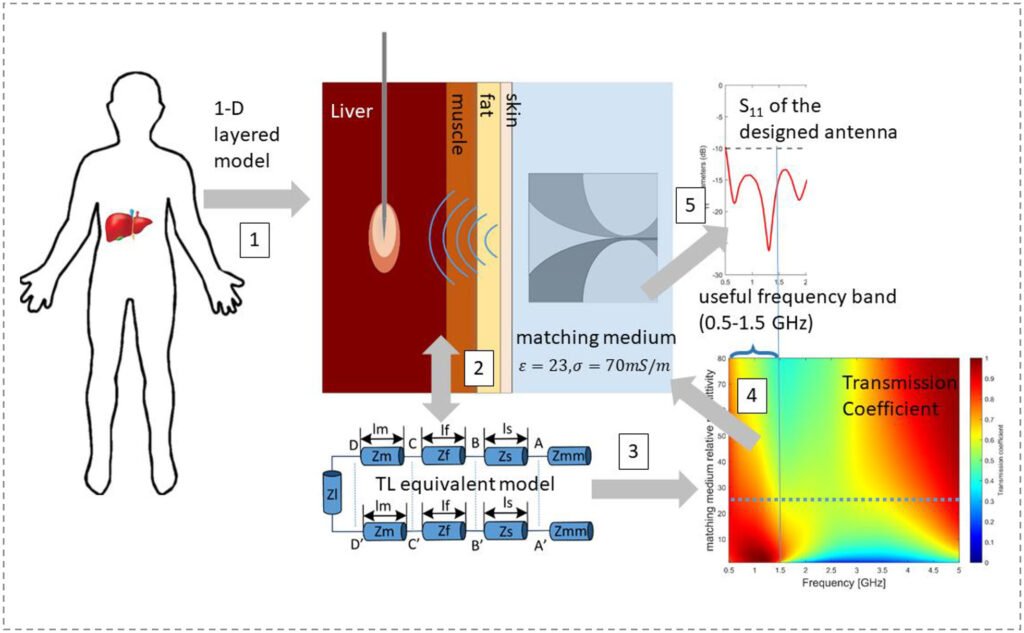
In this respect, microwave imaging has been proposed as a possible candidate, owing to its portability, low-cost, non-ionizing nature, and capability to detect changes in dielectric properties of tissues induced by the temperature. The goal of this paper is to provide the guidelines for the design of a microwave imaging system for thermal ablation monitoring of liver tumors. To this end, an analytical study is performed to determine the proper working conditions, in terms of frequency band and matching medium. Then, three antipodal Vivaldi antennas on different dielectric substrates are designed and numerically assessed. Among those antennas, the Vivaldi antenna on RT/duroid 6010LM substrate proved to be the most suitable choice. The results of this study pave the way to an experimental assessment of microwave imaging as a modality to monitor thermal ablation treatments.