Response Sharpening of Resonant Sensors for Potential Applications in Blood Glucose Monitoring
Read Description
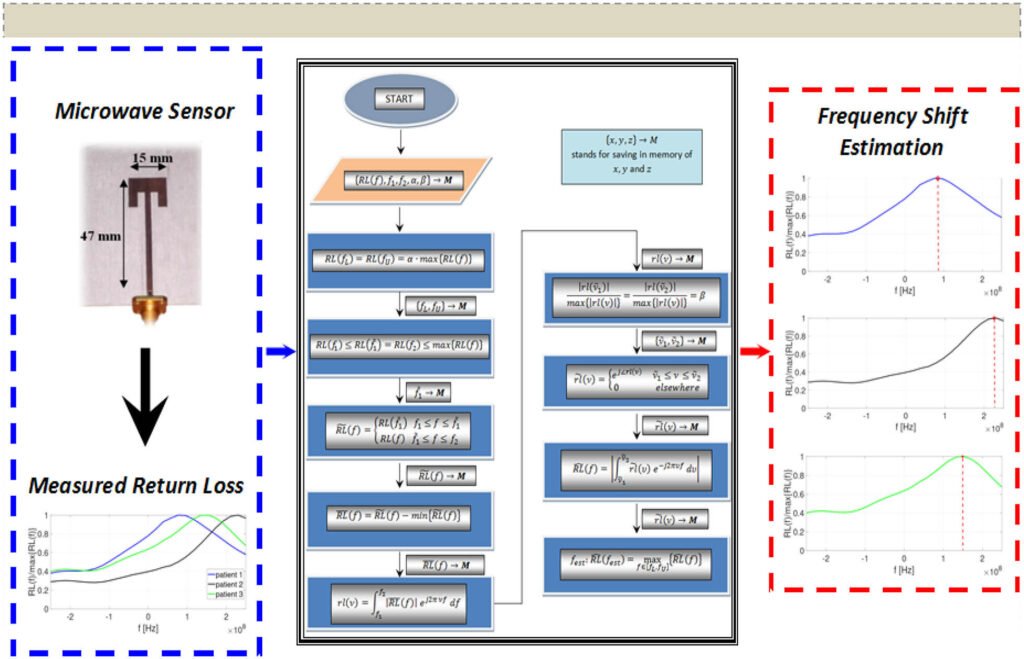
Moreover, since the sensor response is collected over a discrete set of frequencies, the actual resonance peak may not be properly captured. To overcome these drawbacks, an algorithm is presented in this paper which aims at sharpening the microwave sensors response, and mitigating the mentioned frequency discretization problem so to eventually estimate the resonance frequency more accurately. The algorithm is first explained and checked against synthetic data mimicking the response of a resonant sensor. Then, as a further validation, measured data collected by a microwave resonant sensor, properly designed for blood glucose monitoring, just located in contact to human fingers are considered.
Use of a Set of Wearable Dielectric Scatterers to Improve Electromagnetic Transmission for a Body Power Transfer System
Read Description
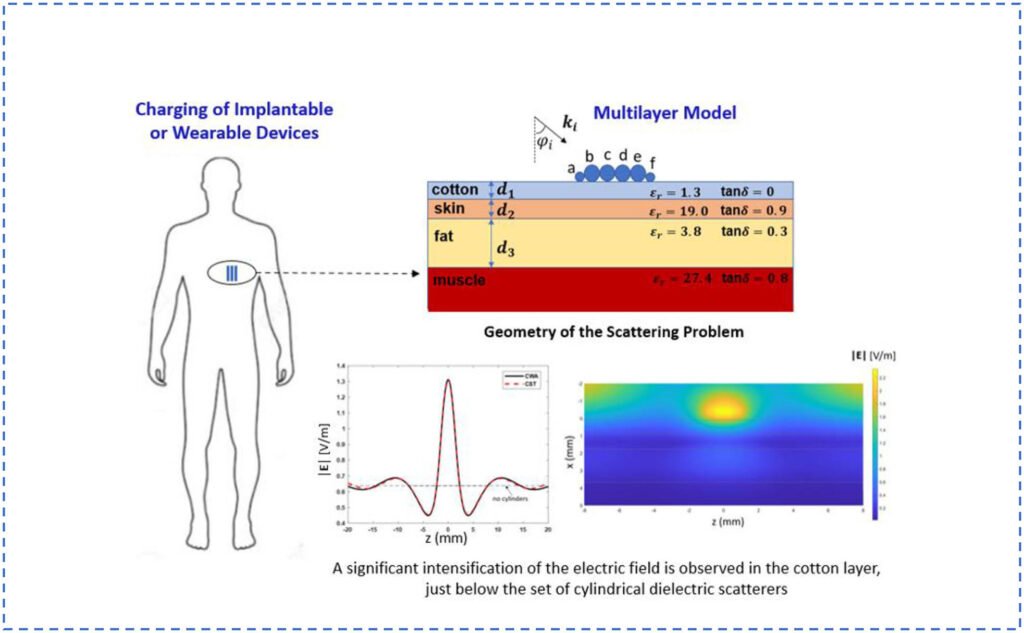
The multilayer models a biological tissue consisting of skin, fat and muscle covered by a cotton textile. Several numerical examples are presented considering the electrical parameters of the biological and textile tissues at the millimeter frequency range (24 GHz). The results show that it is possible to obtain an intensification of the electric field in the underlying tissues in case of TM polarization of the incident wave, finding an interesting application for the charging of implantable or wearable devices.
Ultra-Wideband Impedance Spectroscopy of the Nucleus in a Live Cell
Read Description
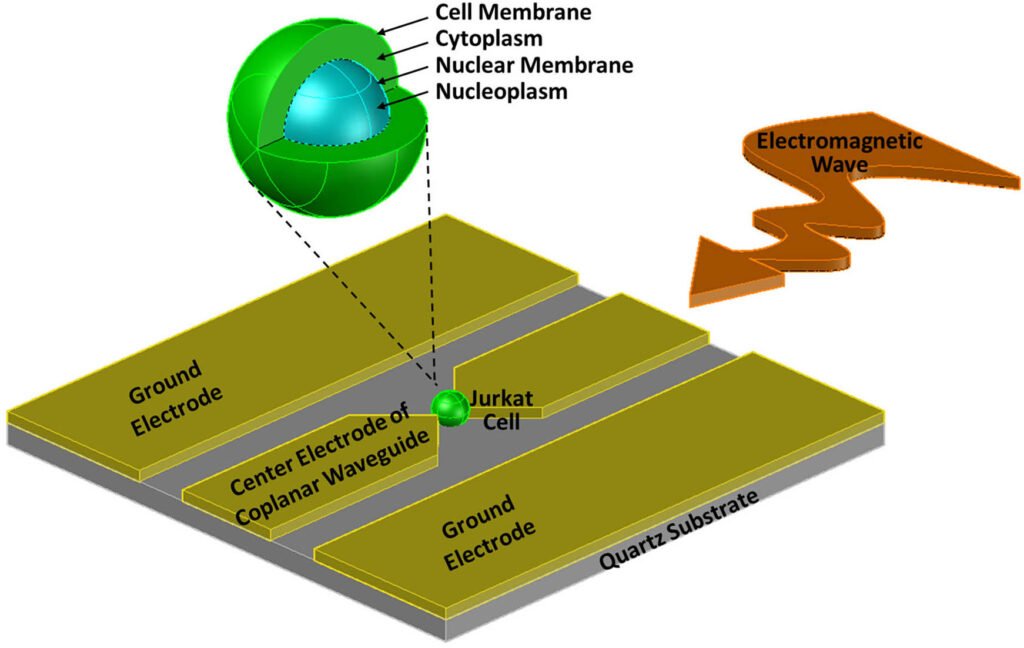
The model parameters include the nucleus-to-cell radius ratio (r) and a parallel R-C circuit for each of the four cell compartments: the cell membrane (CM), the cytoplasm (CP), the nuclear membrane (NM), and the nucleoplasm (NP). In general, the extracted radius ratio agrees with that measured by optical microscopy, and the extracted resistances and capacitances agree with the literature and order-of-magnitude estimates. For example, for a human lymphocytes cell with r ≈ 0.8, the nuclear contribution is approximately linear. Therefore, the membrane parameters are constant so that RCM = 1.5 MΩ, CCM = 1.5 pF, RNM = 0.05 MΩ, and CNM = 1.2 pF, but the plasma parameters are linearly scaled so that RCP → 0.5(1 − r) MΩ, CCP → 6.7/(1 − r) fF, RNP → 0.12r MΩ, and CNP → 9.4/r fF. Because morphological and structural changes of a cell nucleus are important screening, diagnostic, and prognostic markers, these results suggest that ultra-wideband impedance spectroscopy may be a fast, compact, and label-free technique in cancer cytology.
Narrowband Microwave Breast Screening: Repeatability Study With Phantoms
Read Description
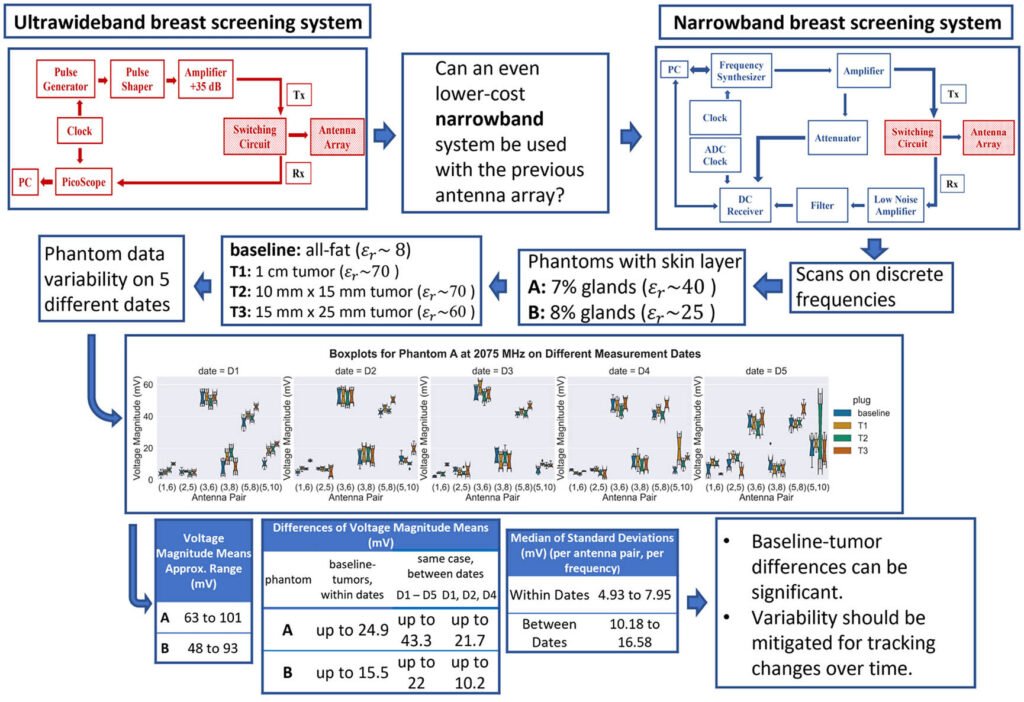
This motivates the research of phantom measurement repeatability. Our narrowband system is described and results are presented for five measurement dates using two phantoms with skin layers and similar low percentages of glands, along with interchangeable plugs for all-fat and three tumor cases. Preliminary clutter rejection uses average trace subtraction on antenna pairs with same distance in-between. Significant signal distinction is noted between baseline and tumors on specific antenna pairs and some distinction is found on central tendencies over all signals. This is promising as the presence of skin and glands can heavily attenuate microwave signals. High variability is found on distinct measurement dates, increasing the standard deviation across all dates considerably. The measurement noise includes comparatively high and easier to remove systematic offsets as well as other confounders that occasionally increase standard deviation, which may mask signal features. This highlights the need to research further techniques to mitigate this variability between measurements in order to increase reliability of microwave breast screening devices and, even more generally, other biomedical devices based on similar principles.
Improved Sensing Volume Estimates for Coaxial Probes to Measure the Dielectric Properties of Inhomogeneous Tissues
Read Description
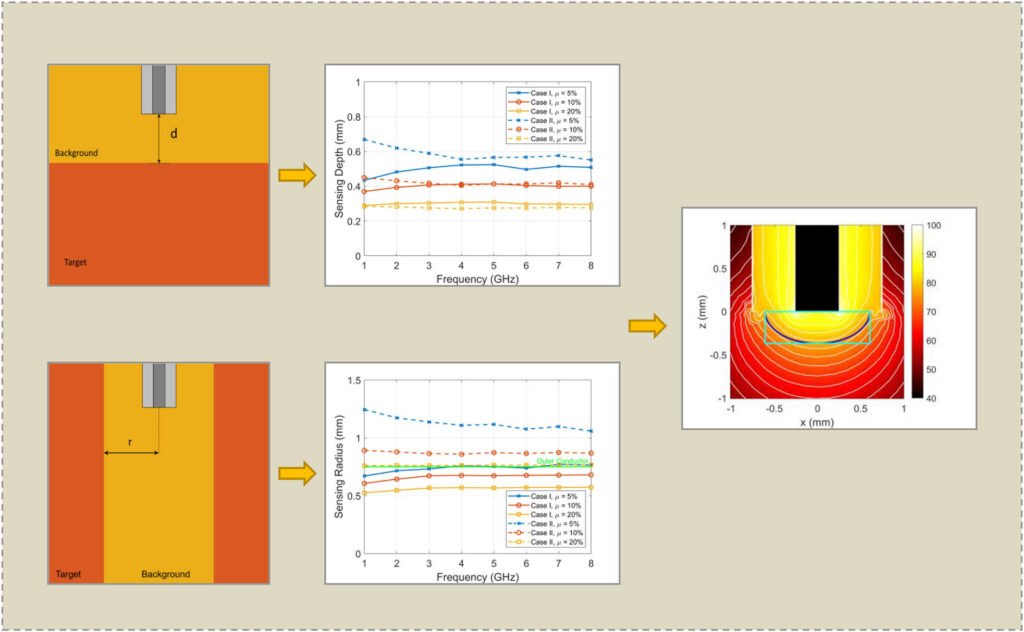
Since the open-ended coaxial probe technique provides an average complex permittivity for the tissues within its sensing volume, when measuring heterogeneous tissues, a post-measurement histological analysis is often conducted to accurately associate the measured dielectric properties to the tissue content. Subsequently, it is crucial to quantify the sensing volume of the probe accurately. Sensing volume is generally defined as a cylindrical volume (rectangular cross-section) based on sensing depth and sensing radius. In this article, the sensing volume is modified based on the field distribution of the probe. Since in practice defining the sensing depth and sensing radius for a given probe is straightforward, the resulting sensing volume is defined as an ellipsoid based on sensing depth and sensing radius values. Considering a finite heterogeneity in a homogeneous background, it is shown that the ellipsoidal sensing volume is a more accurate representation than the typical cylindrical volume for open-ended coaxial probes, and therefore, results in a more accurate dielectric characterization of heterogeneous tissues.
Respiratory Activity Monitoring by a Wearable 5.8 GHz SILO With Energy Harvesting Capabilities
Read Description
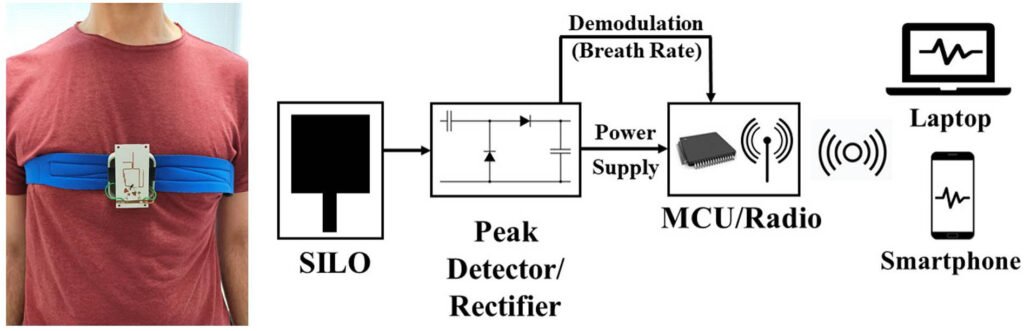
If compared with existing solutions, this device is of reduced dimensions and fully wearable; in fact, it can be worn by the user at a certain distance from the body at the chest position, and work without the need of any dedicated remotely synchronized anchor nodes nor bulky analyzers to be carried close by. As a more distinctive peculiarity, the receiving circuit is designed as an RF-to-DC rectifier in order to also enable the possibility to harvest energy that can be exploited, for instance, to feed a microcontroller unit and a transceiver with the aim of sending wirelessly the breath rate data to a laptop or a smartphone. Circuit simulations are corroborated by measurements in order to ensure the feasibility of the proposed solution.