Remote Vital Sign Monitoring With Reduced Random Body Swaying Motion Using Heartbeat Template and Wavelet Transform Based on Constellation Diagrams
Read Description
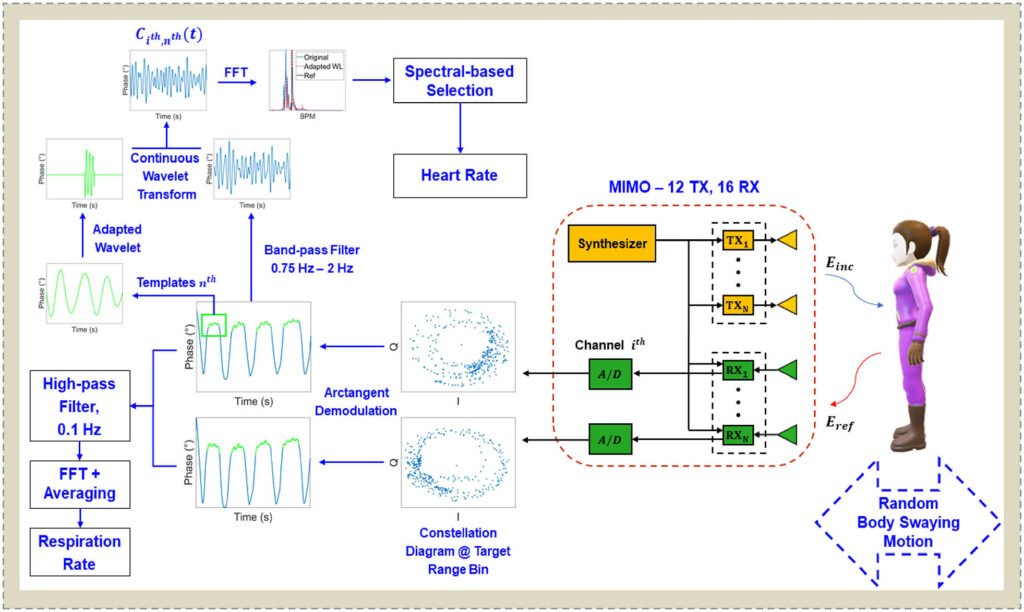
To overcome this challenge, multi-input multi-output (MIMO) configuration can be used to reduce RBM’s impact as each channel has different points of view with respect to the subject under test (SUT). Here we propose the use of a Frequency Modulated Continuous Wave (FMCW) radar from Texas Instruments (TI) at 77 GHz to collect data from its 192-channel configuration. Since vital sign information extracted using Arctangent Demodulation (AD) could be corrupted by either RBM or respiratory harmonics, a method is needed to minimize such effects. Hence, we develop an algorithm where a Heartbeat Template (HBT) is extruded based on the Constellation Diagram that shows the Quadrature signals from the target’s range profile. The HBT is then used to design an adapted-wavelet for Continuous Wavelet Transform (CWT) to magnify the heartbeat signals. Under circumstances where RBM overwhelms the heartbeat signal that the HBT cannot completely reduce its effects, a spectral-based HR selection method is also developed to estimate the HR. By employing the proposed methods, we have reduced mean-error ${mu _e}$ of HR estimation significantly from 9 bpm to less than 2 bpm.
Experimental Evidence of Radio Frequency Radiation From Staphylococcus aureus Biofilms
Read Description
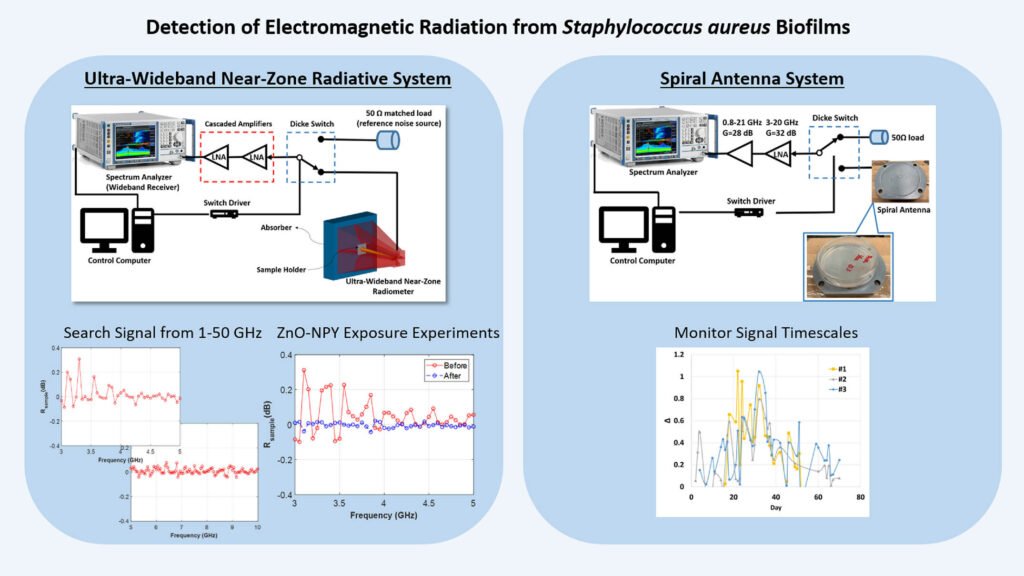
A very sensitive wideband near-zone radiative system specifically designed for this application is first used to search for signals in the 1–50 GHz frequency region. Notable radiation is observed in the 3–4 GHz band. Exposure to lethal doses of Zinc oxide nanopyramids (ZnO-NPY) is used to verify that the signals are indeed produced by living cells rather than material thermal emission. Afterwards, a spiral antenna system is exploited to further examine the band of interest in the near-field region. Radiation from 3 identical biofilm samples is monitored and recorded over 70 days. Two distinct frequency bands, namely the 3.18 GHz and the 3.45 GHz bands, are identified as potential “communication bands”. Furthermore, long-term and short-term cycles of the total radiation intensity within the band are observed over the course of the experiment. This work confirms the presence of EM radiation within bacterial communities, which is a key requirement to demonstrate EM signaling among bacterial cells. The insight could lead to breakthroughs in demystifying how cells communicate as well as advancement of important technologies in biology and communication systems.
Exposure Levels Induced in Curved Body Parts at mmWaves
Read Description
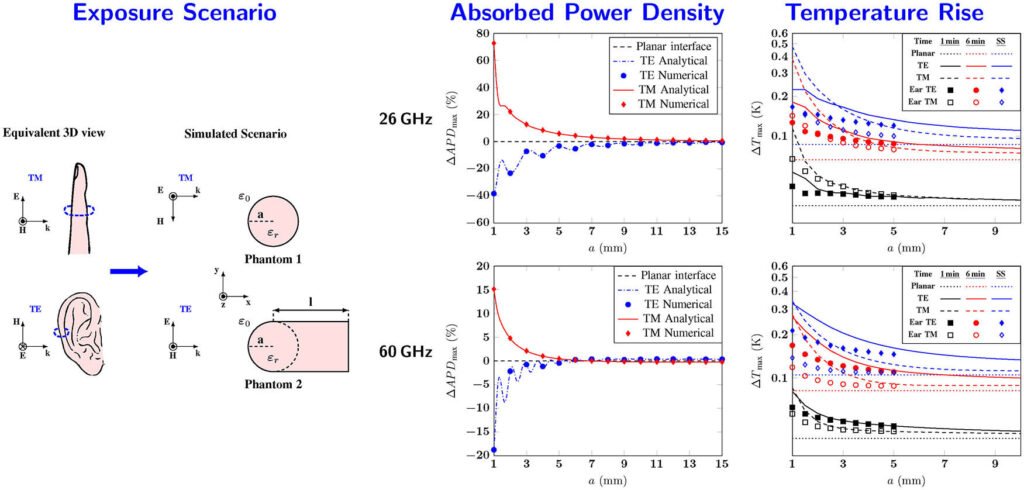
A cylindrical model is used to calculate EM power density and heat in fingers (radii $boldsymbol{aleq }10 ,mathrm{mm}$) and EM power density in ears ($1 ,mathrm{mm}boldsymbol{leq aleq }5 ,mathrm{mm}$). To compute the temperature rise in the ear, the model is modified to account for heat conduction in the tissue connecting the ear to the head. Our results show that for transverse electric (TE) polarization the maximal absorbed power density remains generally lower than for a planar interface (up to $-38.2 ,%$ at $26 ,mathrm{GHz}$ and $-18.7 ,%$ at $60 ,mathrm{GHz}$) and exceeds this value for transverse magnetic (TM) polarization (up to $72.3 ,%$ at $26 ,mathrm{GHz}$ and $15 ,%$ at $60 ,mathrm{GHz}$). The resulting heating is always higher than for the planar model. For the ear model ($boldsymbol{a=}1 ,mathrm{mm}$), the variations at steady state reach $93.11 ,%$ at $26 ,mathrm{GHz}$ and $103.62 ,%$ at $60 ,mathrm{GHz}$.
Sub-Terahertz Waveguide Iris Probe for Ex-Vivo Breast Cancer Tumor Margin Assessment
Read Description
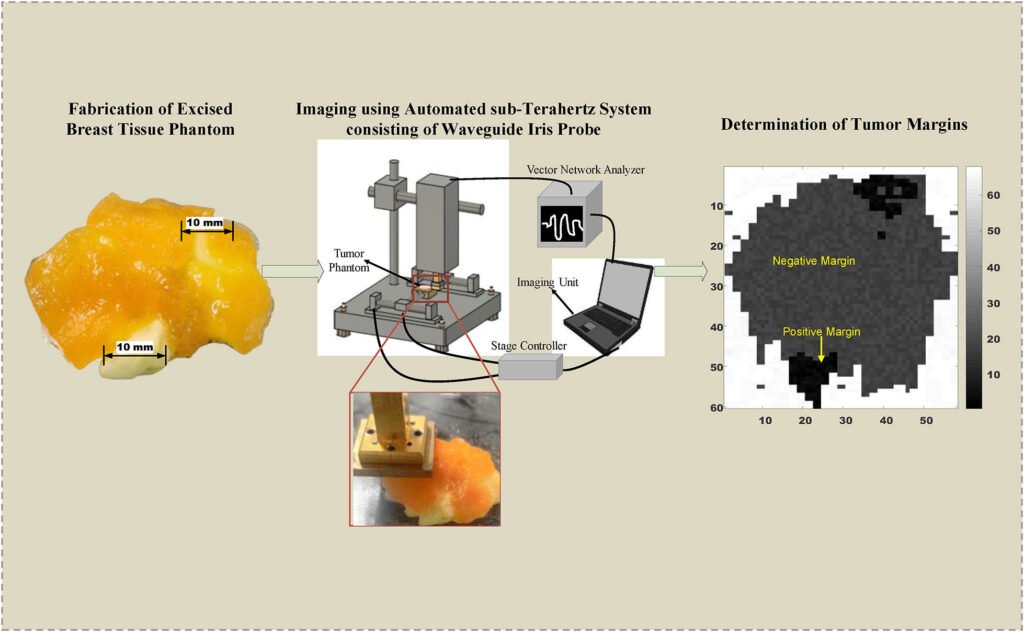
The study demonstrates a robust, efficient, and cost-effective electronic sub-THz waveguide probe for detecting tumor margins intraoperatively during lumpectomies. The proposed iris waveguide probe is capable of detecting fat, fibrous, and tumorous tissue in breast tissue. The device can identify both positive and negative margins in the frequency range of 110-170 GHz. The scanning probe can be used to rapidly and effectively depict the excised tissue surface by placing it in contact with it. According to the imaging results, this probe has a lateral sensitivity of 0.2 mm and a detection depth of 1 mm. It is manufactured using CNC micromachining technology to ensure easy and cost-effective production. The probe was designed and tested in HFSS as well as fabricated and validated on an artificial excised breast mimicking phantom. In this research, sub-terahertz waves are used for tissue penetrating imaging of breast tumor margins, which is an application requiring high resolution and accurate techniques.
The Importance of Sensor Placement During the Measurement of RF Heating of Implants in MRI
Read Description
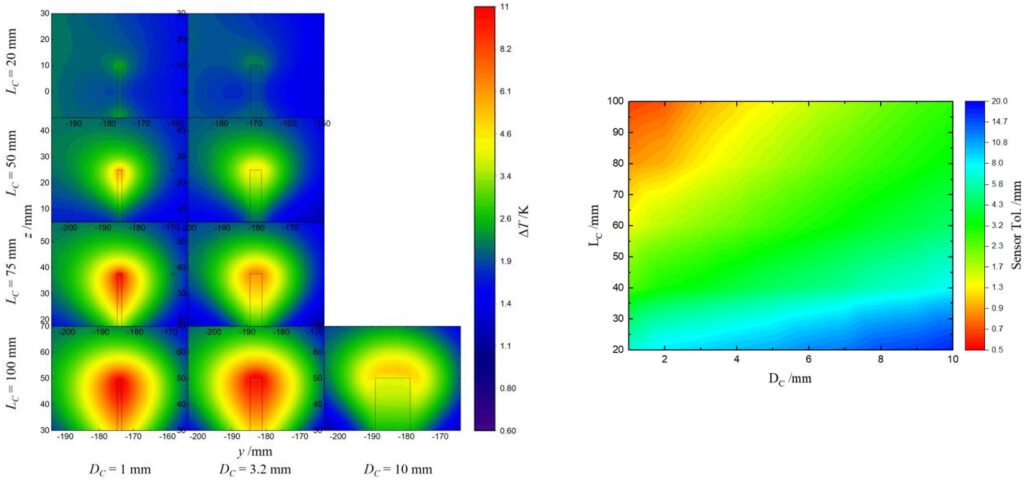
The simulations used a coupled thermal-electromagnetic model created using COMSOL Multiphysics to replicate the measurement conditions virtually. Thermal gradients in parametric models of cylindrical implants of varying length and diameter were evaluated to quantify the sensor placement accuracy required for the measurement of implant heating within the estimated temperature measurement uncertainty. In this way we aim to enhance the understanding of the requirements for experimental procedures and safety standards dealing with implant heating in MRI.
A Sensitivity-Enhanced Sensor Based on Zeroth-Order Resonance for Liquid Characterization
Read Description
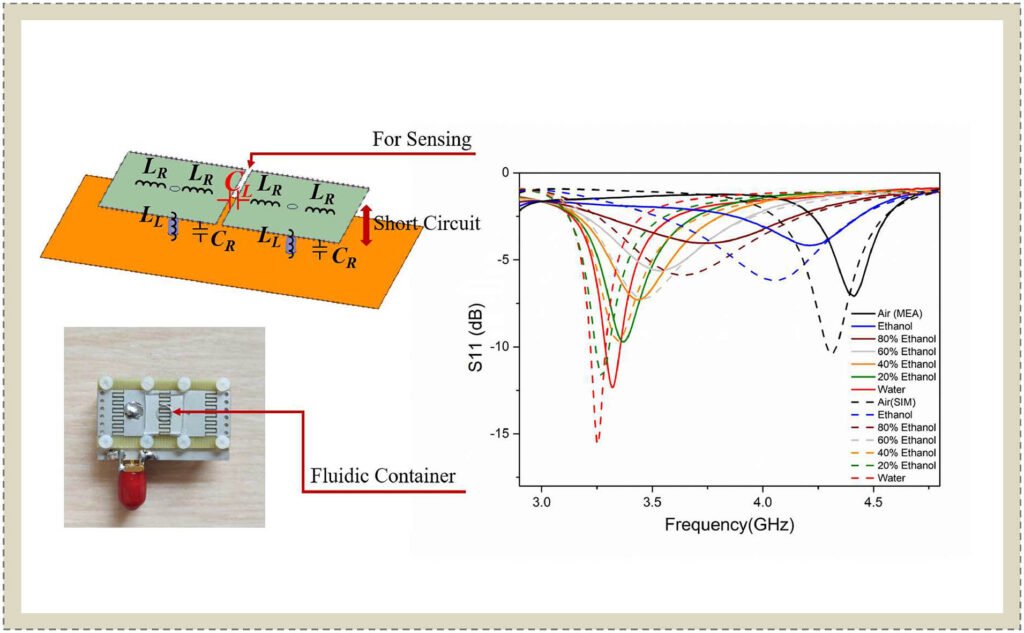
The short-circuit structure reduces the energy loss due to edge radiation and generates a highly concentrated electric field on the top surface of the substrate, which can be used to detect the dielectric loading samples. The presented sensor has been simulated, fabricated and tested. The sensor on the printed circuit board (PCB) is integrated with the fluidic container made of polydimethylsiloxane (PDMS) to form the test device. The water-ethanol binary mixture and sucrose solution are used to proof the concept. Finally, the prediction model for the water-ethanol mixture based on measured parameters has been established and the analysis of prediction error has been carried out. The sensor works around 4 GHz, and the maximum sensitivity reaches 1.04. Due to the high sensitivity and simple structure, the proposed structure is a competitive candidate for the applications including bio-sensing and portable biomedical device.