Super-Regenerative Oscillator Integrated Metamaterial Leaky Wave Antenna for Multi-Target Vital Sign and Motion Detection
Read Description
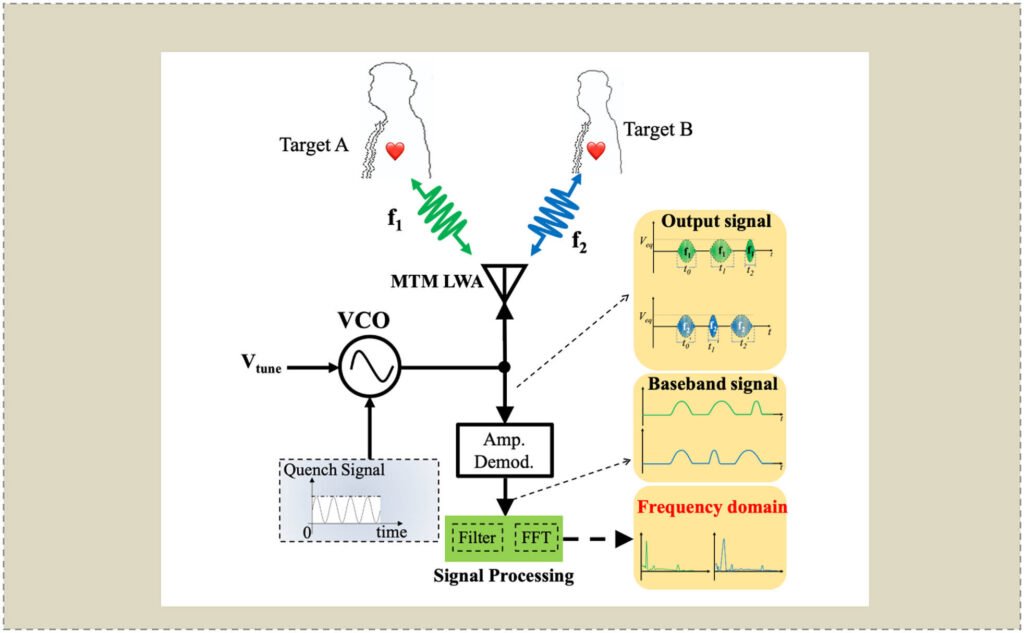
The proposed SRO-integrated MTM LWA system is operated in the logarithmic mode with a quench signal imposed at the drain port of transistor. Experiments have been conducted to show that vital sign information for two human targets can be successfully detected when they are located along different scanning angles of −10 $^circ $ and −30 $^circ $, respectively. Furthermore, compared with MTM LWA radar sensor based on the self-injection-locked (SIL) architecture, vibrating motion at a farther distance can be detected accurately using the proposed radar sensor, indicating a higher sensitivity with reduced system complexity.
Correlation Radiometry for Subcutaneous Temperature Measurements
Read Description
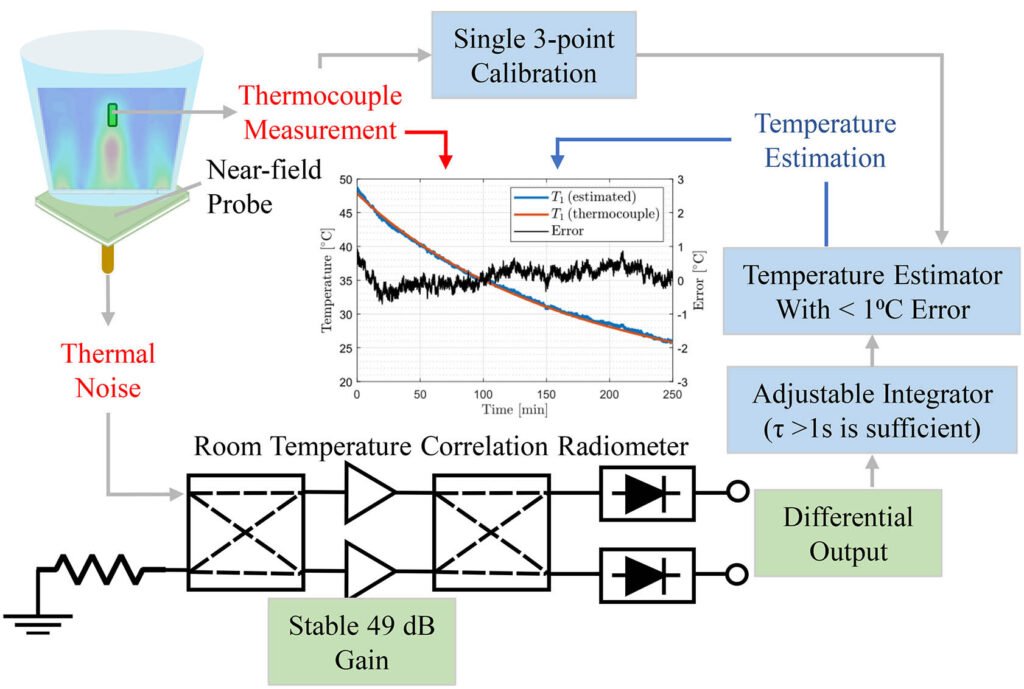
The radiometer is first tested with a matched load, and then with a near-field planar probe antenna, both with two water phantoms of different volumes. The measurement resolution, sensitivity and long-term stability is quantified in terms of integration time for a simple three-point calibration. The lowest measured absolute error compared to a ground-truth thermocouple measurement is ±0.25K over one hour of data collection with a single calibration. Measurements show that an integration time >1 s results in an absolute error limited by the radiometer gain fluctuations. A probe on a seven-layer tissue stack is designed for measuring brain temperature.
Near-Field Circular Array for the Transcutaneous Telemetry of UHF RFID-Based Implantable Medical Devices
Read Description
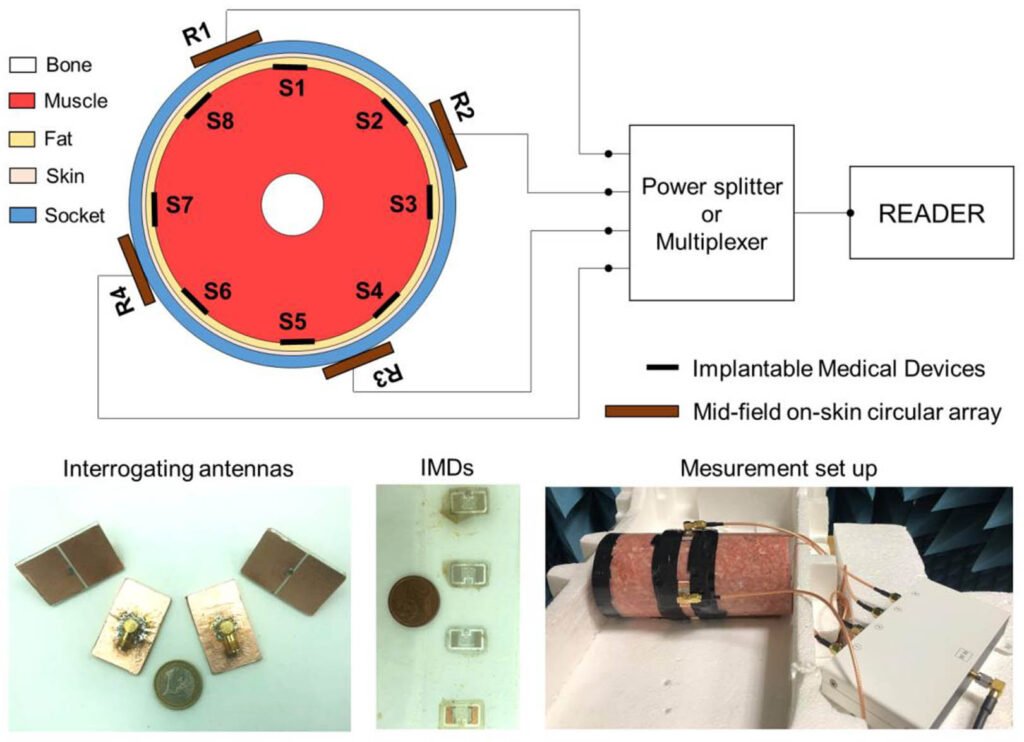
In some applications like the hand prosthesis controlled by Electromyographic signals emitted by muscle contractions, multiple IMDs have to be used to increase the degrees of freedom in driving the actuators. An array of interrogators, working in the near-field can mitigate this bottleneck by greatly extend the read region inside the body. Sequentially- and simultaneously-fed arrays by a same reader are here investigated to optimize the multi-sensor backscattering modulated links. The conditions (feeding scheme and alignment) to guarantee a robust interrogation of a relevant number of implanted sensors with no battery onboard are identified also accounting for the safety constraints related to the SAR. Numerical simulations and experimentation with a cylindrical phantom resembling human limbs, hosting reference antennas, demonstrate that the simultaneous feed permits to interact with eight IMDs by using nearly all the available power from typical readers (30 dBm, 22 dBm as a minimum) without exceeding the SAR limit with a power margin (w.r.t. sensor-oriented ICs with −10 dBm power sensitivity) of more than 5 dB for any angular alignment between the array and the sensors.
Graph Attention Network in Microwave Imaging for Anomaly Localization
Read Description
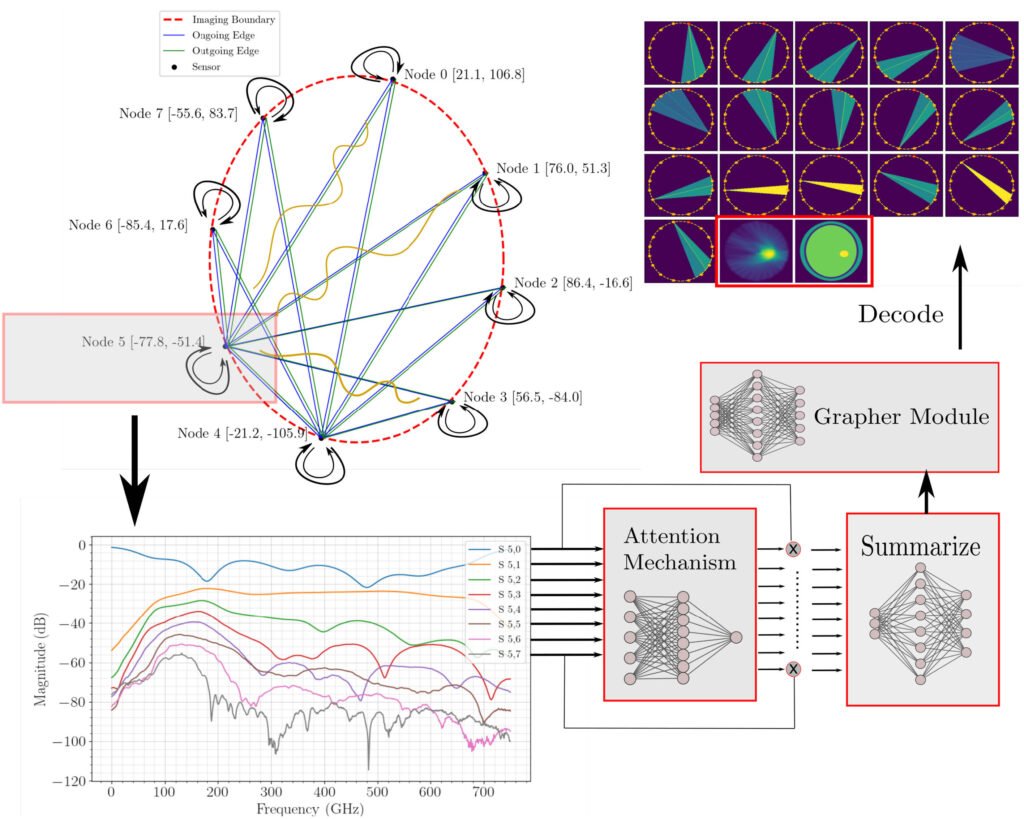
It has always been hard to bake the physical setup of the imaging array into the structure of the network, resulting in a data-intensive models that are not practical. This work put forward a graph formulation of the microwave imaging array. The architectures proposed is made cognizant of the physical setup, allowing it to incorporate the symmetries, resulting in a less data requirements. Graph convolution and attention mechanism is deployed to handle the cases of fully-connected graphs corresponding to multi-static arrays. The model works with a modular fashion at node level to strike a trade-off between flexibility and efficient capture of mutual information present in measured signals. Additionally, the modular working fashion endows the model with immunity to overfitting. The graph-treatment of the problem is evaluated on experimental setup in context of anomaly localization with imaging array and has shown higher performance as compared to the popular radar technique. The thin model was realized with a feasibly procured reasonably-sized dataset in the order of few hundreds, thus eliminating the need to resort to simulations for augmentation.
Millimeter-Wave Radar Cane: A Blind People Aid With Moving Human Recognition Capabilities
Read Description
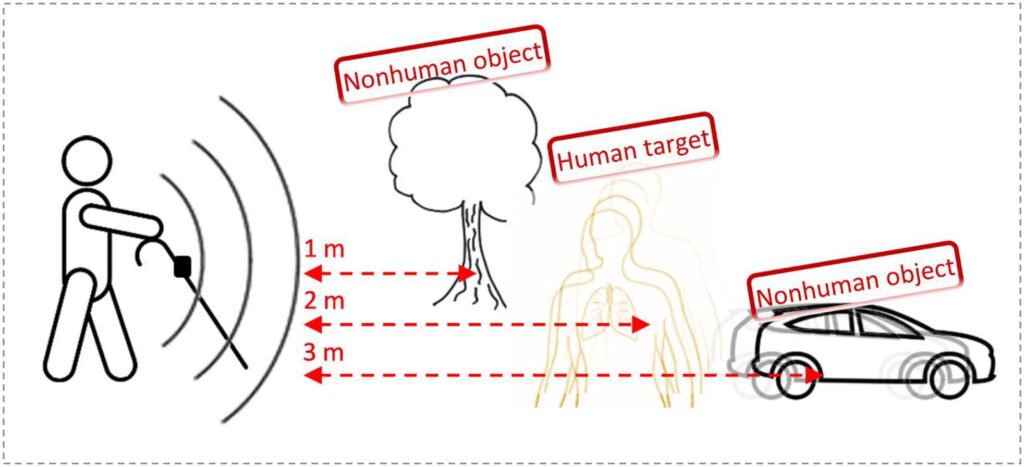
Since real scenarios would likely have moving targets, a new range alignment technique has been proposed with the aim of detecting the tiny chest displacement due to the physiological activity as the key sign of the human presence. The proposed system is able to properly recognize humans in complex environments with multiple moving targets, thus providing to the user a complete set of information, namely presence, position and nature of the available targets. The operating principle and the effectiveness of the system are shown both by simulated case studies and by employing a 122 GHz radar board for carrying out suitable measurements.
Multi-Band Parity-Time-Symmetric Wireless Power Transfer Systems for ISM-Band Bio-Implantable Applications
Read Description
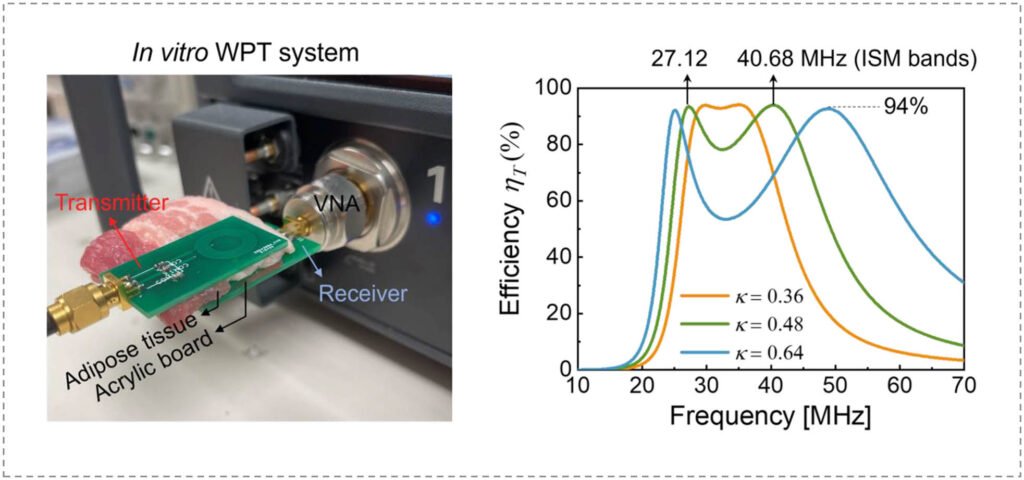
In analogy with non-Hermitian PT-symmetric physical systems that can have branching real eigenfrequencies as a function of the dimensionless non-Hermiticity and the coupling factor, the PT-symmetric WPT system exhibits multi-band and/or wideband operations via adjustment of the non-Hermiticity (i.e., quality-factor of resonant tanks) and their mutual inductive or capacitive coupling strength. Here, we put forward design and implementation for achieving dual-band, tri-band, and wideband PT-symmetric WPT systems, capable of operating in the industrial, scientific, and medical (ISM) bands (27.12 MHz and 40.68 MHz) with high transmission efficiency. This compact and low-cost WPT technique may be exploited in many practical applications, such as wireless charging of bioimplants and wearables, as well as interrogation of battery-free medical devices and internet-of-things (IoT) sensors to assist smart healthcare.