A Miniaturized Four-Element MIMO Antenna with EBG for Implantable Medical Devices
Yi Fan, JinHong Huang, TianHai Chang, Xiongying Liu.
Read Description
A cross-shaped slot etched in the radiator, a branch extending on the conductor ground, and a pair of electromagnetic band gaps (EBGs) are integrated to achieve high isolation. The proposed MIMO antenna has the compact dimensions of 18.5 mm × 18.5 mm × 1.27 mm. The simula-tion in the three-layer phantom indicates that the impedance matching is good with a bandwidth of 18.64% (2.14-2.58 GHz) and a maximum gain of -15.18 dBi and the mutual coupling is reduced to less than -15.99 dB at the ISM band. An ex-vivo test was implemented in a fresh pork slab and the measurement results are well matched with the simulation ones. Health safety considerations and link budget are discussed to validate the antenna’s availability in biomedical telemetry, and the envelope correlation coefficient is computed, illustrating the high independence between antenna elements.
×
Take Out Message
Take-Home Messages
- In MIMO wireless systems, multiple antenna elements are adopted to work as transmitter and receiver to improve capacity such as the enhancement in the data transmission rates of high resolution images from the capsule to outside base station/gateway.
- The proposed four-element implantable MIMO antenna features a wide impedance bandwidth of 18.64% (2.14–2.58 GHz) with a maximum gain of –15.18 dBi, and has the compact dimensions of 18.5 mm × 18.5 mm × 1.27 mm. The mutual coupling between different antenna elements is less than –15.99 dB.
- The ex-vivo measured results illustrate a merit agreement with the simulated ones in a three-layer phantom. The radiation characteristic of the designed antenna follows the healthy protection standards, and the performance of diversity and far-field link budget indicates merit channels characteristics.
Magnetic and Thermal Characterization of Core-Shell Fe-oxide@SiO2Nanoparticles for Hyperthermia Applications
Gabriele Barrera, Marco Coïsson, Federica Celegato, Elena Sonia Olivetti, Luca Martino, Ivana Miletto, Paola Tiberto.
Read Description
Their size remains therefore as small as possible, while still displaying significant hysteresis losses in dynamic conditions (electromagnetic fields up to 48 kA/m at 100 kHz). Static loops measured by vibrating sample magnetometry and dynamic loops measured by a custom B-H tracer are used to characterize the particles magnetic properties, as well as a custom-built, fully modelled, hyperthermia setup. The specific absorption rate is obtained either from static and dynamic loops areas, and from direct hyperthermia measurements. Dynamic loops are shown to be a good estimator of specific absorption rate values.
×
Take Out Message
Take-Home Messages
- Core@shell Fe-oxide@SiO2 nanoparticles: a system for delivering heat selectively to cancer cells through an alternating electromagnetic field. This study provides a critical, anatomy-informed dielectric study of the properties of the bladder.
- The most effective heat transfer is obtained through a maximisation of the energy losses: a careful investigation of the nanoparticles system is required to comply with the constraints imposed by hyperthermia applications.
- An almost superparamagnetic system that minimises magnetostatic interactions (e.g. agglomeration) while keeping dynamic hysteresis losses for heat delivery.
Computational Low Frequency Electromagnetic Dosimetry Based on Magnetic Field Measurements
Alessandro Arduino, Oriano Bottauscio, Mario Chiampi, Ilkka Laakso, Luca Zilberti.
Read Description
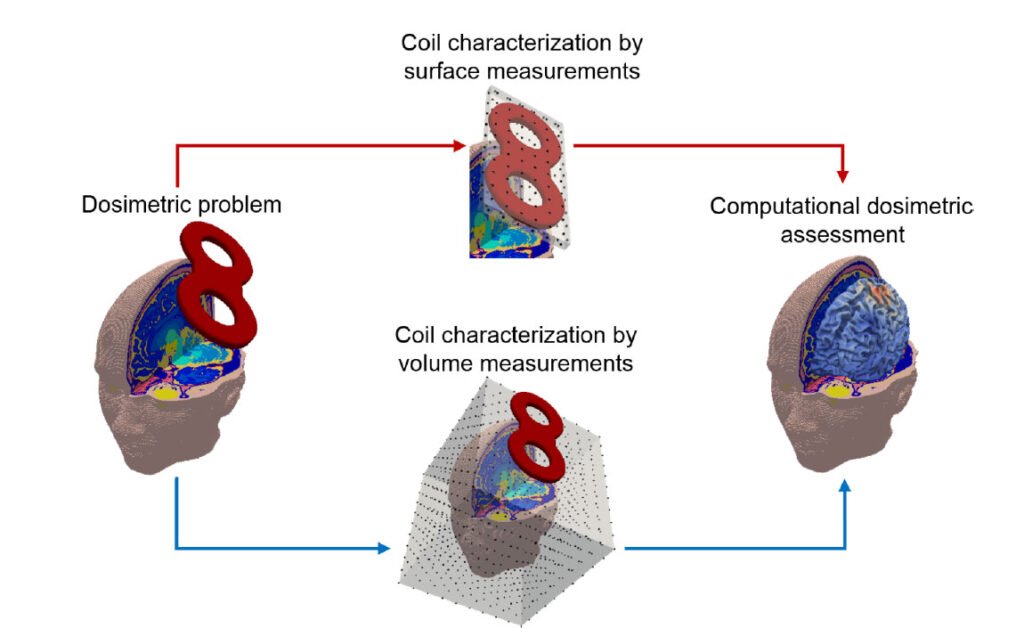
The comparison is performed on a realistic model problem, related to transcranial magnetic stimulation (TMS), in which numerically simulated “virtual measurements” are employed. The comparative analysis is developed in terms of both result accuracy and robustness against noisy input due to unavoidable experimental uncertainties. It results that by performing the measurements on a surface surrounding the sources, a significant reduction of the experimental burden is found with respect to the case of volume measurements, without affecting neither the accuracy nor the robustness of the procedure. In particular, when whole body electric field evaluation must be carried out, the advantage of surface measurements with respect to volume ones becomes significant. Moreover, a preferable scheme obtained as hybridization of previously proposed strategies is identified. Besides the adoption of a TMS model problem in the comparison procedure, the achieved result can be extended to any low frequency dosimetric assessment where the magnetic sources are difficult to model or not completely known.
×
Take Out Message
Take-Home Messages
- We propose an experimental-computational technique for low frequency dosimetric assessments that reduces the experimental burden while maintaining accuracy and robustness.
- The proposed technique can be used when the magnetic source is unknown or not suitable to be modeled.
- By adopting surface measurements, the proposed technique allows to characterize any low frequency magnetic source in a very convenient way.
- By adopting the boundary element method for extrapolating surface measurements as well as a curl inversion operator for magnetic vector potential evaluation, the proposed technique significantly reduces the noise from the input data.
- The positive features of the proposed technique have been put in evidence by testing it in a transcranial magnetic stimulation dosimetric application.
Numerical Investigation Of Bone Tumer Hyperthermia Treatment Using Magnetic Scaffolds
Alessandro Fanti, Matteo Bruno Bruno Lodi, Giuliano Vacca, Giuseppe Mazzarella.
Read Description
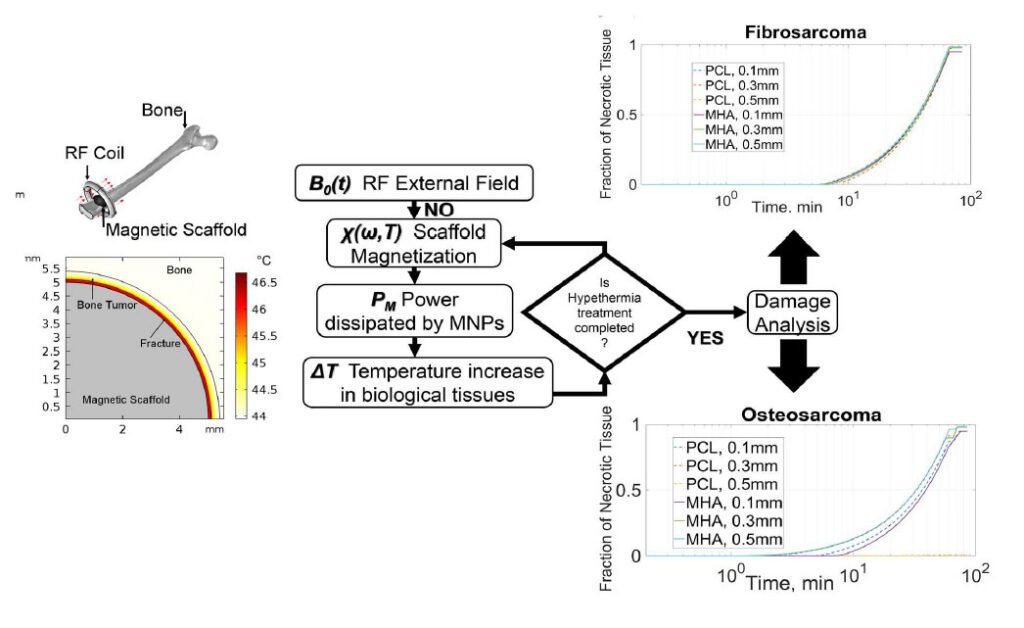
The heating phenomena is investigated considering both the ischemic and inflamed state of the fracture gap at the bone/implants interface. Both Osteosarcoma and Fibrosarcoma tumors are analyzed. Magnetic hydroxyapatite and poly-ε-caprolactone scaffolds are investigated. From the thermal analysis, it is found that the fracture behaves as a resistance to heat conduction, therefore strength and frequency of external magnetic field has to be tuned to perform the treatment taking the fracture status into account. Moreover, numerical experiments indicate that low perfused Fibrosarcoma can be treated using moderate-strength field, whereas more intense external fields are required to treat strongly vascularized Osteosarcoma without damaging healthy bone tissue. Magnetic hydroxyapatite stands out to be the most performant and versatile material to treat both tumors. These simulations can be regarded as a starting point to analyze possible clinical use of magnetic scaffolds for in situ bone hyperthermia.
×
Take Out Message
Take-Home Messages
- Functionalization of bone scaffolds using magnetic nanoparticles allows hyperthermia of bone tumors in an effective way.
- The possibility of employing innovative magnetic scaffolds as therapeutic tool in orthopaedic oncology is analyzed via numerical simulations. Using a Cole-Cole model, non-linear material properties are evaluated to define external field parameter to perform an effective treatment for bone tumors such as Fibrosarcoma and Osteosarcomas.
- Accurate electromagnetic and thermal modeling of scaffolds and nanoparticles, in the whole range of involved temperature, is required to design effective and safe treatments.
- Different tumoral tissues and qualitative features such as the presence, size and type of surgical fracture, affect in a significant way the hyperthermia treatment.
Lead Electromagnetic Model to Evaluate RF-Induced Heating of a Coax Lead: A Numerical Case Study at 128 MHz
Mikhail Kozlov, Wolfgang Kainz
Read Description
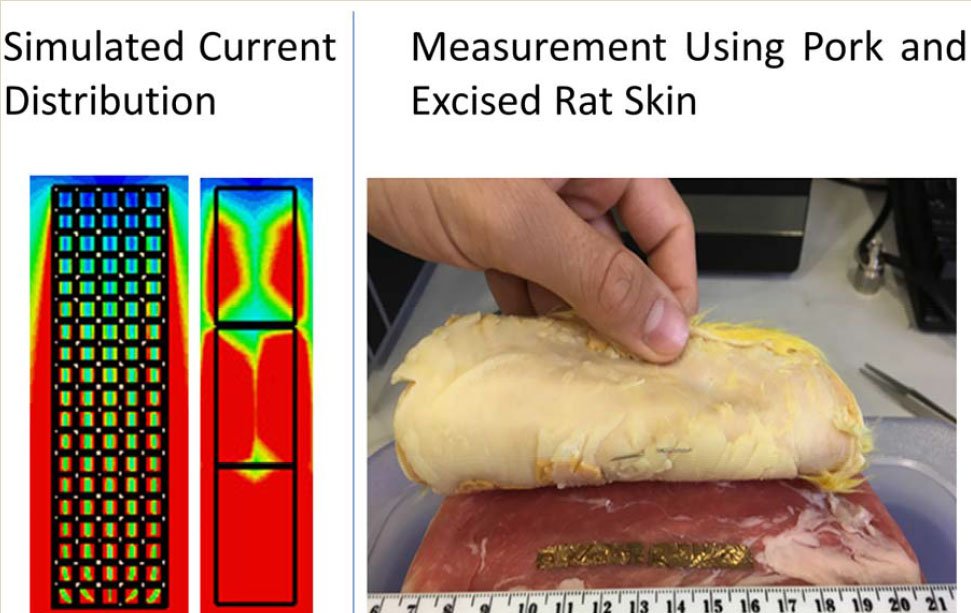
For this, a lead electromagnetic model (LEM) of a generic coax lead at 128 MHz was evaluated with 3D electromagnetic and thermal co-simulations of the entire lead. Two sets of 120 incident electric fields with different profiles were generated in a homogenous medium using the electrical properties of blood by an array of four antennas. Substantial dependence of power deposition and temperature profiles around lead electrodes on the incident electric field did not reduce the quotient of the variances of the fitted LEM values, observed values of power deposition, and the net temperature increase, above background, with the presence of the generic coax lead. The power injection approach based only on the comparison of the temperature increase in the medium along the lead tip electrode axis can result in substantial underestimation or overestimation of power deposition around lead electrodes.
×
Take Out Message
Take-Home Messages
- The developed numerical workflow is appropriate for evaluating power deposition and temperature rise on electrodes of a coax lead located in a homogeneous medium in appliances with ISO/TS 10974 Tier4.
- Small lead electromagnetic model uncertainty does not require that the spatial distribution of power deposition and temperature rise in close proximity to lead electrodes be independent on an incident electric field.
- Determination of the hot spots described in Clause #8 of ISO/TS 10974 Ed2 can depend on the end user’s selection of pathways, that is, variety of incident tangential electric field applied during investigation, the use of specific absorption rate or temperature rise quantities, as well as the duration of RF-induced heating when the approach based on temperature rise is used.
- The power injection approach based on the comparison of temperature increase along the lead tip electrode axis can result in substantial underestimation or overestimation of the power deposition around the lead tip electrode, as well as maximum temperature rise in close proximity to the tip electrode, ring electrode, or both.
Optimized Design of Coils for Wireless Power Transfer in Implanted Medical Devices
Yufeng Zeng, Dongyuan Qiu, Xiangtian Meng, Bo Zhang, Sai Chun Tang.
Read Description
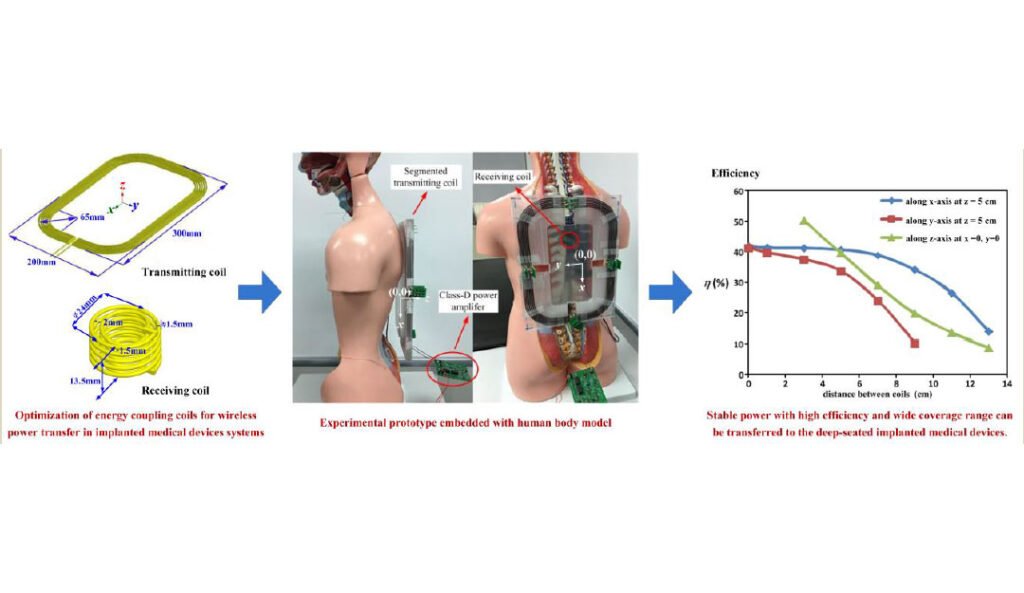
In order to deliver stable power to implantable devices with wide coverage range and high efficiency, coil optimization is investigated, including the consideration of the coil structure, pitch and number of turns. By using finite element analysis (FEA), both the transmitting and receiving coils have been optimized at 6.78MHz. A 200 mm $times$ 300 mm rounded rectangular transmitting coil and a novel double-layer circular receiving coil with an outer diameter of 24 mm were developed, and the transmitting coil was segmented by multiple resonant capacitors to significantly reduce the coil voltage to a safe level. Experiment results show that stable power transfer efficiency over 40% can be achieved at a distance of 5 cm with the optimized transmitting and receiving coils.
×
Take Out Message
Take-Home Messages
- High energy transfer efficiency and wide coverage range are desired to power implanted medical devices (IMDs) with wireless power transfer (WPT) systems.
- A 200 mm × 300 mm rounded rectangular transmitting coil and a double-layer circular receiving coil with an outer diameter of 24 mm have been optimized for a 2-coil IMD-WPT system.
- With the optimized coils, experimental results show that high energy efficiency higher than 40% can be achieved even the implanted receiver is located deep in the body with a wide coverage range of 18 cm × 10 cm.