Accurate Doppler Radar-Based Cardiopulmonary Sensing Using Chest-Wall Acceleration
Read Description
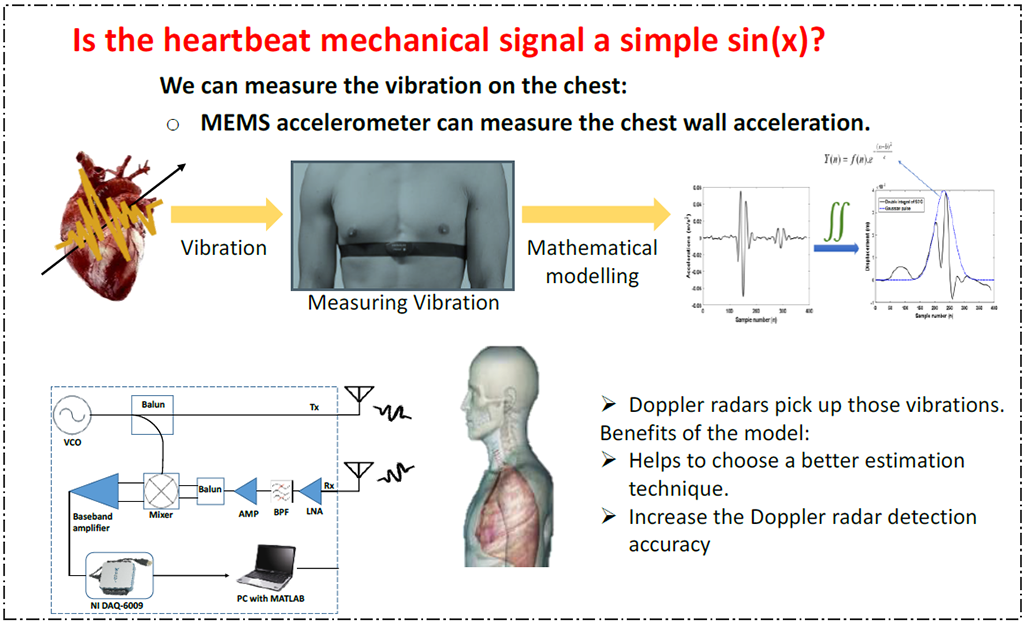
In this paper, we use the fact that that the displacement signal is a complex Gaussian function rather than a pure sine wave. This function shows a declining amplitude versus frequency; therefore, the heartbeat signal will be much weaker than the respiration signal and can be easily buried in the respiration’s harmonics. However, by exploiting the chest wall acceleration instead of its displacement, the heartbeat signal is greatly amplified, leading to a significantly higher heartbeat rate detection accuracy. Recorded data from 12 healthy human subjects show an average heartbeat rate detection accuracy of more than 95% when compared with reference electrocardiogram (ECG) recordings. The proposed technique is robust, simple, and requires minimum calculation resources which is important for online monitoring and power consumption reduction. Measurement results indicate its potential for being used in reliable non-contact heartbeat rate monitoring systems.
![RF Aspects of High and Ultra High Field Magnetic Resonance Imaging [(U)HF-MRI]: Recent Advances](https://ieee-jerm.com/wp-content/uploads/2026/06/8520785.png)
RF Aspects of High and Ultra High Field Magnetic Resonance Imaging [(U)HF-MRI]: Recent Advances
Read Description
This paper will show current trends in HF-MRI to mitigate some of these issues and provide a linkage between traditional MRI components and novel structures for UHF-MRI. Transmit and receive structures as well as the use of metamaterials for improved excitation and SNR will be covered. Other examples of these recent trends will be potential antenna structure to replace the current c.oil-based technology, and then finally, receiver/patient protection circuits will be covered.
Development of Water Content Dependent Tissue Dielectric Property Models
Read Description
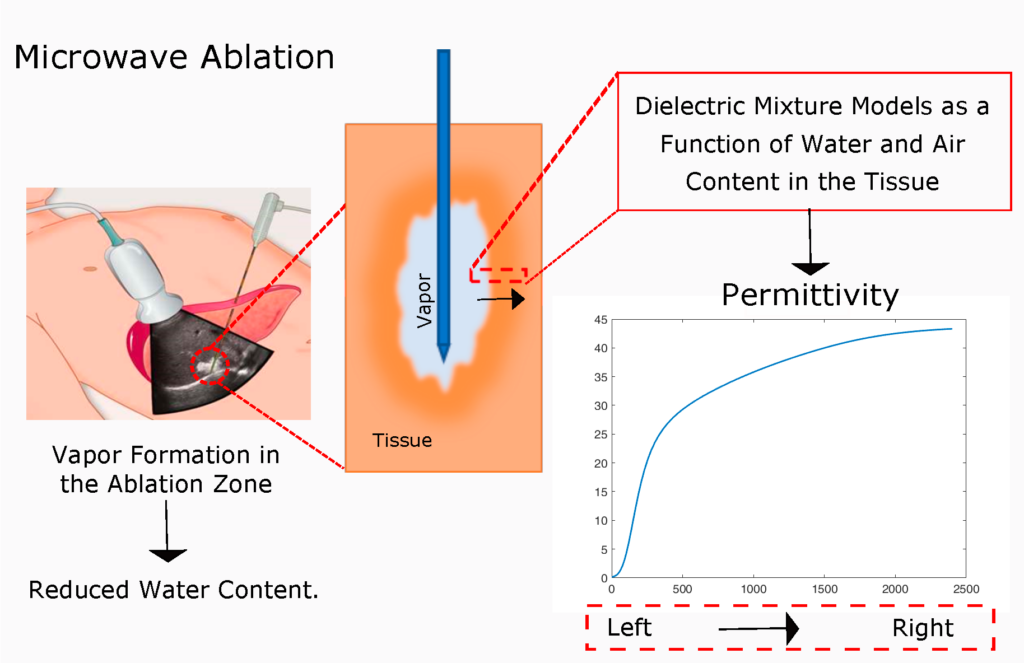
However, dehydration effects due to thermal heating have not been fully characterized. We combined 1) Maxwell-Fricke mixture theory with a four-pole Cole-Cole equation to include water and air content dependency and as the second approach a different 2) Maxwell mixture model was coupled with a Debye function. The proposed approaches (1 and 2) were able to predict the permittivity ( ϵ′ ) and conductivity ( σ ) of bovine liver and swine lung tissues at different hydration and inflation states from 1-15 GHz. A second approach coupling Maxwell and Debye models required fewer assumptions and modelled tissue properties with higher accuracy (less than 15% mean percent error in all tissue types). These models may help improve the accuracy of microwave ablation simulation when tissue water content changes as a result of vaporization, and may facilitate personalized treatment planning.
Non-Contact Human Gait Analysis and Limb Joint Tracking Using Doppler Radar
Read Description
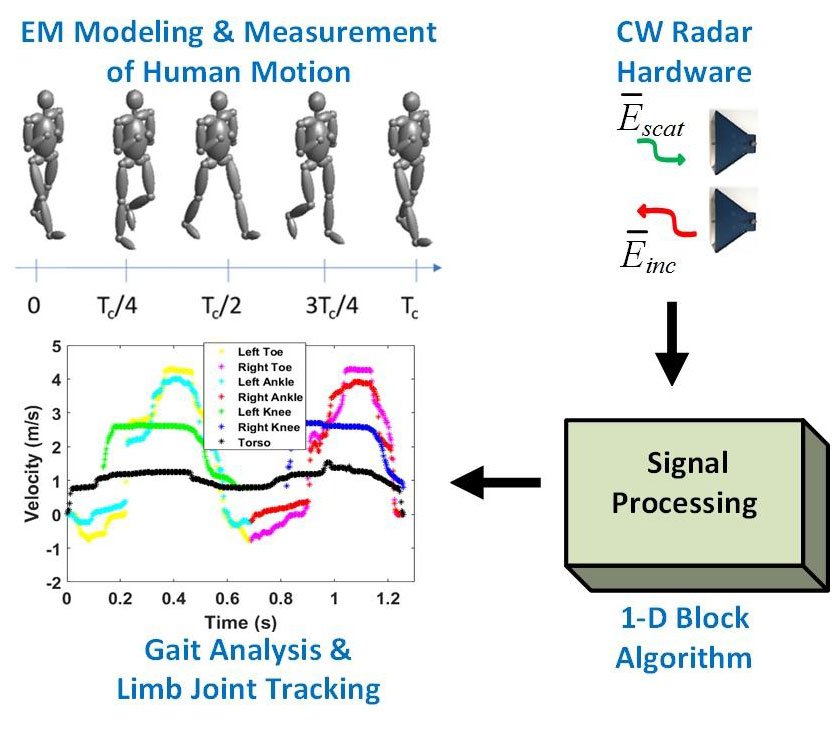
Here, we investigate the feasibility of extending the 1-D block processing algorithm to distinctly track specific limb joints and discuss the advantages and limitations of the technique for CW radar. To establish a repeatable reference data, we run a full wave EM analysis on customized Boulic human model emulating specific video recorded body motions. Results based on measured data are in agreement with simulated ones for simple motions like swinging one hand or one leg only. The proposed technique is also successful in extracting lower body parts while the whole body is in motion, however it is still hard to clearly extract upper body parts like swinging hands.
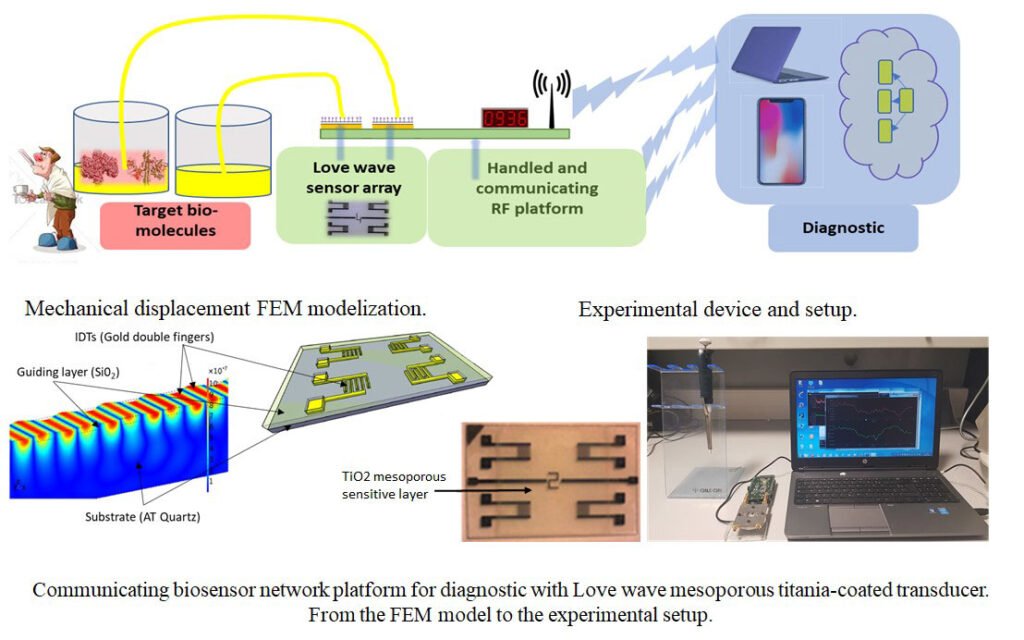
Mesoporous titania-coated biosensor and FEM model design for highly sensitive detection of low molecular weight targets
Read Description
The strategy of using such Love wave devices, with 3D porous layers, offering further easy functionalization, aims not only to increase the amount of targets caught on the sensor surface, but also to enhance the detection mechanism by a higher perturbation of the Love wave acoustic energy which could be trapped inside the 3D sensitive layer. First, as a proof of concept, experimental devices with a 3D titania mesoporous layer were realized, and they have shown a good agreement with simulated results. Furthermore, experimental test with several Newtonian liquids are investigated, in a range of viscosities from 1 to 7 cP, typical of those concerned by our biochemical applications. The sensitivity with a 300 nm thick porous sensing layer was 10 times that of the bare device, with interesting dynamical issues to be further studied, giving rise to the great potentialities for biological detection of low weight biochemical targets.
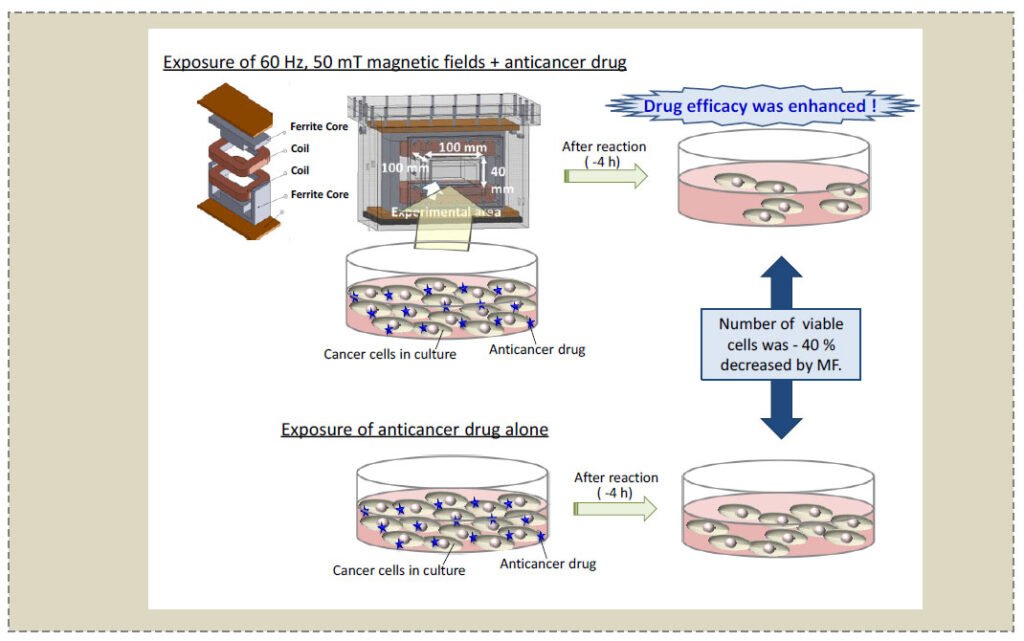
Combined Effect of 60 Hz Magnetic Fields and Anticancer Drugs on Human Hepatoma HepG2 Cells
Read Description
However, since the prokaryotic bacterial cells, E.coli, differ from human cells which are eukaryotes and multicellular organisms in many ways, it was not clear whether the magnetic fields affect a potency of anticancer drug against human cancer cells. In this study, we designed and produced magnetic fields exposure device for human cancer cells in culture, and investigated whether 60 Hz, 50 mT magnetic fields affect the potency of anticancer drugs against human hepatoma HepG2 cells. The results of experiments with an anticancer drug, cisplatin indicated that the quantity of viable HepG2 cells become decreased significantly by the combination of cisplatin and magnetic fields as compared to that by cisplatin alone. This suggested that 60 Hz, 50 mT magnetic fields increase the cytocidal activity of cisplatin to human hepatoma cells. The efficiency of the anticancer drugs, mitomycin C and doxorubicin against HepG2 cells was also increased significantly by exposure to magnetic fields, although the time associated with the greatest enhancement of the drugs potency achieved by magnetic fields differed among drugs. These results suggest that 60 Hz, 50 mT magnetic fields strengthen the effect of anticancer drugs on human cancer HepG2 cells.