Deep transcranial magnetic stimulation for the addiction treatment: Electric field distribution modeling
Read Description
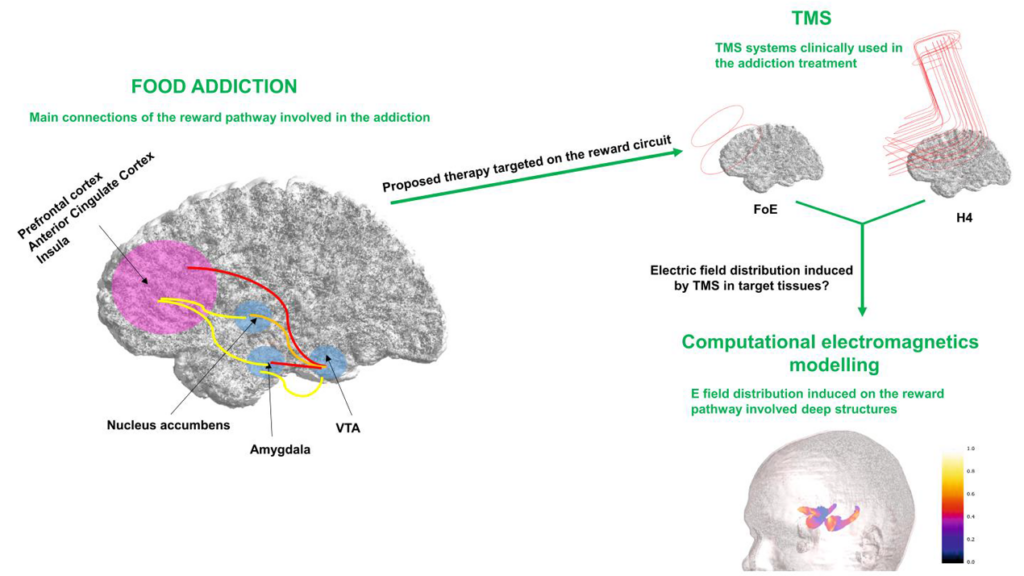
Recent clinical studies have focused on the use of H4 coils, which utilizes a left-right symmetric structure for bilateral stimulation of the prefrontal cortex, and demonstrated efficacy for therapy such as smoking cessation. The mechanism of activity, however, remains poorly understood, in part because the affected regions of the brain are not known in detail. To this purpose, computational techniques applied to highly detailed inhomogeneous tissue phantoms, provide a powerful tool for testing coil efficacy. In this work we quantified both electric field E distribution and its penetration depth in the prefrontal cortex, induced by a specific Hesed-coil, H4, designed for the addiction treatment and by the traditional figure-of-8 coil for comparison. Results show that H4 coil preferentially targets insula and cingulate cortex. Moreover, it can induce in the deepest tissues E amplitude ranging between the 20-40% of the cortical peak and it can penetrate the cortex up to 4 cm with a E>50% of the cortical peak, thus noticeably increasing the penetration depth of the traditional TMS systems.
A Near Field Cloaking Study to Reduce MRI RF-Artefacts in Presence of Elongated Prostheses
Read Description
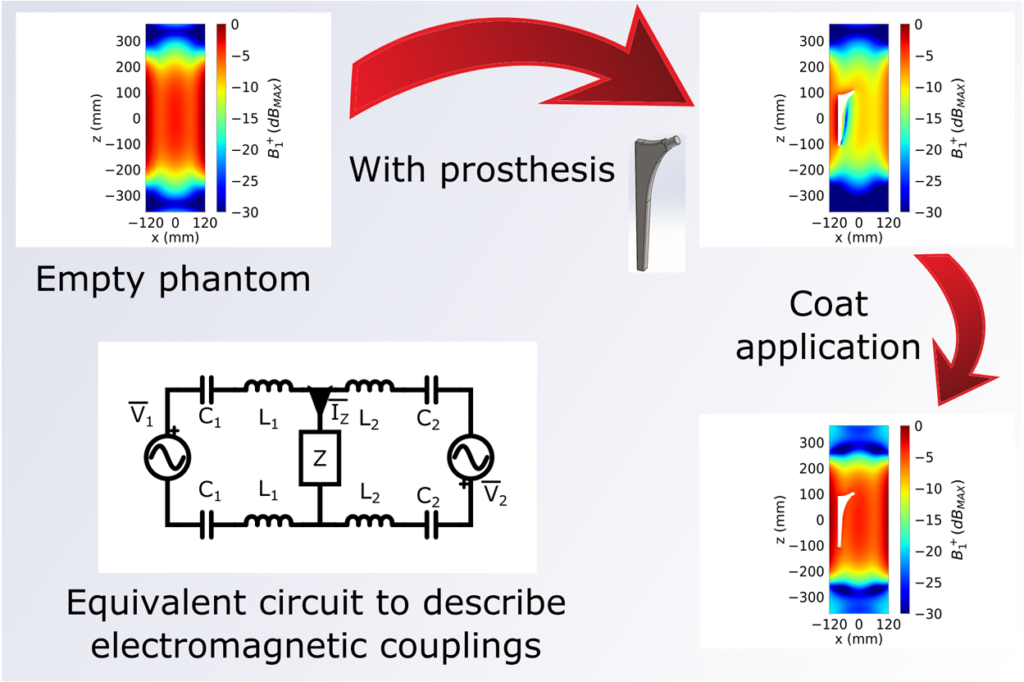
The theoretical assumptions are proved by means of full-wave simulations that are also applied to a realistic hip prosthesis considering a frequency equal to 64 MHz and 128 MHz. Results: The numerical results confirm the theoretical assumptions. Both the theoretical analysis and the numerical simulations highlight the different role that the coat thickness and electric permittivity have in the definition of a proper dielectric coat. Clinical or Biological Impact: A particular cloaking approach leads to a dielectric coat whose constitutive electrical parameters may be simple enough to fit the considered application reducing the interaction between an elongated prosthesis and the RF antenna. Furthermore, results obtained at 64 MHz suggest the possibility to employ an existing biocompatible material to achieve the envisaged purposes.
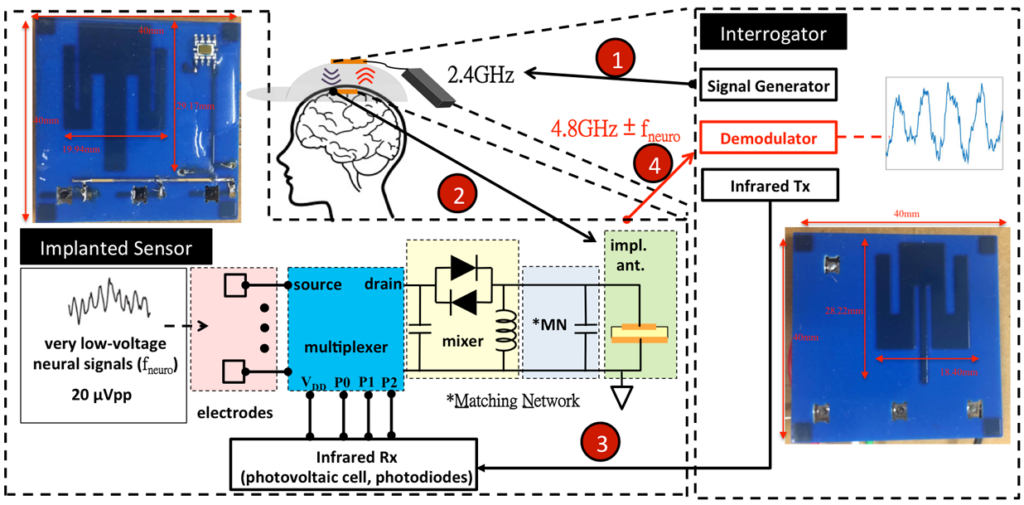
A Multi-Channel Passive Brain Implant for Wireless Neuropotential Monitoring
Read Description
The proposed system consists of an external interrogator and a neuro-recorder implanted inside the scalp. For operation, the interrogator sends a) a 2.4 GHz carrier signal to “turn on” the implant, and b) an infrared control signal for channel selection. The latter activates the desired channel via a photo-activated multiplexer. For this channel, the carrier signal is mixed with the neural signal ( fneuro ) to generate a 4.8GHz±fneuro modulated signal. The latter is then transmitted back to the interrogator. To verify the implant’s operation inside biological tissues, in−vitro measurements are presented using pig skin. Experimental results show that the proposed neuropotential recorder exhibits 20 μVpp sensitivity at all eight channels (viz. it can record any signal generated by the human brain). The system is also in compliance with the strictest Federal Communications Commission standards for patient safety. Notably, the proposed approach is scalable to a much higher number of channels. As such, the proposed.
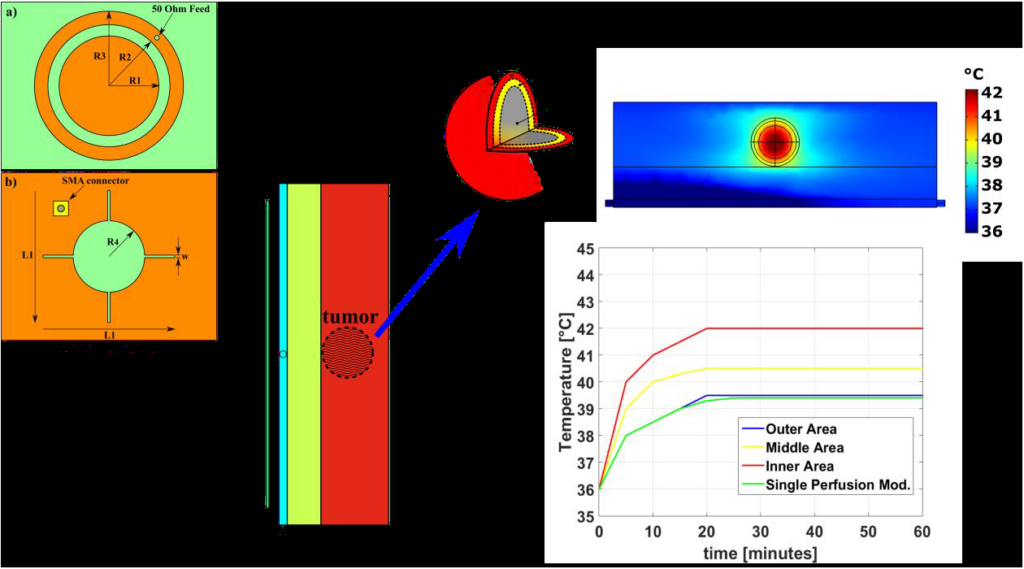
A Blood Perfusion Model Of A RMS Tumor In A Local Hyperthermia Multi-Physic Scenario: A Preliminary Study
Read Description
The main goal of this therapy, primarily used as adjuvant therapy along with radio and chemotherapy, is to reach a suitable temperature inside the neoplastic mass – about 7-8 degrees above the normal body temperature – able to kill the cancerous cells without compromising the healthy tissues. Many factors contribute to this goal, such as the radiation characteristics of the antenna, the thermal profiles of the healthy and cancerous tissues and the dynamic of the water flux inside the bolus. Moreover, despite being often overlooked, an important role is played by the perfusion characteristics of the tumor. In this work, we present a multi-physic analysis in a local hyperthermia scenario, considering a simple patch antenna resonating at 434 MHz as a heat source, a water bolus, a bi-layered body phantom and, most importantly, a tumor placed inside the phantom described employing a realistic space-dependent blood perfusion model. The results of this study show the effectiveness of the hyperthermia treatment using the physiopathology-driven perfusion model, and they may be useful in a real local hyperthermia case.
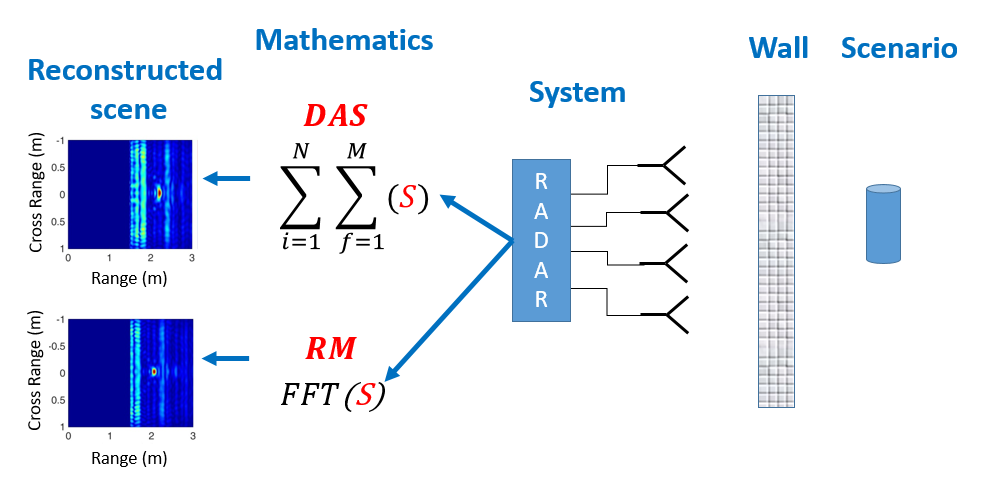
Comparison between Delay and Sum and Range Migration Algorithms for Image Reconstruction in Through-the-Wall Radar Imaging Systems
Read Description
These algorithms have been applied to analytical, simulated, and measured data both in the absence and in the presence of a wall between the antenna and the target. Both techniques were able to accurately reconstruct the position of targets behind a wall. The DAS presents a wider angle of non-ambiguity while the RM is faster. An improvement of the DAS, in terms of accuracy in the target positioning, is achieved applying the Fermat’s principle.
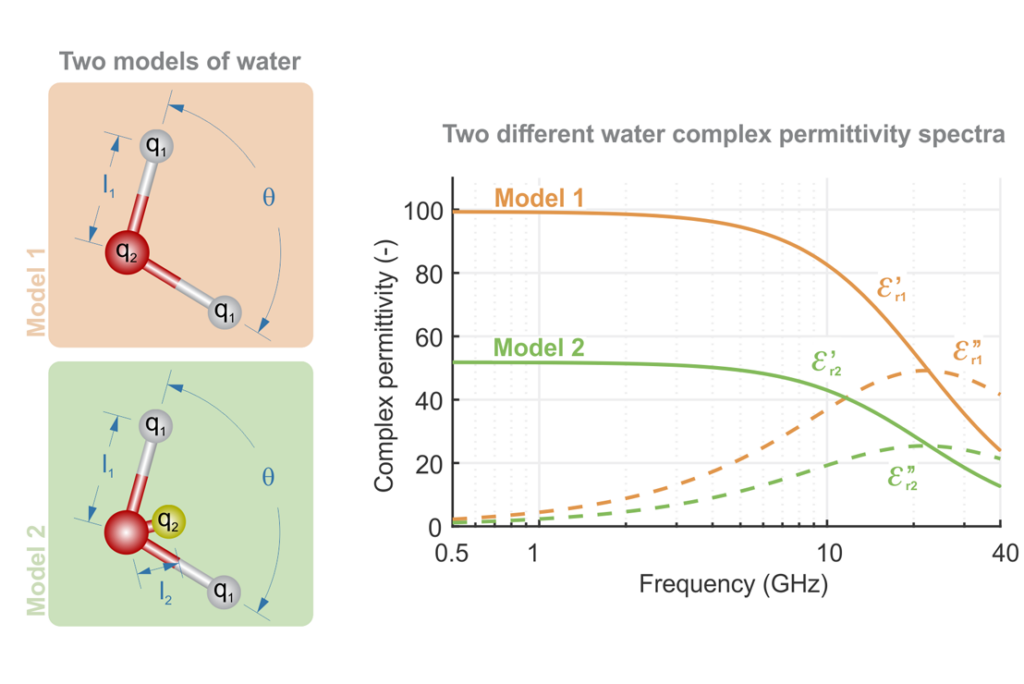
Water models in molecular dynamics simulation prediction of dielectric properties of biomaterials
Read Description
However, such measurements require dedicated hardware and physical availability of sufficient volume of biological samples of interest. Instead, here we demonstrate the prediction of complex permittivity of a simple biomolecular sample using computational molecular dynamics simulations. We focus here on the role of a molecular model of water since it is the major compound determining microwave dielectric properties of biological tissues and wet samples. Here, for the first time, we analyze how the common molecular water models (SPCE, TIP3P, and TIP4P) affect complex permittivity of biomolecular solutions predicted by molecular dynamics simulations. We found that the type of the molecular water model used in the simulation affects not only water contribution but also biomolecule contribution to the permittivity spectra. Our results contribute to in silico prediction and understanding of dielectric properties of biomaterials